On Sat, Oct 29, 2011 at 12:14 PM, ...@singnet.com> wrote:
Dear Dr Sing,
Queenie, the 12 year old dog, is doing well. She is eating and running around. Has no problems passing motion and easing herself.
Enclosed are the pictures you asked for. I suppose her stiches come out on the 2nd of Nov (14 days)
Thanks alot
regards
Thanks for pictures. 14 days should be OK to take out stitches. Best wishes.
Sunday, October 30, 2011

Friday, October 28, 2011
FURTD, FIV and FeLV in cats
1. Feline upper respiratory tract diseases (FURTD) are usually caused by Feline herpes virus and calicivirus in 90% of the cases in Australia's multi-cat environments. In Singapore, usually stray cats.
Sneezing, pus in both nostrils and eye discharges are the main signs.
2. FIV
Feline Immunodeficiency Virus (FIV)
Transmission is mainly by biting e.g. roaming male cats.
Clinical 4 phases
1. Acute infection - 4-6 weeks, fever, neutropenia, lymphadenopathy
2. Asymptomatic carrier state (FIV Ab positive). Most common. last months or years.
3. Chronic disease. Non-specific signs like chronic stomatitis (possible immunodeficiency cause)
4.Terminal AIDS-phase. Infections and neoplasia.
Few cats go to Phase 3 and 4.
Hard to give prognosis.
Laboratory list is typical as follows:
neutropenia, thrombocytopenia, non-regenerative anaemia (use erythropoietin)
monocyotosis and lymphocytosis
renal azotaemia
ployclonal hyperglobulinaemia
ELISA test kits. detect anti-FIV antibodies
PROGNOSIS
Most cats don't develop FIV-associated disease, prognosis is generally good.
Keep cat inddors. FIV cats isolated in cattery. Good nutrition, proper sanitation and stress reduction.
Routine vaccination with inactivated vaccines
TREATMENT
Supportive treatment. prolonged or repeated antibiotics.
Anti-viral therapy
Erythropoietin
PREVENTION
Vaccine available. Roaming outdoor cat advised.
FIV and FeLV easily destroyed by disinfection and tranmission by fomites is unusual.
Prevent contact FIV+ to FIV-ve cats
regular deworming, clinical monitoring and preventive dental care
spay or neuter
Feline Leukaemia Virus (FeLV)
Mainly an infection of young cats cf. FIV cats older than 6 years usually. Non-specific signs like weight loss, anorexia, fever, depression.
Transmission mainly via saliva, nasal secretions during grooming, sharing of food or water sources.
Three outcomes
1. Transietn infection
2. Latency (sub-clinical)
3. Persistent viraemia.
Lympadenopathy (thymic and multicentric lymphoma most frequency associated with FeLV), ocular signs and anaemia YOUNG cats
Laboratory - non-specific
Anaemia
MOST common abnromality. non-regenrative
Leucoppenia, thrombocytopenia, haemolytic anaemia
Azotaemia (pre-renal or enal)
Hyperbilirubinaemia (pre-hepatic or hepatic)
ALT/AP increses
Proteinuria (secondary glomerulopathies or UTI)
Bacteruia
SPECIFIC TEST
ELISA antigen detection.
Other tests;
IFAT blood smears (antigen in WBC and platelets)
Virus isolation
TREATMENT
Supportive treatment ---- control secondary infections, restore hydration with fluid therapy and nutrition. blood transfusions in anaemic cats, doxycycline for FIA. Lymphoma treated with chemotherapy.
PREVENTION
Avoid exposure by contact.
FeLV is also a non-core vaccine,use in cats at risk e.g. cattery, outdoor, rehoming cats
PCR
Sneezing, pus in both nostrils and eye discharges are the main signs.
2. FIV
Feline Immunodeficiency Virus (FIV)
Transmission is mainly by biting e.g. roaming male cats.
Clinical 4 phases
1. Acute infection - 4-6 weeks, fever, neutropenia, lymphadenopathy
2. Asymptomatic carrier state (FIV Ab positive). Most common. last months or years.
3. Chronic disease. Non-specific signs like chronic stomatitis (possible immunodeficiency cause)
4.Terminal AIDS-phase. Infections and neoplasia.
Few cats go to Phase 3 and 4.
Hard to give prognosis.
Laboratory list is typical as follows:
neutropenia, thrombocytopenia, non-regenerative anaemia (use erythropoietin)
monocyotosis and lymphocytosis
renal azotaemia
ployclonal hyperglobulinaemia
ELISA test kits. detect anti-FIV antibodies
PROGNOSIS
Most cats don't develop FIV-associated disease, prognosis is generally good.
Keep cat inddors. FIV cats isolated in cattery. Good nutrition, proper sanitation and stress reduction.
Routine vaccination with inactivated vaccines
TREATMENT
Supportive treatment. prolonged or repeated antibiotics.
Anti-viral therapy
Erythropoietin
PREVENTION
Vaccine available. Roaming outdoor cat advised.
FIV and FeLV easily destroyed by disinfection and tranmission by fomites is unusual.
Prevent contact FIV+ to FIV-ve cats
regular deworming, clinical monitoring and preventive dental care
spay or neuter
Feline Leukaemia Virus (FeLV)
Mainly an infection of young cats cf. FIV cats older than 6 years usually. Non-specific signs like weight loss, anorexia, fever, depression.
Transmission mainly via saliva, nasal secretions during grooming, sharing of food or water sources.
Three outcomes
1. Transietn infection
2. Latency (sub-clinical)
3. Persistent viraemia.
Lympadenopathy (thymic and multicentric lymphoma most frequency associated with FeLV), ocular signs and anaemia YOUNG cats
Laboratory - non-specific
Anaemia
MOST common abnromality. non-regenrative
Leucoppenia, thrombocytopenia, haemolytic anaemia
Azotaemia (pre-renal or enal)
Hyperbilirubinaemia (pre-hepatic or hepatic)
ALT/AP increses
Proteinuria (secondary glomerulopathies or UTI)
Bacteruia
SPECIFIC TEST
ELISA antigen detection.
Other tests;
IFAT blood smears (antigen in WBC and platelets)
Virus isolation
TREATMENT
Supportive treatment ---- control secondary infections, restore hydration with fluid therapy and nutrition. blood transfusions in anaemic cats, doxycycline for FIA. Lymphoma treated with chemotherapy.
PREVENTION
Avoid exposure by contact.
FeLV is also a non-core vaccine,use in cats at risk e.g. cattery, outdoor, rehoming cats
PCR
712. Update: In 2008, tick fever in a Great Dane
A veterinary-client relationship of trust and respect benefits this Great Dane
"My Great Dane does not eat even his favourite curry chicken rice. He is tired and has pale eyelids for at least 2 days. Is it possible he has tick fever?" Jenny phoned me. "I removed some ticks from him recently."

She was my ex-veterinary nurse some 20 years ago and has at least 20 years of handling dogs and cats in various employment in boarding, veterinary practice, breeding and retail. She started work with animals since she was 18 years old and has hands-on experiences in dog diseases in Singapore.
Jenny continued: "The Great Dane has no appetite and sleeps a lot for the past 2 days. He looks pale in his gums. Can it be tick fever? Can you make a house-call?" the caregiver asked me.
"Jenny, if you think it is tick fever, bring the dog to the Surgery. There is no point making a house-call as it is much easier to treat him in the Surgery." I advised this busy manager of a large pet accessory warehouse retail shop in Pasir Ris.
"Can I come tonight?" the caregiver wanted to clear her administrative and paper work first.
"If you think he has tick fever, do not delay treatment," I needed no explanation that every delay permitted the blood parasites to multiply and destroy the blood cells.
"I will get a pet transport man to bring the dog down to the surgery. If it is the starting of tick fever, come down now to get the dog treated before the blood parasites multiplying in his red blood cells overwhelms and kills him," I advised.
Jenny arrived at 3 pm with an assistant. She is a gentle soft-voiced lady in her forties. I was surprised that her hair was disheveled while multiple frown lines creased her face. The 2.5-year-old male giant canine came down from Jenny's car and sauntered into the Surgery. He had never been sick and therefore had not been to the veterinary surgery for the past 2 years. He was as tall as a 12-year-old child.

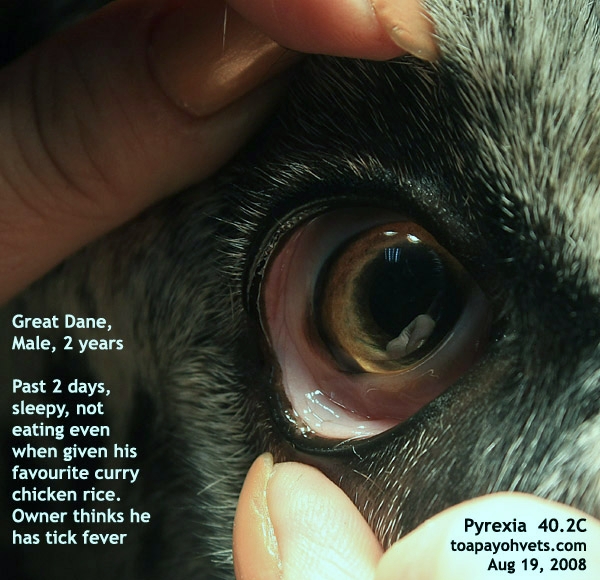
Fever of 40.2C was confirmed by taking the rectal temperature. There was moderate pallor of gums and conjunctiva.
Two men carried the giant onto the table. He weighed around 80 kg.
Complete blood count needed. I/V antibiotics and amino acids given. Sent home with the i/v catheter in his vein.
Care-giver wants the dog home to treat herself
Put catheter IV inserted. 3 blood samples to be sent to the laboratory. IV dextrose saline, duphalyte and baytril IV given. Sent home with bottle of 5% dextrose saline and duphalyte on slow IV drip. Dog could still walk home. He looked normal.
Wednesday Aug 20, 2008
Not eating much. Lethargy. No news from caregiver.
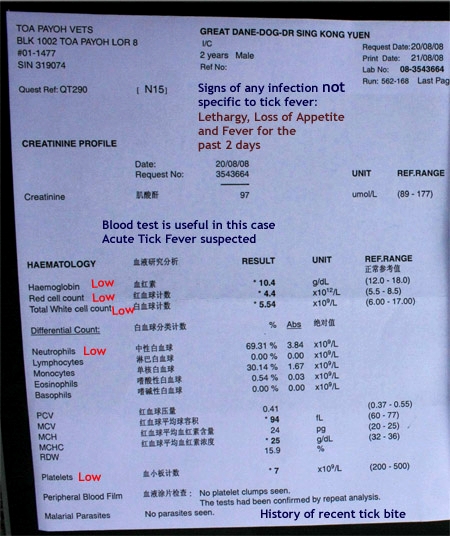
Pancytopenia in blood test result - Low red, white blood cells and platelets. Based on laboratory tests, the Great Dane should not be standing and should be bleeding to death. But he could be at the start of the acute stage of Tick Fever and the parasites were just destroying his blood cells. Was there any hope for him?
Thursday Aug 21, 2008 house-call by vet
Phoned caregiver. Not really improved. Still not eating much. I told caregiver I would need to make a house-call to check and give anti-babesiosis injection. What I said was all Greek to the caregiver.
Vet needs to do a house call. The busy caregiver did not update the vet.
Caregiver cooked liver. She gave a few bags of fluid and lots of multivitamins to the Great Dane for the past 2 days.
"Dog looks normal," his gentleman owner said. "No pallor of tick fever."
The Great Dane remembered the injections and drips at the vet and ran into the safety of his home.
The Great Dane reluctantly said goodbye to me since his caregiver asked him to do it. Given anti-babesia injection on Aug 21, 2008 before I left the Great Dane's residence. He had not recovered fully as at Aug 25, 2008. Jenny was advised to monitor his rectal temperature. She needed to buy a thermometer.
The caregiver was cooking liver. Dog ate when caregiver hand-fed bits of liver. Caregiver showed me that she had bought 0.9% Sodium Chloride from a general practitioner and 5% dextrose bag from somewhere. She would give the solutions by SC. I gave 2.6 ml Imizole SC. Duphalyte x 1 bottle to caregiver. Advised caregiver to come for more vibravet medication on completion of 7 days' course and buy a thermometer.
Friday Aug 22, 2008
Great Dane not really interested in food.
"No time to buy the thermometer," caregiver said.
"Did you check on how much water the Great Dane drink and what is the colour of his urine?" I asked.
"You know, I have been very busy updating price list of goods nowadays," she said. "I also cooked for the dog. I do not have time to monitor how much water he drinks or the colour of his pee!" The cost of goods must increase as there was a surge in food, petrol and other prices in the past week and the caregiver was responsible to get the updates done before the weekend sales. The Great Dane had to fall sick and took up a lot of her time.
"Blood tests for Babesia and Ehrlichia at the AVA would cost $200. Do you want them?" I asked the caregiver. She was hesitant about the costs involved. As I have had given the Great Dane the important treatment for the two types of parasites causing tick fever, I said, "Wait and see".
Tuesday Aug 26, 2008
"Great Dane asked to be bathed today," Jenny phoned me. "I need to come down to your surgery to get the vibravet tablets". Surprisingly the caregiver remembered as she had a lot of paperwork to do and I did expect her to forget about the medication as most owners will do. After all, the Great Dane is now eating and medication had been given for 7 days.
"When did the Great Dane recover?" I asked as I did not pester Jenny since the last call. She said she had some much paper work to do the last time I phoned her. Nowadays, a capable and intelligent hardworking employee does the work of 3 people and work never ends for the good employee.
Jenny said, "On Sunday, the Great Dane was so hungry and wolfed down his food."
"It must be due to Imizole and medication," I forgot to acknowledge caregiver's important role.
"It is due to my extra vitamins and cooking of liver for him." Jenny replied. Sometimes veterinarians look at the cause and effect of drugs rather than the acknowledgement of the care, time spent and love of the caregiver when the case is closed successfully.
Her boss came to the surgery to get vibravet for 10 more days as Jenny was busy updating the pricing of pet products. "Go and buy two thermometers," I said to the boss. "Jenny has been too busy to buy one. The thermometers can help to monitor the fever of your sick dogs." Jenny monitored the fever by feeling whether the belly of the Great Dane was hot to the hand or not. That was not a good way to do it.
Conclusion
It is important for the vet to follow up on suspicious tick fever cases. As there was a relationship of trust and respect, I made a house-call to give the Great Dane the anti-Babesia injection after reviewing his blood panel tests. There was no time to wait for the specific blood tests to confirm the presence of the blood parasites which may or may not be present.
This caregiver was extremely good in the nursing care of the Great Dane and a great asset to her boss. A relationship of trust and respect between the caregiver and the veterinarian is always beneficial to the pet. If there was no such relationship, I doubt I would dare to do the house-call as a follow up on the first treatment.
UPDATES
This case is probably an acute tick fever. Although the blood parasites were not isolated nor was a blood smear done due to financial considerations, the blood test of low blood cells and platelets is suggestive of an acute tick fever. Aggressive treatment is necessary to prevent recurrence of fever. No further treatment was requested by the owner.
As at Sep 10, 2008, the Great Dane was normal. He lived for a few more years and passed away suddenly around 2010.
Acute Tick Fever in dogs is hard to diagnose as there are no specific signs. Lethargy, fever and loss of appetite may be the only signs. As these are non-specific symptoms, diagnosis of tick fever is often missed.
Blood parasites such as Ehrlichia canis and Babesia canis (protozoa) destroy the white and red blood cells respectively.
Haematolgy. Blood tests can be very useful in aiding the diagnosis of tick fever. In this case, the Great Dane had very low white cell, red cell and platelets. Test for Ehrlichia titres and babesia are available at the AVA (Agri-Food and Veterinary Authority) laboratory. The cost for both is around S$200.00. 5 ml blood in plain tubes is needed. However, the client did not want the blood tests done.
Subclinical Tick Fever (no signs) can exist in the dog for years. Then it becomes Chronic Tick Fever (severe anaemia, bleeding from nose, kidneys and intestines to death). Most cases of tick fever are diagnosed at the chronic stage.

Doxycycline oral tablets and Imizole (imidocarb) injection are drugs of choice for the treatment of tick fever. Avoidance of ticks by using fipronil, permethrin and amitraz are best as there is no known vaccine available.
In this case, financial considerations prevent me from following up to check the elimination of the parasites or any carrier status.
More pictures at:
Toa Payoh Vets
Report at:
http://www.bekindtopets.com/dogs/20080839Great_Dane_Tick_Fever_ToaPayohVets.htm
"My Great Dane does not eat even his favourite curry chicken rice. He is tired and has pale eyelids for at least 2 days. Is it possible he has tick fever?" Jenny phoned me. "I removed some ticks from him recently."
She was my ex-veterinary nurse some 20 years ago and has at least 20 years of handling dogs and cats in various employment in boarding, veterinary practice, breeding and retail. She started work with animals since she was 18 years old and has hands-on experiences in dog diseases in Singapore.
Jenny continued: "The Great Dane has no appetite and sleeps a lot for the past 2 days. He looks pale in his gums. Can it be tick fever? Can you make a house-call?" the caregiver asked me.
"Jenny, if you think it is tick fever, bring the dog to the Surgery. There is no point making a house-call as it is much easier to treat him in the Surgery." I advised this busy manager of a large pet accessory warehouse retail shop in Pasir Ris.
"Can I come tonight?" the caregiver wanted to clear her administrative and paper work first.
"If you think he has tick fever, do not delay treatment," I needed no explanation that every delay permitted the blood parasites to multiply and destroy the blood cells.
"I will get a pet transport man to bring the dog down to the surgery. If it is the starting of tick fever, come down now to get the dog treated before the blood parasites multiplying in his red blood cells overwhelms and kills him," I advised.
Jenny arrived at 3 pm with an assistant. She is a gentle soft-voiced lady in her forties. I was surprised that her hair was disheveled while multiple frown lines creased her face. The 2.5-year-old male giant canine came down from Jenny's car and sauntered into the Surgery. He had never been sick and therefore had not been to the veterinary surgery for the past 2 years. He was as tall as a 12-year-old child.
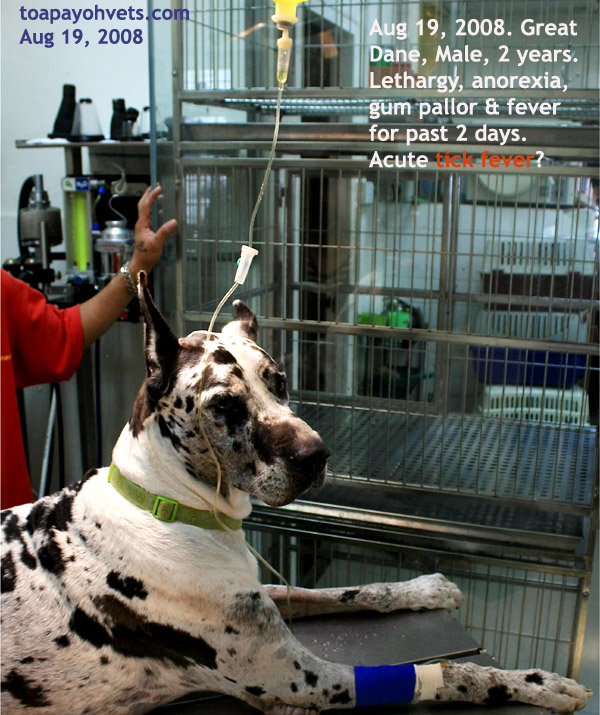
Fever of 40.2C was confirmed by taking the rectal temperature. There was moderate pallor of gums and conjunctiva.
Two men carried the giant onto the table. He weighed around 80 kg.
Complete blood count needed. I/V antibiotics and amino acids given. Sent home with the i/v catheter in his vein.
Care-giver wants the dog home to treat herself
Put catheter IV inserted. 3 blood samples to be sent to the laboratory. IV dextrose saline, duphalyte and baytril IV given. Sent home with bottle of 5% dextrose saline and duphalyte on slow IV drip. Dog could still walk home. He looked normal.
Wednesday Aug 20, 2008
Not eating much. Lethargy. No news from caregiver.
Pancytopenia in blood test result - Low red, white blood cells and platelets. Based on laboratory tests, the Great Dane should not be standing and should be bleeding to death. But he could be at the start of the acute stage of Tick Fever and the parasites were just destroying his blood cells. Was there any hope for him?
Thursday Aug 21, 2008 house-call by vet
Phoned caregiver. Not really improved. Still not eating much. I told caregiver I would need to make a house-call to check and give anti-babesiosis injection. What I said was all Greek to the caregiver.
Vet needs to do a house call. The busy caregiver did not update the vet.
Caregiver cooked liver. She gave a few bags of fluid and lots of multivitamins to the Great Dane for the past 2 days.
"Dog looks normal," his gentleman owner said. "No pallor of tick fever."
The Great Dane remembered the injections and drips at the vet and ran into the safety of his home.
The Great Dane reluctantly said goodbye to me since his caregiver asked him to do it. Given anti-babesia injection on Aug 21, 2008 before I left the Great Dane's residence. He had not recovered fully as at Aug 25, 2008. Jenny was advised to monitor his rectal temperature. She needed to buy a thermometer.
The caregiver was cooking liver. Dog ate when caregiver hand-fed bits of liver. Caregiver showed me that she had bought 0.9% Sodium Chloride from a general practitioner and 5% dextrose bag from somewhere. She would give the solutions by SC. I gave 2.6 ml Imizole SC. Duphalyte x 1 bottle to caregiver. Advised caregiver to come for more vibravet medication on completion of 7 days' course and buy a thermometer.
Friday Aug 22, 2008
Great Dane not really interested in food.
"No time to buy the thermometer," caregiver said.
"Did you check on how much water the Great Dane drink and what is the colour of his urine?" I asked.
"You know, I have been very busy updating price list of goods nowadays," she said. "I also cooked for the dog. I do not have time to monitor how much water he drinks or the colour of his pee!" The cost of goods must increase as there was a surge in food, petrol and other prices in the past week and the caregiver was responsible to get the updates done before the weekend sales. The Great Dane had to fall sick and took up a lot of her time.
"Blood tests for Babesia and Ehrlichia at the AVA would cost $200. Do you want them?" I asked the caregiver. She was hesitant about the costs involved. As I have had given the Great Dane the important treatment for the two types of parasites causing tick fever, I said, "Wait and see".
Tuesday Aug 26, 2008
"Great Dane asked to be bathed today," Jenny phoned me. "I need to come down to your surgery to get the vibravet tablets". Surprisingly the caregiver remembered as she had a lot of paperwork to do and I did expect her to forget about the medication as most owners will do. After all, the Great Dane is now eating and medication had been given for 7 days.
"When did the Great Dane recover?" I asked as I did not pester Jenny since the last call. She said she had some much paper work to do the last time I phoned her. Nowadays, a capable and intelligent hardworking employee does the work of 3 people and work never ends for the good employee.
Jenny said, "On Sunday, the Great Dane was so hungry and wolfed down his food."
"It must be due to Imizole and medication," I forgot to acknowledge caregiver's important role.
"It is due to my extra vitamins and cooking of liver for him." Jenny replied. Sometimes veterinarians look at the cause and effect of drugs rather than the acknowledgement of the care, time spent and love of the caregiver when the case is closed successfully.
Her boss came to the surgery to get vibravet for 10 more days as Jenny was busy updating the pricing of pet products. "Go and buy two thermometers," I said to the boss. "Jenny has been too busy to buy one. The thermometers can help to monitor the fever of your sick dogs." Jenny monitored the fever by feeling whether the belly of the Great Dane was hot to the hand or not. That was not a good way to do it.
Conclusion
It is important for the vet to follow up on suspicious tick fever cases. As there was a relationship of trust and respect, I made a house-call to give the Great Dane the anti-Babesia injection after reviewing his blood panel tests. There was no time to wait for the specific blood tests to confirm the presence of the blood parasites which may or may not be present.
This caregiver was extremely good in the nursing care of the Great Dane and a great asset to her boss. A relationship of trust and respect between the caregiver and the veterinarian is always beneficial to the pet. If there was no such relationship, I doubt I would dare to do the house-call as a follow up on the first treatment.
UPDATES
This case is probably an acute tick fever. Although the blood parasites were not isolated nor was a blood smear done due to financial considerations, the blood test of low blood cells and platelets is suggestive of an acute tick fever. Aggressive treatment is necessary to prevent recurrence of fever. No further treatment was requested by the owner.
As at Sep 10, 2008, the Great Dane was normal. He lived for a few more years and passed away suddenly around 2010.
Acute Tick Fever in dogs is hard to diagnose as there are no specific signs. Lethargy, fever and loss of appetite may be the only signs. As these are non-specific symptoms, diagnosis of tick fever is often missed.
Blood parasites such as Ehrlichia canis and Babesia canis (protozoa) destroy the white and red blood cells respectively.
Haematolgy. Blood tests can be very useful in aiding the diagnosis of tick fever. In this case, the Great Dane had very low white cell, red cell and platelets. Test for Ehrlichia titres and babesia are available at the AVA (Agri-Food and Veterinary Authority) laboratory. The cost for both is around S$200.00. 5 ml blood in plain tubes is needed. However, the client did not want the blood tests done.
Subclinical Tick Fever (no signs) can exist in the dog for years. Then it becomes Chronic Tick Fever (severe anaemia, bleeding from nose, kidneys and intestines to death). Most cases of tick fever are diagnosed at the chronic stage.
Doxycycline oral tablets and Imizole (imidocarb) injection are drugs of choice for the treatment of tick fever. Avoidance of ticks by using fipronil, permethrin and amitraz are best as there is no known vaccine available.
In this case, financial considerations prevent me from following up to check the elimination of the parasites or any carrier status.
More pictures at:
Toa Payoh Vets
Report at:
http://www.bekindtopets.com/dogs/20080839Great_Dane_Tick_Fever_ToaPayohVets.htm
Thursday, October 27, 2011
711. Perineal haematoma and circum-anal tumour
Thur Oct 27, 2011
Today's cases.
CASE 1,
A Shetland 6-month-old male had a firm lump on the right of the anus. "Perineal hernia?" I thought at first but it was not reduced in size when pushed inwards. No pain. "Suddenly appeared in the last 4 days," the young man said. So, what is it?
SEDATION
Zoletil 50 0.1 ml sedated lasted 5 minutes. No hyperextension of limbs. Isoflurane gas top up. Syringe out serous blood 4 ml. Incise. A capsule-like sac seen. 3/0 nylon stitched cross stitch x 1. Blood test showed no bacterial infection.
CASE 2.
8-year-old male shih Tzu with blood in both ears. After washing, I could see a large wart in left ear and numerous tumours in right ear. "No drugs can cure this dog," I said. "Surgery is required." Ideally ear canal ablation, not just excise the warts and lumps. "Wear an e-collar," I said as the owner did not wish to have the operation on financial considerations. Ringworm generalised and a small circum-anal tumour above anus.
Today's cases.
CASE 1,
A Shetland 6-month-old male had a firm lump on the right of the anus. "Perineal hernia?" I thought at first but it was not reduced in size when pushed inwards. No pain. "Suddenly appeared in the last 4 days," the young man said. So, what is it?
SEDATION
Zoletil 50 0.1 ml sedated lasted 5 minutes. No hyperextension of limbs. Isoflurane gas top up. Syringe out serous blood 4 ml. Incise. A capsule-like sac seen. 3/0 nylon stitched cross stitch x 1. Blood test showed no bacterial infection.
CASE 2.
8-year-old male shih Tzu with blood in both ears. After washing, I could see a large wart in left ear and numerous tumours in right ear. "No drugs can cure this dog," I said. "Surgery is required." Ideally ear canal ablation, not just excise the warts and lumps. "Wear an e-collar," I said as the owner did not wish to have the operation on financial considerations. Ringworm generalised and a small circum-anal tumour above anus.
710. Follow up: Acute Tick fever in a young dog that went to a dog park
DRAFT CASE REPORT
DAY 1
Thursday, Oct 20, 2011
English Cocker, Male, 2 years, 11 kg
Dog eating less. Not active. The friend suggested taking the dog to see me.
I saw small ticks all over the body. The dog had been to a dog park in Pasir Ris recently/
Very pale gums. Blood test - low haemogloblin, low RBC and low platelets. Blood smear on Giemsa stain showed Babesia gibsoni. Ehrlichia seen. 0.5 ml Imizole (imidocarb) SC given. Dosage is 0.5 ml/10 kg.
IV dextrose and baytril. Vit K1 2 ml IV. Doxycycline 5mg/kg twice a day for 21 days. 10mg/kg twice a day had been proposed by some vet books but this is 4x the standard dose. Multivitamin paste. Vit K1 tablets (1/4 tab/day).
DAY 2
Friday, Oct 21, 2011
Gums still pale. No appetite. Vit K1 2 ml IV and supportive therapy. However the dog barks loudly when the owner came, exhausting himself. Owner brought his liver treats. He ate one.
Blood test results before Imizole 0.5 ml SC treatment:
Liver profile= Normal
Kidney profile= Normal
Hematology=
*Hemoglobin- 7g/dL [Normal range: 12-18]
*Red Blood Cells- 2.8 x10^12/L [Normal range: 5.5-8.5]
White Blood Cells- 13.2 x10^9/L [Normal range: 6-17]
*Packed Cell Volume= 0.19 [Normal range: 0.37-0.55]
Platelets= 52 [Normal range: 200-500]
*Nucleated Red Blood Cells seen [Severe demand for RBC to be release from Bone Marrow]
No platelet clump seen
--------------------------------------------------------------------------------
Blood test results 1 day after Imizole 0.5 ml SC treatment:
Liver profile= Enzymes increased
Kidney profile= Normal
Hematology=
*Hemoglobin- 7g/dL [Normal range: 12-18]
*Red Blood Cells- 2.9 x10^12/L [Normal range: 5.5-8.5]
White Blood Cells- 9.6 x10^9/L [Normal range: 6-17]
Packed Cell Volume= 0.2 [Normal range: 0.37-0.55]
*Platelets= 64 [Normal range: 200-500]
No platelet clump seen but few giant platelets present
-------------------------------------------------------------------
What is the importance of platelets?
a) Numbers:
The platelet count gives a general indication of the clotting ability of the blood. If the number of platelets falls below a certain critical level, spontaneous bleeding may occur. A low platelet count may indicate a problem with platelet production in the bone marrow, or may signal the presence of disease that is causing the platelets to be used up or destroyed. An increased platelet count often reflects excitement, exertion, or an activated bone marrow. In rare cases, an extremely high platelet count may indicate there is underlying bone marrow cancer.
b) Size:
The size of a platelet is related to its age; young platelets are large and plump, and older platelets are generally smaller. This can be important if the platelet count is low; the presence of large, plump, young platelets in the blood indicates that the bone marrow is functioning well, and is responding to the need for more platelets.
c) Appearance:
Very rarely, bizarre giant platelets, or abnormal immature platelets may be found, and these may signal the presence of an underlying bone marrow disorder or cancer
[Reference: http://www.fetchdog.com/learn-connect/dog-resource-library/health/diagnostic-tests/Complete-Blood-Count-for-Dogs/D/300600/P/1:5:55:601:6103/I/AR000010025]
DAY 3
Saturday, Oct 22, 2011
4PM
The owner came, her friend and the godfather. 2-hour visit. Loud barks.
At 7 pm, the 3 visitors left. The dog panted, heart beat very fast, as if he had run a sprint. It was bad. Would he die? I should have allowed a 10-minute visit, not 120 minutes!
Connected IV - glucose 100 ml, then dextrose saline with duphalytes 500 ml. Gave lasix IV. Atropine 0.5 ml IM. By the time I went home, it was past 7 pm.
The owner was prohibited from visiting for the next few days. This dog had a keen hearing as he could hear the owner's voice at the reception area some distance away in the back of the Surgery and started barking non-stop for several minutes.
DAY 4
Sunday, Oct 23, 2011
Morning 10 am. Dog felt well. Barking for a while. Smelt food. Not eating. Hand fed A/D canned food and given water and electrolytes.
DAY 5.
Monday, Oct 24, 2011
IV drip. Blood looked reddish unlike bluish blood for past few days. Good news.
Passed normal stools when taken out.
DAY 6.
Tuesday, Oct 25, 2011
Deepavali. Public holiday.
Alert and standing in cage. I am relieved that the gum looks pinker. Blood test at another lab showed normal platelets but still very low Hb and RBC. I phoned owner to take the dog home at 6 pm to be nursed by owner.
DAY 7.
Wednesday, Oct 26, 2011
At home. With iron tablets and good food including egg yolk and liver.
DAY 8.
Thursday, Oct 27, 2011
At home. I phoned the owner at 6.30 pm
"My dog is very active, hungry and thirsty. I found two ticks, a grey one on her body. I put tick powder onto my bed area." One tube Advantix Spot on had been applied on Day 6. Yet he had two ticks stuck in skin. Otherwise appeared normal.
-------------------------------------------------------------------------------------------------------------
Scheduled Appointments
DAY 9
Friday, Oct 28, 2011
DAY 11
Sunday, Oct 30, 2011
Scheduled for next Imizole (imidocarb) injection SC. Babesia and Ehrlichia seen on 2nd blood smear on Day 6. Possibly has anaplasmosis?
DAY 12
Monday, Oct 31, 2011
Urine to be collected by the owner for urinalysis.
Acute tick fever needs regular monitoring till negative blood test results 2 weeks after the previous test but most owners don't have the time to do so.
DAY 1
Thursday, Oct 20, 2011
English Cocker, Male, 2 years, 11 kg
Dog eating less. Not active. The friend suggested taking the dog to see me.
I saw small ticks all over the body. The dog had been to a dog park in Pasir Ris recently/
Very pale gums. Blood test - low haemogloblin, low RBC and low platelets. Blood smear on Giemsa stain showed Babesia gibsoni. Ehrlichia seen. 0.5 ml Imizole (imidocarb) SC given. Dosage is 0.5 ml/10 kg.
IV dextrose and baytril. Vit K1 2 ml IV. Doxycycline 5mg/kg twice a day for 21 days. 10mg/kg twice a day had been proposed by some vet books but this is 4x the standard dose. Multivitamin paste. Vit K1 tablets (1/4 tab/day).
DAY 2
Friday, Oct 21, 2011
Gums still pale. No appetite. Vit K1 2 ml IV and supportive therapy. However the dog barks loudly when the owner came, exhausting himself. Owner brought his liver treats. He ate one.
Blood test results before Imizole 0.5 ml SC treatment:
Liver profile= Normal
Kidney profile= Normal
Hematology=
*Hemoglobin- 7g/dL [Normal range: 12-18]
*Red Blood Cells- 2.8 x10^12/L [Normal range: 5.5-8.5]
White Blood Cells- 13.2 x10^9/L [Normal range: 6-17]
*Packed Cell Volume= 0.19 [Normal range: 0.37-0.55]
Platelets= 52 [Normal range: 200-500]
*Nucleated Red Blood Cells seen [Severe demand for RBC to be release from Bone Marrow]
No platelet clump seen
--------------------------------------------------------------------------------
Blood test results 1 day after Imizole 0.5 ml SC treatment:
Liver profile= Enzymes increased
Kidney profile= Normal
Hematology=
*Hemoglobin- 7g/dL [Normal range: 12-18]
*Red Blood Cells- 2.9 x10^12/L [Normal range: 5.5-8.5]
White Blood Cells- 9.6 x10^9/L [Normal range: 6-17]
Packed Cell Volume= 0.2 [Normal range: 0.37-0.55]
*Platelets= 64 [Normal range: 200-500]
No platelet clump seen but few giant platelets present
-------------------------------------------------------------------
What is the importance of platelets?
a) Numbers:
The platelet count gives a general indication of the clotting ability of the blood. If the number of platelets falls below a certain critical level, spontaneous bleeding may occur. A low platelet count may indicate a problem with platelet production in the bone marrow, or may signal the presence of disease that is causing the platelets to be used up or destroyed. An increased platelet count often reflects excitement, exertion, or an activated bone marrow. In rare cases, an extremely high platelet count may indicate there is underlying bone marrow cancer.
b) Size:
The size of a platelet is related to its age; young platelets are large and plump, and older platelets are generally smaller. This can be important if the platelet count is low; the presence of large, plump, young platelets in the blood indicates that the bone marrow is functioning well, and is responding to the need for more platelets.
c) Appearance:
Very rarely, bizarre giant platelets, or abnormal immature platelets may be found, and these may signal the presence of an underlying bone marrow disorder or cancer
[Reference: http://www.fetchdog.com/learn-connect/dog-resource-library/health/diagnostic-tests/Complete-Blood-Count-for-Dogs/D/300600/P/1:5:55:601:6103/I/AR000010025]
DAY 3
Saturday, Oct 22, 2011
4PM
The owner came, her friend and the godfather. 2-hour visit. Loud barks.
At 7 pm, the 3 visitors left. The dog panted, heart beat very fast, as if he had run a sprint. It was bad. Would he die? I should have allowed a 10-minute visit, not 120 minutes!
Connected IV - glucose 100 ml, then dextrose saline with duphalytes 500 ml. Gave lasix IV. Atropine 0.5 ml IM. By the time I went home, it was past 7 pm.
The owner was prohibited from visiting for the next few days. This dog had a keen hearing as he could hear the owner's voice at the reception area some distance away in the back of the Surgery and started barking non-stop for several minutes.
DAY 4
Sunday, Oct 23, 2011
Morning 10 am. Dog felt well. Barking for a while. Smelt food. Not eating. Hand fed A/D canned food and given water and electrolytes.
DAY 5.
Monday, Oct 24, 2011
IV drip. Blood looked reddish unlike bluish blood for past few days. Good news.
Passed normal stools when taken out.
DAY 6.
Tuesday, Oct 25, 2011
Deepavali. Public holiday.
Alert and standing in cage. I am relieved that the gum looks pinker. Blood test at another lab showed normal platelets but still very low Hb and RBC. I phoned owner to take the dog home at 6 pm to be nursed by owner.
DAY 7.
Wednesday, Oct 26, 2011
At home. With iron tablets and good food including egg yolk and liver.
DAY 8.
Thursday, Oct 27, 2011
At home. I phoned the owner at 6.30 pm
"My dog is very active, hungry and thirsty. I found two ticks, a grey one on her body. I put tick powder onto my bed area." One tube Advantix Spot on had been applied on Day 6. Yet he had two ticks stuck in skin. Otherwise appeared normal.
-------------------------------------------------------------------------------------------------------------
Scheduled Appointments
DAY 9
Friday, Oct 28, 2011
DAY 11
Sunday, Oct 30, 2011
Scheduled for next Imizole (imidocarb) injection SC. Babesia and Ehrlichia seen on 2nd blood smear on Day 6. Possibly has anaplasmosis?
DAY 12
Monday, Oct 31, 2011
Urine to be collected by the owner for urinalysis.
Acute tick fever needs regular monitoring till negative blood test results 2 weeks after the previous test but most owners don't have the time to do so.
709. Neoderm for 2 months thins the 6-month-old shetland dog's skin
Oct 27, 2011
SOME INTERESTING CASES
I was on duty today and the young man came with a 5 kg thin Shetland with a big right perineal swelling of 4 days. Firm but not painful. Around 3 cm x 3 cm. So, what was it? A perineal hernia? No, as it cannot be pushed in. A haematoma or abscess? Likely. Zoletil 50 0.1 + 0.4 ml saline ml IV sedated the dog.
No hyperextension and therefore no need atropine unlike the Westie (pus in ears, consulted Vet 1 with no success, owner referred by an old client to me) last week when I gave him the same Zoletil 0.1 ml IV. He had stiff limbs which relaxed when I gave atropine 0.5 ml IM and gave ear irrigation. Pus and debris esp. right ear. No head-shaking 3 days after treatment
"My shetland's skin disease did not get cured," the young man of 20 years with 4 months left of National Service said. "I read in the internet that he may be suffering from demodecosis. The vet scraped his nose skin but found nothing. He gave me a Neodern cream to apply."
Two front paws near the dew claws were bald. I could see thinning of the skin and the tendons and bones below. Other parts of both the front paw look moth-bitten with hairless squares and circles. Both lower elbows ventral surface were bald.
I saw redness in skin below the front paws but not the back paws, took a hair microscopic exam and showed the young man ringworm. The other hairless area did not have ringworm as Neoderm had killed any fungus and also thinned the skin.
"My dog licks away everytime I apply Neoderm," he said of the hairless elbow and armpits.
"How long you had applied?" I asked.
"Two months," he said. I asked him to stop Neoderm as it thins the skin when used too long. Prescribed anti-fungal tablets and wash and review in 2 weeks. Should recover. Demodex unlikely.
I showed Dr Vanessa the effects of Neoderm. "This is the reason I seldom prescribe Neoderm," I said. "The owner uses it for a long time, thinning the skin."
SOME INTERESTING CASES
I was on duty today and the young man came with a 5 kg thin Shetland with a big right perineal swelling of 4 days. Firm but not painful. Around 3 cm x 3 cm. So, what was it? A perineal hernia? No, as it cannot be pushed in. A haematoma or abscess? Likely. Zoletil 50 0.1 + 0.4 ml saline ml IV sedated the dog.
No hyperextension and therefore no need atropine unlike the Westie (pus in ears, consulted Vet 1 with no success, owner referred by an old client to me) last week when I gave him the same Zoletil 0.1 ml IV. He had stiff limbs which relaxed when I gave atropine 0.5 ml IM and gave ear irrigation. Pus and debris esp. right ear. No head-shaking 3 days after treatment
"My shetland's skin disease did not get cured," the young man of 20 years with 4 months left of National Service said. "I read in the internet that he may be suffering from demodecosis. The vet scraped his nose skin but found nothing. He gave me a Neodern cream to apply."
Two front paws near the dew claws were bald. I could see thinning of the skin and the tendons and bones below. Other parts of both the front paw look moth-bitten with hairless squares and circles. Both lower elbows ventral surface were bald.
I saw redness in skin below the front paws but not the back paws, took a hair microscopic exam and showed the young man ringworm. The other hairless area did not have ringworm as Neoderm had killed any fungus and also thinned the skin.
"My dog licks away everytime I apply Neoderm," he said of the hairless elbow and armpits.
"How long you had applied?" I asked.
"Two months," he said. I asked him to stop Neoderm as it thins the skin when used too long. Prescribed anti-fungal tablets and wash and review in 2 weeks. Should recover. Demodex unlikely.
I showed Dr Vanessa the effects of Neoderm. "This is the reason I seldom prescribe Neoderm," I said. "The owner uses it for a long time, thinning the skin."
Wednesday, October 26, 2011
708. Script for "skin disease in a dwarf hamster" video to educate pet owners
Skin Diseases In A Dwarf Hamster
Dr Sing Kong Yuen, BVMS (Glasgow), MRCVS
26 October, 2011
toapayohvets.com
Be Kind To Pets
Veterinary Education
Project 2010-0129
THE HOOK - A ROBOROVSKI HAMSTER CAN'T STOP SCRATCHING

The 10-year-old caregiver asks mum many times: "Please go to the vet." Mum has no time. (Show busy Singaporean mum with two jobs at workplace if possible, taking MRT, bus etc)
Bringing Veterinary Knowledge Alive To Vet Students & Pet Owners - Sponsored by
Toa Payoh Vets --- toapayohvets.com
26 October, 2011
INTRODUCTION - hamster bites himself. More self-biting wounds - to treat or not to treat?
If not treated - consequences - cellulitis and death
10-year-old girl is worried.
MIDDLE - Picture of cage and home?
what the mother does, what the vet does, what the vet groomer does? Images show hamster has been clipped short by the groomer. Ready for bathing. How do you bathe a hamster?
HOW TO BATHE A HAMSTER - VIDEO
Will hamster drown? Hamsters are usually given sand-bath (picture of hamster doing a sand bath) by pet owners. But now, he needs a water bath. What to do? How to bathe him? Video "How-to"
POST-BATHING - GOES HOME. Medication, bathing and new bedding. Hygiene of cage.
Check out example at: Oro-nasal fistula in the dog
http://www.youtube.com/user/99pups#p/u/1/5AWHpWYWgy4
CONCLUSION - Pictures of other hamsters with skin diseases to be provided by Dr Sing
Early treatment of skin diseases means
earlier recovery, lower veterinary cost and more peace of mind to your child who cares for the hamster
For more information
please visit: www.toapayohvets.com, +65 9668-6468, 6254-3326, e-mail judy@toapayohvets.com
CREDITS.
Concept by: Dr Sing Kong Yuen
Video and narration by:
NO copyrighted music or audio to be inside this video
BE KIND TO DOGS & CATS --- GET EYE ULCERS TREATED WITHIN 4 HOURS --- IF YOU DON'T WANT THEM TO BE BLIND. More case studies, goto: Cats or Dogs
To make an appointment: e-mail judy@toapayohvets.com
tel: +65 9668-6469, 6254-3326
toapayohvets.com
Be Kind To Pets
Veterinary Education
Project 2010-0129
Webpage at:
http://www.sinpets.com/F6/20111037roborovski-dermatitis-skin-disease-singapore-toapayohvets.htm
Dr Sing Kong Yuen, BVMS (Glasgow), MRCVS
26 October, 2011
toapayohvets.com
Be Kind To Pets
Veterinary Education
Project 2010-0129
THE HOOK - A ROBOROVSKI HAMSTER CAN'T STOP SCRATCHING
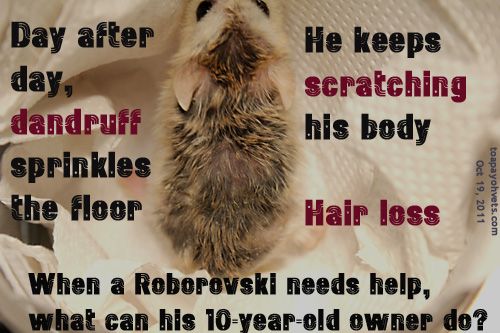
The 10-year-old caregiver asks mum many times: "Please go to the vet." Mum has no time. (Show busy Singaporean mum with two jobs at workplace if possible, taking MRT, bus etc)
Bringing Veterinary Knowledge Alive To Vet Students & Pet Owners - Sponsored by
Toa Payoh Vets --- toapayohvets.com
26 October, 2011
INTRODUCTION - hamster bites himself. More self-biting wounds - to treat or not to treat?
If not treated - consequences - cellulitis and death
10-year-old girl is worried.
MIDDLE - Picture of cage and home?
what the mother does, what the vet does, what the vet groomer does? Images show hamster has been clipped short by the groomer. Ready for bathing. How do you bathe a hamster?
HOW TO BATHE A HAMSTER - VIDEO
Will hamster drown? Hamsters are usually given sand-bath (picture of hamster doing a sand bath) by pet owners. But now, he needs a water bath. What to do? How to bathe him? Video "How-to"
POST-BATHING - GOES HOME. Medication, bathing and new bedding. Hygiene of cage.
Check out example at: Oro-nasal fistula in the dog
http://www.youtube.com/user/99pups#p/u/1/5AWHpWYWgy4
CONCLUSION - Pictures of other hamsters with skin diseases to be provided by Dr Sing
Early treatment of skin diseases means
earlier recovery, lower veterinary cost and more peace of mind to your child who cares for the hamster
For more information
please visit: www.toapayohvets.com, +65 9668-6468, 6254-3326, e-mail judy@toapayohvets.com
CREDITS.
Concept by: Dr Sing Kong Yuen
Video and narration by:
NO copyrighted music or audio to be inside this video
BE KIND TO DOGS & CATS --- GET EYE ULCERS TREATED WITHIN 4 HOURS --- IF YOU DON'T WANT THEM TO BE BLIND. More case studies, goto: Cats or Dogs
To make an appointment: e-mail judy@toapayohvets.com
tel: +65 9668-6469, 6254-3326
toapayohvets.com
Be Kind To Pets
Veterinary Education
Project 2010-0129
Webpage at:
http://www.sinpets.com/F6/20111037roborovski-dermatitis-skin-disease-singapore-toapayohvets.htm
707. Producing the educational hamster skin disease video - comments by Dr Sing
Oct 26, 2011
I am producing a video for the AVA Responsible Pet Ownership Roadshow 2011 in Nov 2011 and time is running out. Below is my comment on the production!
Thank you for your two videos. Good hands-on work done on both videos. It is only by doing that one can learn and improve and I am glad you did that. Below are my comments.
GENERAL COMMENTS FOR HAMSTER VIDEO WHICH IS ATTENTION-GETTING
1. Hamster video introduction. Excellent narrative of daughter and mother. It captures the attention of the viewer.
2. Sequence is not correct as your starting scene is that of a hamster with its hair already clipped. Then you show scenes with a hamster with hair. Then, hair clipped, then a hamster with hair. Correct sequence is shown in www.toapayohvets.com front page but I will give you a webpage address when I produce the draft.
3. The point of view is that of the little girl who is worried about her hamster with skin disease. Because she is little, she can't go to the vet by herself. So she need to ask the mother for help.
So, the introduction, middle (at least 5 messages on a hamster's skin diseases) and conclusion will be from the little girl's point of view and her actions. Did she achieve her mission?
If she fails to get her mother to act, the hamster's self biting wounds will become skin infections with pus-producing bacteria (show another hamster with cellulitis from one of my cases). By then, it will be too late.
Why did the mother act? One reason is that the examinations are on-growing. The daughter's worries distract her from studying. So she goes to the vet. "The hamster needs to be hospitalised for 3 days to be treated," I said. "That will be fine, as my daughter is having her examinations!"
The side characters are the mother, the vet (consultation by the mother, diagnosis and treatment) and the groomer (clipping coat, bathing time, bathing).
4. Try NOT to superimpose text onto the character (e.g. onto the labrador's body) as this spoil the enjoyment of viewing of the animal.
This is an example from me:
THE HOOK
A roborovski (with hair)
http://www.kongyuensing.com/cgi/20111083dwarf-hamster-roborovski-scales-dandruff-skin-ulcers-toapayohvets-singapore.jpg
e.g. narrative from little girl. Show hamster moving if you have the video before clipping the hair
http://www.kongyuensing.com/cgi/20111085dwarf-hamster-roborovski-scales-dandruff-skin-ulcers-toapayohvets-singapore.jpg
CONCLUSION. The daughter phones the vet two times after bathing: "When can my hamster come home?" After bathing, on day 4 after hospitalisation, the mother brings the hamster. The 10-year-old girl is very happy.
ADVICES FROM DR SING
1. "Do not use the sharp pelleted litter as bedding," I said. "Use the soft paper type". Show cage with pelleted litter usually used for cats, covering part of the floor. Show cage with paper bedding covering the whole floor.
"But the other vet said that it is best not to change the bedding as it will stress out the hamster!"
"No two vets offer the same advices," I said. "In this case, the active roborovski hamster's body could have been scratched by the sharp ends of those pellets and bacterial infection of the skin causes itchiness and scratching!"
2. "Keep the cage floor clean," I advised.
Generally, the story must flow smoothly with actions preferred. The "clock" scene needs to be removed as it does not help since the timing is still 12 o'clock every time you flash this scene. No time movement!
FOR THE EAR IRRIGATION VIDEO
1. Do not superimpose text onto the body of the dog as it makes it less enjoyable to view the video.
2. Repetition of same scene. I note that ear scoping scene has been shown twice.
3. The video needs a hook which I spoke to you about. An action of the dog intensely scratching.
I have spoken to you earlier about this production.
Keep up the good work.
ADVICES
Try to use similar light text and black background as in the "Attack The Block"
trailer at:
http://www.youtube.com/results?search_query=attack+the+block+trailer&aq=1&oq=Att
Also adapt some of the stories and sounds but not copy their sounds, the story telling and the hook.
e.g. "Better call the police," the girl said
"You are better off calling the ghost-buster!"
e.g. In this hamster video narrative,you may think of above lines and replace "police" with "groomer" and "ghost-buster" with "vet"
I am producing a video for the AVA Responsible Pet Ownership Roadshow 2011 in Nov 2011 and time is running out. Below is my comment on the production!
Thank you for your two videos. Good hands-on work done on both videos. It is only by doing that one can learn and improve and I am glad you did that. Below are my comments.
GENERAL COMMENTS FOR HAMSTER VIDEO WHICH IS ATTENTION-GETTING
1. Hamster video introduction. Excellent narrative of daughter and mother. It captures the attention of the viewer.
2. Sequence is not correct as your starting scene is that of a hamster with its hair already clipped. Then you show scenes with a hamster with hair. Then, hair clipped, then a hamster with hair. Correct sequence is shown in www.toapayohvets.com front page but I will give you a webpage address when I produce the draft.
3. The point of view is that of the little girl who is worried about her hamster with skin disease. Because she is little, she can't go to the vet by herself. So she need to ask the mother for help.
So, the introduction, middle (at least 5 messages on a hamster's skin diseases) and conclusion will be from the little girl's point of view and her actions. Did she achieve her mission?
If she fails to get her mother to act, the hamster's self biting wounds will become skin infections with pus-producing bacteria (show another hamster with cellulitis from one of my cases). By then, it will be too late.
Why did the mother act? One reason is that the examinations are on-growing. The daughter's worries distract her from studying. So she goes to the vet. "The hamster needs to be hospitalised for 3 days to be treated," I said. "That will be fine, as my daughter is having her examinations!"
The side characters are the mother, the vet (consultation by the mother, diagnosis and treatment) and the groomer (clipping coat, bathing time, bathing).
4. Try NOT to superimpose text onto the character (e.g. onto the labrador's body) as this spoil the enjoyment of viewing of the animal.
This is an example from me:
THE HOOK
A roborovski (with hair)
http://www.kongyuensing.com/cgi/20111083dwarf-hamster-roborovski-scales-dandruff-skin-ulcers-toapayohvets-singapore.jpg
e.g. narrative from little girl. Show hamster moving if you have the video before clipping the hair
http://www.kongyuensing.com/cgi/20111085dwarf-hamster-roborovski-scales-dandruff-skin-ulcers-toapayohvets-singapore.jpg
CONCLUSION. The daughter phones the vet two times after bathing: "When can my hamster come home?" After bathing, on day 4 after hospitalisation, the mother brings the hamster. The 10-year-old girl is very happy.
ADVICES FROM DR SING
1. "Do not use the sharp pelleted litter as bedding," I said. "Use the soft paper type". Show cage with pelleted litter usually used for cats, covering part of the floor. Show cage with paper bedding covering the whole floor.
"But the other vet said that it is best not to change the bedding as it will stress out the hamster!"
"No two vets offer the same advices," I said. "In this case, the active roborovski hamster's body could have been scratched by the sharp ends of those pellets and bacterial infection of the skin causes itchiness and scratching!"
2. "Keep the cage floor clean," I advised.
Generally, the story must flow smoothly with actions preferred. The "clock" scene needs to be removed as it does not help since the timing is still 12 o'clock every time you flash this scene. No time movement!
FOR THE EAR IRRIGATION VIDEO
1. Do not superimpose text onto the body of the dog as it makes it less enjoyable to view the video.
2. Repetition of same scene. I note that ear scoping scene has been shown twice.
3. The video needs a hook which I spoke to you about. An action of the dog intensely scratching.
I have spoken to you earlier about this production.
Keep up the good work.
ADVICES
Try to use similar light text and black background as in the "Attack The Block"
trailer at:
http://www.youtube.com/results?search_query=attack+the+block+trailer&aq=1&oq=Att
Also adapt some of the stories and sounds but not copy their sounds, the story telling and the hook.
e.g. "Better call the police," the girl said
"You are better off calling the ghost-buster!"
e.g. In this hamster video narrative,you may think of above lines and replace "police" with "groomer" and "ghost-buster" with "vet"
Tuesday, October 25, 2011
706. Practise defensive medicine? New puppy with blood in the stools
A NEW PUPPY WITH BLOOD IN THE STOOLS OR VOMITING AND DIARRHOEA
PROCEDURES AT TOA PAYOH VETS

When a new puppy has blood in the stools or vomiting/diarrhoea, the following will be the procedures at Toa Payoh Vets to provide the highest standard of care and to defend the vet in the event of litigation or complaint when the puppy dies later.
1. HISTORY. Record all vaccinations done and dates and by whom. Do not forget to do so. Record your epidemiological study to determine whether parvovirus is a likely cause.
2. GENERAL EXAMINATION. Demeanour. Weight, rectal temperature, pulse and respiratory rate. Abdominal pain, gas in the GIT and other observations.
3. DETAILED EXAMINATION. Parvoviral test, blood test (haematology or complete blood test), stool test. It will be a case for veterinary negligence if the parvoviral test is not done.

4. TREATMENT. According to symptoms. IV, SC or oral fluid therapy depending on situation. Antispasmodic, antibiotics, multivitamins, protein drip, Vit K1 when necessary. Times and amounts given will be recorded.

The vet in charge of the case is responsible for details of time, amount and other information will be recorded in the hospitalisation sheet.
5. COMMUNICATIONS WITH THE OWNER IN WRITING. A veterinary report explaining the significance of the tests and case must be given to the owner on discharge/death of the puppy. It is best to keep the owner informed daily of the health of the puppy. Such phone calls must be recorded in the medical case files.

Record under AMD (Against Medical Advice) the owner's rejection of advices of the test in your medical record. Failure to do so implies that the vet has not advised at all in cases of litigation/complaint. As Singapore is becoming a litigious society, I advise that the highest standard of care to be given at all times. An example of a case done by me is down shown in the images.
Updates and more pictures are at: TOA PAYOH VETS WEBPAGE:
http://www.sinpets.com/dogs/20111036puppy-blood-in-stools-diarrhoea-vomiting-singapore-toapayohvets.htm
PROCEDURES AT TOA PAYOH VETS

When a new puppy has blood in the stools or vomiting/diarrhoea, the following will be the procedures at Toa Payoh Vets to provide the highest standard of care and to defend the vet in the event of litigation or complaint when the puppy dies later.
1. HISTORY. Record all vaccinations done and dates and by whom. Do not forget to do so. Record your epidemiological study to determine whether parvovirus is a likely cause.
2. GENERAL EXAMINATION. Demeanour. Weight, rectal temperature, pulse and respiratory rate. Abdominal pain, gas in the GIT and other observations.
3. DETAILED EXAMINATION. Parvoviral test, blood test (haematology or complete blood test), stool test. It will be a case for veterinary negligence if the parvoviral test is not done.
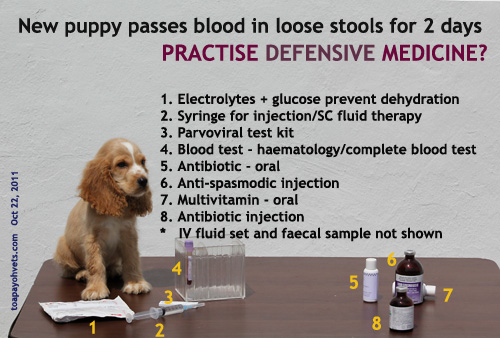
4. TREATMENT. According to symptoms. IV, SC or oral fluid therapy depending on situation. Antispasmodic, antibiotics, multivitamins, protein drip, Vit K1 when necessary. Times and amounts given will be recorded.
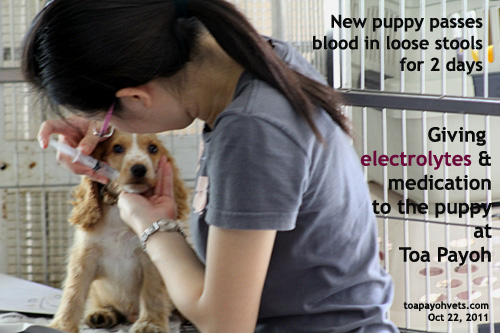
The vet in charge of the case is responsible for details of time, amount and other information will be recorded in the hospitalisation sheet.
5. COMMUNICATIONS WITH THE OWNER IN WRITING. A veterinary report explaining the significance of the tests and case must be given to the owner on discharge/death of the puppy. It is best to keep the owner informed daily of the health of the puppy. Such phone calls must be recorded in the medical case files.
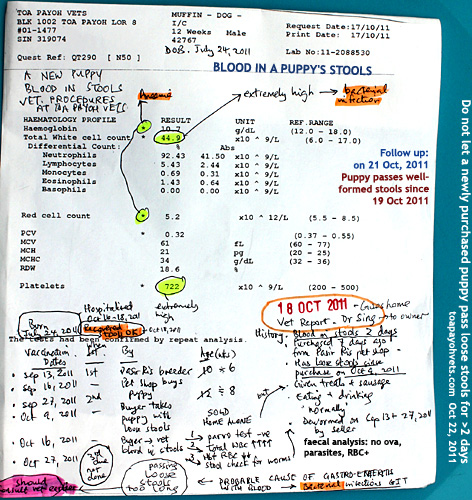
Record under AMD (Against Medical Advice) the owner's rejection of advices of the test in your medical record. Failure to do so implies that the vet has not advised at all in cases of litigation/complaint. As Singapore is becoming a litigious society, I advise that the highest standard of care to be given at all times. An example of a case done by me is down shown in the images.
Updates and more pictures are at: TOA PAYOH VETS WEBPAGE:
http://www.sinpets.com/dogs/20111036puppy-blood-in-stools-diarrhoea-vomiting-singapore-toapayohvets.htm
705. Post-op discharge 3 days after a breast tumour surgery
Yesterday, Oct 24, 2011, the lady owner brought her dog back as there was a "leakage" of reddish-brown fluid from the surgical wound. She had asked for advice over the phone but I told her that it would be hard to know what was happening. However the dog was eating.

"It is not possible for the dog to lick her wound," the lady said since her dog was wearing an E-collar post-operation. "I don't see my dog licking the wound when I am with her."
"I have seen cases where it has been done," I did now want to argue as most owners seem to think that the dog would lick the surgical wound in their presence. If not, then, the dog had not done it. Unless the e-collar is of a size so big, the dog can still lick its surgical wounds partly.
One of the stitches had a gap and post-op blood had leaked out. It was not serious. So, I hospitalised the dog for 3 days as she was walking at home. "Not much walking as she always lay down," the owner said.
"Any walking other than crate confinement will put tension on this long surgical wound," I said. "This is not a small 2-cm wound but more than 20-cm long. Good communication with the owner is important but sometimes it can test a vet's patience.
TIPS
In this case, I had not performed the surgery. However, I had discussed in my previous article that the "walk-in" sutures and horizontal mattress sutures on the skin would have given a tighter fit to control bleeding and prevent "leaking" of plasma. As each vet has his or her own skill and style in stitching up, it is difficult to say whether the subcutaneous stitching of the tissue and then simple interrupted skin sutures did permit "leakage" as there are many factors involved in a post-operation bleeding. In this case, the whole lower part of the dog's body was wet with the reddish brown plasma and blood. I asked Min to bathe the dog as her front leg skin and elbows had yellow flakes and this has nothing to do with the surgery. The dog had not been groomed.
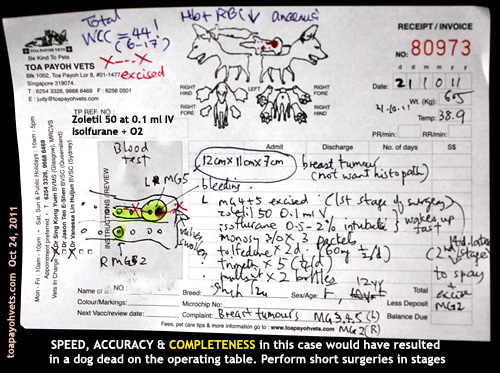
"It is not possible for the dog to lick her wound," the lady said since her dog was wearing an E-collar post-operation. "I don't see my dog licking the wound when I am with her."
"I have seen cases where it has been done," I did now want to argue as most owners seem to think that the dog would lick the surgical wound in their presence. If not, then, the dog had not done it. Unless the e-collar is of a size so big, the dog can still lick its surgical wounds partly.
One of the stitches had a gap and post-op blood had leaked out. It was not serious. So, I hospitalised the dog for 3 days as she was walking at home. "Not much walking as she always lay down," the owner said.
"Any walking other than crate confinement will put tension on this long surgical wound," I said. "This is not a small 2-cm wound but more than 20-cm long. Good communication with the owner is important but sometimes it can test a vet's patience.
TIPS
In this case, I had not performed the surgery. However, I had discussed in my previous article that the "walk-in" sutures and horizontal mattress sutures on the skin would have given a tighter fit to control bleeding and prevent "leaking" of plasma. As each vet has his or her own skill and style in stitching up, it is difficult to say whether the subcutaneous stitching of the tissue and then simple interrupted skin sutures did permit "leakage" as there are many factors involved in a post-operation bleeding. In this case, the whole lower part of the dog's body was wet with the reddish brown plasma and blood. I asked Min to bathe the dog as her front leg skin and elbows had yellow flakes and this has nothing to do with the surgery. The dog had not been groomed.
Subscribe to:
Posts (Atom)