Sunday, September 25, 2011

Parvovirus kills puppies

Recently I had a chat with Vet 1 regarding the importance of evidence-based medicine in the diagnosis of vomiting and diarrhoea in puppies. There was presented a case of a puppy with vomiting and diarrhoea vaccinated 5 days ago. Vet 1 did not think it was parvovirus since the puppy had been vaccinated and the recent vaccination was 5 days ago.

Vet 1 showed me two comments about parvovirus infections in a short paragraph in veterinary medicine text book edited by US vets. These comments are:

1. Parvoviral tests will provide false positive if the puppy has been vaccinated from 5 - 10 days ago.

2. Most puppies with parvoviral infections survive when given supportive treatment.


POINT NO. 1
Apparently one Singapore vet had remarked to Vet 1 that parvovirus test will show a false positive when the puppy had been vaccinated 5 days ago. Therefore, Vet 1 showed me the book which stated the same. I said: "Will Vet 1 put in writing that he or she finds that a positive parvoviral test is a false positive? I doubt it. The puppy may have got vaccinated 5 days ago but it could be incubating the parvoviral infections before that and shows positive on the test. So, it can also be a true positive."

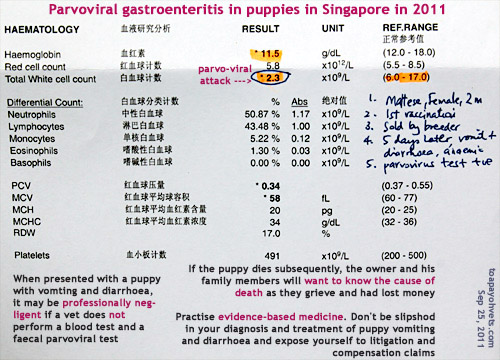
In any case, I got this puppy which was vaccinated 5 days ago but suffering from vomiting and diarrhoea tested for parvovirus. It was positive.


POINT NO. 2

"From my experience in working with the professional dog breeders in Pasir Ris for around 2-3 years, covering almost all the breeders, I know that parvovirus kills puppies despite supportive treatment," I said. "This observation has had been reported by various breeders and vets in countries like Australia.

"Much depends on the immune status and age of the puppies, the number of vaccinations, whether the dams have had been regularly vaccinated to produce maternal antibodies, the environmental load of parvoviruses and the strains. The author of the book cannot be trusted as he wrote a generalised statement. Young puppies with one or no vaccinations rarely survive even with supportive treatment because they are very young and their immune system is not developed. Breeders sometimes miss out regular vaccinations of their dams and it is extremely difficult for breeders to isolate infected puppies owing to their management system of cleaning crates with the same brushes."

IMAGE SHOWS A CASE OF PARVOVIRUS WHERE THE PUPPY WAS VACCINATED 5 DAYS AGO AND SOLD. A DIAGNOSIS OF PARVOVIRUS ON EVIDENCE-BASED MEDICINE NEEDS A BLOOD TEST, PARVOVIRAL TEST TO CONFIRM THE CLINICAL SIGNS OF VOMITING AND DIARRHOEA.

In rare cases, expensive supportive treatment like blood transfusion, intensive care, IV drips, antibodies, long hospitalisations may save the odd puppy. But how many owners are willing to pay for such treatments which are not guaranteed to save the puppy? The puppy costs $500 - $1,000. Do you really expect the owner to shell out much more to save it without a guarantee of success? There will be owners but not many.

Two years ago, one pet shop girl told me that her staff spent $20,000 to treat her puppy with vomiting and diarrhoea at a veterinary practice when I tested it to be positive for parvovirus. The staff took the puppy to another practice for treatment since I gave a poor prognosis. I had no reason to doubt her story although it does sound incredible.

In the past years, I used to go to pet shops to vaccinate puppies even if there were only 2-3 puppies and got to know more about the practices of the pet shops and breeders. But I have stopped doing it nowadays as I need to spend more time with my private patients to build up the practice rather than being "not around" when I went to the pet shops and breeders.


Website:
http://www.sinpets.com/dogs/20110926parvovirus-kills-puppies-singapore_ToaPayohVets.htm

630. Inguinal hernia in a Shih Tzu puppy in Hawaii

On Sat, Sep 24, 2011 at 10:31 AM, ...@gmail.com> wrote:

My friend gave us a sweet loving 4 month old Shih Tzu who had an inguinal hernia. No one wanted her so I took her and planned to get her surgery taken care of. Well, my husband lost his job and we don't have the $1,000+ Hawaii charges for the 45 min. surgery. When she stands it feels like a golf ball and the other side ain't so bad. It hasn't grown. Can I monitor it? When do I know we're in trouble? Hope you can help.
Much mahalo for your kokua.
Name of owner


E-MAIL REPLY FROM DR SING DATED SUNDAY SEP 25, 2011


I am Dr Sing from Toa Payoh Vets, www.toapayohvets.com. Thank you for your email.

Inguinal hernias in Shih Tzus or other puppies vary in size. Small-sized hernias of less than 1 cm in diameter may not cause problems to the Shih Tzu and have been left alone without any health issues. Two health issues are as follows:

1. Since your Shih Tzu's hernia is the size of a golf ball (according to your email), it is best to get it repaired as soon as possible. This is because the intestines get trapped inside the hernia and may get twisted over time.

When the intestines get twisted, the blood supply to the intestines get strangulated and so the intestines cannot receive blood supply. The intestines become gangrenous. The puppy's inguinal hernial area will be painful to the touch.

2. Some puppies keep licking the skin of the hernia till it becomes thin and rupture as they try to relieve themselves of the pain and irritation under the skin of the hernia. When the skin ruptures, the intestines and fat spill out, leading to the imminent death of the puppy unless the vet repairs the defect immediately.

I presume the puppy has no pain in the herniated area presently. Therefore you can still continue to monitor it. The hernia may get bigger with time as the puppy grows bigger. Therefore, it is best for the puppy to get such a large hernia repaired.

Explain to the vet your financial situation (discuss instalment payments) or look for another vet who may be able to help your puppy.

Pl email to me 2 pictures of the hernia (side view left side and right side standing) if possible. Best wishes.

Saturday, September 24, 2011

Email about puppy toilet training - should the owner take it out to pee and poo?

On Fri, Sep 23, 2011 at 2:07 PM,

Hi Judy,
I read this article http://www.toapayohvets.com/sinpets/050620play_pen_toilet_training.htm and find it very useful. I am currently actively looking for a family pet and would be very thankful if you could help to answer my following query.
I am interested to use the crate + pee pan method or play pen + pee pan method. With one of these method, does it mean that they are trained to pee/poo inside the crate/play pen and I do not have to bring him/her out to pee/poo? How about at night? Do I still have to wake up and bring it to pee/poo or should I leave him/her in the crate/play pen? Your kind advise would be greatly appreciated.

Rgds,
Name of owner


E-MAIL REPLY FROM DR SING DATED SEP 24, 2011

I am Dr Sing from Toa Payoh Vets, http://www.toapayohvets.com.
Thank you for your email.

1. The objective of the two methods you mention in your email above is to confine the puppy for 2-4 weeks so that they will pee and poop within that confined area. However, the owner must clean up the soiled area immediately after the puppy has had eliminated. The puppy is naturally a clean animal and if the owner does not remove the stools or wash the soiled area, the chances of early sucess (ie. within 4 weeks) are slim.

1.1 Therefore, you do not have to bring the puppy out to pee and poop using the above methods. However, after midnight, in some situations where there is no distraction from many family members, (e.g. a couple living alone), some new puppies do make a lot of noise asking the owner to change/wash the soiled area. Owners who sleep near the puppies will do it. But most owners don't know and think that the puppy needs company.

2. If you wish to take the puppy out to pee and poop, you can do it but do it as a routine (i.e. at certain times e.g. after each meal) but you sabotage your objective as stated in Para 1. You just need to be consistent in your routine in toilet training.

I hope the above answers your questions.

628. Puppy health check-up

E-MAIL TO DR SING DATED SEP 24, 2011

My name is ... and I'd like to take my two family pets (a Jack Russell and a mongrel) for a routine checkup, just to make sure that they're in good health! How much would this cost in total, GST and other surcharges included?

Do get back to me at this email address. Thank you!

Sincerely,
Name

E-MAIL FROM DR SING DATED SEP 24, 2011

1. A general health check up including consultation & general eye examination as prescribed in our form will be $65.00/dog.

2. Blood test $150. Urine test $50.

A new ultrasonic dental scaler and anaesthetic machine

I have installed a new ultrasonic dental scaler as I had given the older one to my ex-Vet technician Mr Saw who brought it back to Yangon. He had decided to open his own practice and I hope this scaler would help a bit to lower his cost of start up.

As to the new anaesthetic machine and the piping system, I discovered that in the past 3 months, the oxygen and isoflurane used were much more than necessary. My assistant asked me to order a 250-ml of isoflurane within a month. It was not that we had done a hundred general anaesthetics.

So, I got Mr Goh to check. He said that the lever on the vaporiser was not "locked", thereby permitting leaks of isoflurane. In the old vaporisers, there was no such lever.

He got me a new set. More fanciful gadget. There is an "alarm" gauge when the pressure of the system is below normal.

As to the dental scaler, I am chasing him to install an extra switch for the water inlet so that the switch can be turned off and the machine kept in the cabinet. This is because I note that my assistants of past and present don't really bother to treat the machines well. After all, they don't pay for it.

A culture of responsibility and care for the tools of the trade is either in an assistant or not. I think the vet schools do not bother to teach them the need to take care of vet machines which are expensive things and not disposable toys.

Friday, September 23, 2011

626. Vulval leiomyoma

Today, Sep 23, 2011, I was reviewing some medical records today as part of my performance assessment of myself and my associates. What went wrong and what could be improved? Reviews improve operational efficiency and productivity as much can be learnt from the past case experiences. Such reviews add up, providing real life experiences as the vet ages.

In a histopathology report dated May 12, 2011, the age of a Jack Russell's nodule at the dorsal vulval lips was stated to be 5 years old. It had a leiomyoma, 2x1.3x1.2 cm.

The histopathology report:
Dermal circumscribed nodule. Whorled fascicles of bland smooth muscle cells. No necrosis, cytological atypia or increased mitotic activity. No evidence of malignancy.

Why did the lab report state the dog as 5 years old? I checked my records. In 2006, 3 Jack Russell pups came in for tail docking. The dam did not come till 2009 when I excised 3 breast tumours. She was said to be 14 years old then. The owner did not want to spay the dog in her younger days as he believed that she would become fat when spayed.


With this big growing vulval tumour, he agreed to the dog being operated to excise the tumour and spayed in May 2011. This was done by my associate vet. The vulval tumour was sent to the laboratory for histopathology by my assistant who wrote 5 years as the age.

So, I phoned the gentleman who is in his mid 60s today. He said the dog would be more than 14 years old. Definitely not 5 years old. This dog could not be 5 years old and I informed my assistant and the vet to check with the owner every time. In the Singapore General Hospital, the nurse will ask the patient going for surgery, several times his name and what operation he or she would be going for on the way to the operating room. I know this because I went for an operation. Sometimes, they even took a picture of the area to be operated.
"Is she OK after the surgery (to spay and remove leiomyoma)?" I asked. "Yes," he said. If the dog is more than 14 years old, it still had false pregnancy before the spay. How old should a female dog be before they go into "menopause"? Do dogs go into menopause?

Sometimes clients cannot remember the exact age of their dogs or they may have more than one of the same breed. It is best practice for the vet to ask the client at EVERY consultation what is the age of the dog patient. Some practices take one facial image of the dog patient. In my opinion, there needs to be front and two side views in order to identify the dog. If there are markings and the dog is of one colour, it will be wise to ask the owner to identify the dog.


Website:
http://www.sinpets.com/dogs/20110924leiomyoma-old-female-not-spayed-jack-russell-singapore_ToaPayohVets.htm

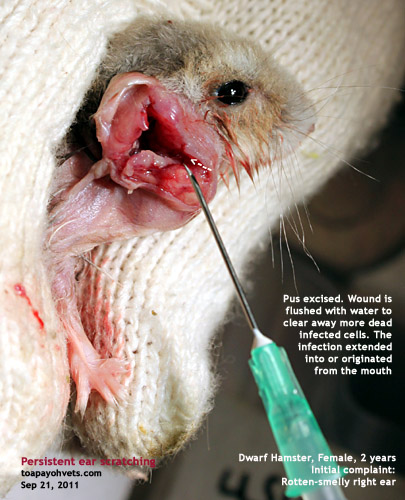
625. Follow up on the dwarf hamster with foul-smelly right ear

This dwarf hamster is a tough cookie as she had survived 4 operations. Details are at case report:
http://www.sinpets.com/hamsters/20110922rotten-smelly-right-ear-abscesses-dwarf-hamster-singapore_ToaPayohVets.htm


E-MAIL FROM DR SING DATED SEP 22, 2011

How's the hamster now, Sep 22, 2011?


E-MAIL REPLY FROM OWNER DATED SEP 22, 2011
Thanks for checking in. XXX is active. Her wound is dark and dry around the edges but moist in the centre. (will try to take a photo) Sometimes, the wound has that odour, even after swabbing. She grooms and rubs the area quite often.

She is being given water from a syringe (0.05ml every 3h or so) and seems to urinate fairly regularly. Her stool count is still under 10/day but the consistency of the stools appears to have returned to normal.

She nibbled on the mashed up food pellets once, but on subsequent occasions, did not want any. She is willing eat (perhaps two or three) sunflower seeds that have been shelled for her and also seems to like this triangular black seed (can't identify) from the mix. Will mash up some peanuts and see if she will eat that. Will also try to find a proper weighing scale.


E-MAIL REPLY FROM DR SING DATED SEP 23, 2011
I did smell this rotten bad smell when I operated recently on your dwarf hamster. It was a faint foul smell from the wound and did not persist. The smell is from the bacteria deep inside the wound. It could be an anaerobic type of bacteria.

Buy a bottle of 6% hydrogen peroxide from the pharmacy. Put some on the cotton tip and try to swab deep inside the wound once or twice per day. If the smell persists, the hamster needs the antibiotics. This will be given, if necessary, after she has produced normal stools.