My receptionist Jame retires today. He is 76 years old and has a severe hunch to 45 degrees forward. Last week, he fell off the plastic stool and fortunately landed his bum on the floor without fracturing his hip. He complained of a back pain but said it was nothing.
"My mother lived past 90 years," he said.
"How about your father?" I presumed he would live to 90 years.
"Around 50 years," he replied.
I advised him to see the Polyclinic as he had both lower limbs swollen and some non-healing wounds on his left lower leg above the ankle. "The Toa Payoh Polyclinic is closed for renovation," he said. I phoned 100 and got the Ang Mo Kio Polyclinic address for him to get a thorough check up of his hips and his hunched back. The General Practitioner prescribed tight bandages for his lower legs and advised him that he had higher than normal cholesterol after pricking his finger to test for diabetes.
No other exam. I asked him to go to Singapore General Hospital Health Screening Unit to get blood test, heart check, ultrasound and colonscopy. "How long can you live?" I asked. "Better to enjoy your life without having to work 5 days a week," I advised.
Friday, February 11, 2011

330. Photography: a tool for better veterinary health care for pets?
From: Digital photographer Issue 97
www.dphotographer.co.uk
PHOTOGRAPHY: A TOOL FOR POLITICAL CHANGE?
Mona Miri:
Images must be visually compelling and tell a story. Photography is a very powerful tool to highlight important humanitarian and environmental issues (www.monamiri.com). When we see images of degradation, starvation, pollution or natural disasters, we want to make a difference.
www.simonnorfolk.com
Photographers need to be telling stories about their world, providing a voice for the subjects and make us think differently about conventional wisdom.
IMPACT
It must be a combination of the photos and the facts or ideas behind them that can change people's view. Not just photos alone.
An image is a very powerful weapon but a person must show the correct view instead of a distorted one.
Photo is a powerful tool that bring issues to the attention of the big decision-makers. But it is the campaign with images that makes the biggest difference
Money is influence, influence is access and that is what makes the world go round, not pictures
www.dphotographer.co.uk
PHOTOGRAPHY: A TOOL FOR POLITICAL CHANGE?
Mona Miri:
Images must be visually compelling and tell a story. Photography is a very powerful tool to highlight important humanitarian and environmental issues (www.monamiri.com). When we see images of degradation, starvation, pollution or natural disasters, we want to make a difference.
www.simonnorfolk.com
Photographers need to be telling stories about their world, providing a voice for the subjects and make us think differently about conventional wisdom.
IMPACT
It must be a combination of the photos and the facts or ideas behind them that can change people's view. Not just photos alone.
An image is a very powerful weapon but a person must show the correct view instead of a distorted one.
Photo is a powerful tool that bring issues to the attention of the big decision-makers. But it is the campaign with images that makes the biggest difference
Money is influence, influence is access and that is what makes the world go round, not pictures
Thursday, February 10, 2011
329. Modern carpark warrior
For many years, Singapore's car park wardens walk to the carparks to catch errant motorists. Before they could book one, the Toa Payoh Lor 8 industrial park tenants co-operated and warned their neighbours motorists would run to their cars to put parking coupons onto the dashboard. So, the wardens needed to sneak inspections by arriving at odd times.
Today, I noted a golden car and commercial wordings like "Chubb" parked across my car which was parked near the the fire hydrant. I was leaving and was going to politely ask the driver to make way. Inside were 2 men. One was checking his digital pad and said to me: "Somebody complained but I had not keyed in your car details yet." I thanked him and drove to the Library.
From my speculation, the HDB had outsourced to Chubb to catch errant motorists. Somebody in Chubb would check google maps at 9 am in the Chubb ofoffice and see my car parked illegally. So, it was time for enforcement.
No more walking wardens now. They sneak in by car and booked errant motorists by printing out a summons from their PDAs. No more chance for the ordinary citizen now, but most car parks are automated and only this one near my Surgery is not. So, expect driving car park wardens at any time and at any day now. Hit and run, I mean book from inside the car and drive away!
Today, I noted a golden car and commercial wordings like "Chubb" parked across my car which was parked near the the fire hydrant. I was leaving and was going to politely ask the driver to make way. Inside were 2 men. One was checking his digital pad and said to me: "Somebody complained but I had not keyed in your car details yet." I thanked him and drove to the Library.
From my speculation, the HDB had outsourced to Chubb to catch errant motorists. Somebody in Chubb would check google maps at 9 am in the Chubb ofoffice and see my car parked illegally. So, it was time for enforcement.
No more walking wardens now. They sneak in by car and booked errant motorists by printing out a summons from their PDAs. No more chance for the ordinary citizen now, but most car parks are automated and only this one near my Surgery is not. So, expect driving car park wardens at any time and at any day now. Hit and run, I mean book from inside the car and drive away!
328. Fifty words to recommend a pet product
An inaugural issue of a magazine asked me to write 50 words to recommend a pet product and suggested an image of me and the product.
The images will not be of educational interest to readers. However, an X-ray of a bladder stone will have greater interest to readers (I presume).
I used Microsoft Word, "Tools" - Word Count and got the number of words as 50. Then I clicked "Spelling and Grammar. The advice was to revise the following long fragment:
I recommend Hill's® Prescription Diet® s/d® Canine pet food to dissolve struvite bladder stones in dogs that have difficulty in peeing.
Since I have a limit of 50 words, I did not revise the fragment. The 50 words are as follows:
I recommend Hill's® Prescription Diet® s/d® Canine pet food to dissolve struvite bladder stones in dogs that have difficulty in peeing. Veterinary tests are required. However, large bladder stones (X-ray) require surgical removal so that your dog does not suffer painful urination of smelly bloody urine daily for several months.

The 50 words' limit forces me to be concise and yet be able to educate pet owners.
Advice to youths.
A person must write daily to be able to write better just as exercising the muscles make one better built. There is no other way to improve one's writing.
Message from the magazine
Dear Dr Sing,
Good day! This is Michelle from the CozyCot Editorial team.
We are working on a pet story to be published in our print magazine's inaugural issue in April, and I'm hoping that with your expertise and experience, you can recommend one pet product (this can be anything and everything from pet food, to pet cages to pet toys) and tell us what's so good about it in about 50 words. It would also be great if you could accompany the text with image(s) of the product and yourself.
As we are running on a tight deadline, I would be extremely grateful if you could get back to me as soon as possible. Many thanks!
Best Regards,
Michelle Ong
Writer
michelle@cozycot.com
t: (65) 6100 2699
f: (65) 6226 3733
e: michelle@cozycot.com
CozyCot Pte. Ltd.
1 Scotts Road #26-05/07 Shaw Centre Singapore 228208
Hitwise Awards - CozyCot #1 Women's Site since 2006: http://cot.ly/aXPnbp
Hitwise Awards - CozyCot #1 Beauty Site in 2010: http://cot.ly/cnqDe2
Nielsen says CozyCot Members are Opinion Leaders: http://cot.ly/d4Hty0
The images will not be of educational interest to readers. However, an X-ray of a bladder stone will have greater interest to readers (I presume).
I used Microsoft Word, "Tools" - Word Count and got the number of words as 50. Then I clicked "Spelling and Grammar. The advice was to revise the following long fragment:
I recommend Hill's® Prescription Diet® s/d® Canine pet food to dissolve struvite bladder stones in dogs that have difficulty in peeing.
Since I have a limit of 50 words, I did not revise the fragment. The 50 words are as follows:
I recommend Hill's® Prescription Diet® s/d® Canine pet food to dissolve struvite bladder stones in dogs that have difficulty in peeing. Veterinary tests are required. However, large bladder stones (X-ray) require surgical removal so that your dog does not suffer painful urination of smelly bloody urine daily for several months.

The 50 words' limit forces me to be concise and yet be able to educate pet owners.
Advice to youths.
A person must write daily to be able to write better just as exercising the muscles make one better built. There is no other way to improve one's writing.
Message from the magazine
Dear Dr Sing,
Good day! This is Michelle from the CozyCot Editorial team.
We are working on a pet story to be published in our print magazine's inaugural issue in April, and I'm hoping that with your expertise and experience, you can recommend one pet product (this can be anything and everything from pet food, to pet cages to pet toys) and tell us what's so good about it in about 50 words. It would also be great if you could accompany the text with image(s) of the product and yourself.
As we are running on a tight deadline, I would be extremely grateful if you could get back to me as soon as possible. Many thanks!
Best Regards,
Michelle Ong
Writer
michelle@cozycot.com
t: (65) 6100 2699
f: (65) 6226 3733
e: michelle@cozycot.com
CozyCot Pte. Ltd.
1 Scotts Road #26-05/07 Shaw Centre Singapore 228208
Hitwise Awards - CozyCot #1 Women's Site since 2006: http://cot.ly/aXPnbp
Hitwise Awards - CozyCot #1 Beauty Site in 2010: http://cot.ly/cnqDe2
Nielsen says CozyCot Members are Opinion Leaders: http://cot.ly/d4Hty0
Wednesday, February 9, 2011
Too good to be true Golden Retriever and Norwich Terrier from the SPCA, Singapore
CASE 1.
I was invited to the 2nd day of Chinese New Year dinner organised yearly by a remiser. Beautiful bungalow in a serene tranquil area of Margoulith Road. My wife and I had our food outside at the corner. I was with the owners of the skin and bone poodle with megaoesophagus (no more vomiting, a big relief to the lady owner as vomiting was presented daily for the past 3 years) and a widow in her late 60s who related an incredible tale.
"The Golden Retriever was so good looking that we adopted him even if he had no pedigree papers. My son was excited and we quickly signed the SPCA papers. This dog was recommended by my relative, a vet who helped out at the SPCA."
This vet was my intern over 20 years ago and when her name was mentioned, this woman related the incredible tale.
First the Golden Retriever chewed on plants, legs of tables and graduated to chewing metal. "The puppy chewed steel? Really?" I asked.
"Yes, it is true," the grandmother said. "The neighbour's cars parked outside the house would have no steel rims!"
"What happened to the dog after you returned him to the SPCA?" I asked.
"I don't want to know," the grandmother said. "Was there any solution to this problem? The dog trainer said no solution."
"How old is the puppy?" I presumed incorrectly.
"8 months old when I adopted him."
"Destructive chewing can be prevented when the Golden Retriever is a puppy. Put him inside the kennel when he starts to chew destructively and reward him with treats and exercise when he behaves. However this needs a lot of patience and time." The grandmother had given the dog much freedom and so he kept on destroying the garden and cars. A child not properly disciplined or trained with love will also end up being lacking in ethics and morals too. Parents need time to do the training but there will be handsome men and pretty women out to scam and con. It is best not to judge a book by its cover.
From this incident, she prohibited her grandchildren living in her house from keeping dogs! Despite the fact she enjoyed the company of dogs at a young age.
CASE 2.
I was surprised to see a Norwich Terrier puppy coming in for vaccination. This breed is expensive and rare in Singapore. It costs around $2,000 and the owners had adopted him from the SPCA Singapore. Fortunately he has no destructive chewing but he was adopted as a 4-month-old. The daughter in her pre-teens and the parents were very fond of this well behaved puppy.
I was invited to the 2nd day of Chinese New Year dinner organised yearly by a remiser. Beautiful bungalow in a serene tranquil area of Margoulith Road. My wife and I had our food outside at the corner. I was with the owners of the skin and bone poodle with megaoesophagus (no more vomiting, a big relief to the lady owner as vomiting was presented daily for the past 3 years) and a widow in her late 60s who related an incredible tale.
"The Golden Retriever was so good looking that we adopted him even if he had no pedigree papers. My son was excited and we quickly signed the SPCA papers. This dog was recommended by my relative, a vet who helped out at the SPCA."
This vet was my intern over 20 years ago and when her name was mentioned, this woman related the incredible tale.
First the Golden Retriever chewed on plants, legs of tables and graduated to chewing metal. "The puppy chewed steel? Really?" I asked.
"Yes, it is true," the grandmother said. "The neighbour's cars parked outside the house would have no steel rims!"
"What happened to the dog after you returned him to the SPCA?" I asked.
"I don't want to know," the grandmother said. "Was there any solution to this problem? The dog trainer said no solution."
"How old is the puppy?" I presumed incorrectly.
"8 months old when I adopted him."
"Destructive chewing can be prevented when the Golden Retriever is a puppy. Put him inside the kennel when he starts to chew destructively and reward him with treats and exercise when he behaves. However this needs a lot of patience and time." The grandmother had given the dog much freedom and so he kept on destroying the garden and cars. A child not properly disciplined or trained with love will also end up being lacking in ethics and morals too. Parents need time to do the training but there will be handsome men and pretty women out to scam and con. It is best not to judge a book by its cover.
From this incident, she prohibited her grandchildren living in her house from keeping dogs! Despite the fact she enjoyed the company of dogs at a young age.
CASE 2.
I was surprised to see a Norwich Terrier puppy coming in for vaccination. This breed is expensive and rare in Singapore. It costs around $2,000 and the owners had adopted him from the SPCA Singapore. Fortunately he has no destructive chewing but he was adopted as a 4-month-old. The daughter in her pre-teens and the parents were very fond of this well behaved puppy.
326. pug with recurrent infected struvite stones - case report for vet students and owners
http://www.sinpets.com/dogs/20110207urinary-stones-pug-toapayohvets-singapore.htm
has the latest updates
Blogger can't display tables directly. The report is below:
FOR TOA PAYOH VETS VET REFERENCE BOOK FOR OWNER EDUCATION
Case study: Infection-induced struvite uroliths in the dog
Pug, Male, 2 and half years. Bladder stones removed by Vet 1 around one year ago. Dog was on Hill's SD on one month, CD for 3 months. The complaint was dysuria (straining to pee) for the past few days.
"Why?" the lady who had kept 3 pugs to an old age, had no urinary stone problems. The black pug lived up to 18 years of age. (3 pugs were fed home-cooked food by the mother but this 4th pug was given dry dog food as her mother had passed away.
However, she anticipated no problem after bladder stone removal by Vet 1. "Why did the vet not advise follow-up? I stopped giving the Hills' Prescription diet as my dog was showing allergy and feed home-cooked rice and meat." Her father asked me at another visit: "Is it because the vet (Vet 1) had not completely removed all urinary stones?" Residual stones could cause a recurrence but stones do recur even after complete stone removal.
urethral obstruction - used smaller catheter. pug drinks little. toapayohvets, singaporeA real case will interest the vet student as it can be sleep-inducing to read through the several hundreds of pages of urinary stones in dogs in various text books and the internet. The following case will help to explain to students the approach to one approach to the medical treatment of struvite uroliths in the dogs at Toa Payoh Vets.
There are 3 scenarios mentioned in the above website.
1. Medical dissolution of struvite uroliths in dogs
2. Prevention of infection-induced struvite uroliths
3. Prevention of sterile struvite uroliths in dogs
This pug has 1 and 2 and so the medical treatment (as contrasted to surgical treatment) is discussed below.
On 26.1.11, the pug strained to pass urine.
Urine Test results from lab:
Urine: amber & turbid
pH= 8.0 (5-8)
SG = 1.010 (1.005 - 1.030)
Bilirubin ++
Blood ++++
WBC 0
RBC 8
Casts Nil
Bacteria ++ Crystals
triple phosphate +,
calcium oxalate occasional, amorphous phosphate ++
Calcium oxalate crystalluria. Collect fresh urine and analyse within 30 minutes. If persistent and in breeds (Bichon Frise, Miniature Schnauzer, Yorkshire Terrier, Shih Tzu, Lhasa Apso), discontinue diets that promote formation of acidic urine and consult recommendations for Calcium oxalate prevention. Struvite crystalluria is insignificant if the dog has negative urine cultures. However this pug had bacteria in the urine. Struvite is also known as triple-phosphate, ammonium phosphate and urease stones and are invariably associated with urinary tract infections in people and dogs with alkaline urine (pH > 7.2).
Blood Test results from the lab:
% Absolute
WBC normal range. Biochemistry normal Neutrophils 71%
Lymphocytes 18%
Monocytes 9%
Eosinophils 0.2%
Basophils 1.8% 11.50
2.9
1.42
0.03
0.29
X-ray
No obvious urinary stones seen in the kidney, bladder or os penis. The alkaline pH, bacteria in the urine and struvite crystals indicated a recurrence of the urinary stone formation with urinary tract infection. The Owner wants medical (conservative) treatment. Acidifying tablets* (1 tablet 1 x/day for 10 days), canned CD diet and trimethoprim antibiotics were prescribed.
*1 tablet/5 kg twice a day is recommended by manufacturer. The pug is 9.5 kg and would be getting 2 tablets 2x/day in theory.
Feb 7, 2011. Owner is in her 30s and has good medical knowledge as she works in the medical profession. She probably does internet research on urinary stones in the dogs. She e-mailed to me the follow dipstick result I had asked her to do at home.
Feb 7, 2011
Greetings Dr Sing
Happy New Year to you, your family and your folks at Toa Payoh Vets! I had done a urine dipstix for XXX and results are as follows:
Leukocytes: Neg
Nitrate: Neg
Urobilinogen: 0.2 Protein: Neg
pH: 5.0-6.0
Blood: Neg Ketone: Neg
Bilirubin: Neg
Glucose: Neg
He's so much better with his urination though at times, his post void can be slightly delayed (meaning he puts his leg down quite some time even when there seems to be no more urine).
As I will be leaving for overseas for a week on Wed morning, do you need me to bring XXX over tomorrow?
Thanks and regards
The urine was not alkaline as on the first day of consultation. pH was 8.0 then. Dipstick results are not reliable but is easy for the owner to do. I advised a review of dog, urine bacterial culture and test 3-4 weeks after the first visit and get a urine test done (via catherisation since it is difficult for the owner to collect a mid-stream urine into the urine collection container! The pug would stop peeing when she tried to collect urine.)
On Feb 8, 2011, the lady owner came for acidurin tablets for another 20 days and said that since the dog does not have much difficulty in urination, the trimethoprim tablets must be effective and therefore there is no need for a urine antibiotic-sensistivity test.
PREVENTION OF INFECTION-INDUCED STRUVITE UROLITHS
1. Treatment: Control urinary tract infections. Select antibiotics based on urine bacterial culture and susceptibility results. Culture urine during therapy to verify effectiveness of antibiotics.
With additional recurrent infections, antibiotics for 4 weeks, then 1/2 daily doses for 9-12 months, 4-weekly urine cultures.
2. Acidify urine: medication
3. Diet which promotes acidic urine. These have reduced protein, phosphorus and magnesium.
4. Monitoring: Urine culture and urinalysis in 1 month and 3-monthly.
5. X-ray: Every 6 months or sooner if the patient has recurrent urinary tract infection symptoms*.
*excessive vulval licking, urinating in the house, pollakiuria, haematuria etc.
*identify and eradicate anatomic abnormalities (vaginourethrocystoscopy, contrast vaaginourethrocystography and ultrasonography) and functional (urine cortisol to creatinine ratio, serum biochemical and thyroid profiles and neurological exam) risk factors for recurrent infections.
Note 1: struvite crystalluria is insignificant if the dog has negative urine cultures. However this case has bacteria in the urine.
Note 2: Calcium oxalate crystalluria. Collect fresh urine and analyse within 30 minutes. If persistent and in breeds (Bichon Frise, Miniature Schnauzer, Yorkshire Terrier, Shih Tzu, Lhasa Apso), discontinue diets that promote formation of acidic urine and consult recommendations for Calcium oxalate prevention.
An American veterinary school (webpage not available to the members of the public) that does urolith analysis for Hills' samples, recorded that medical dissolution of struvite uroliths with Hills' s/d canine was 100% effective after 3-6 weeks for sterile struvite uroliths and 8-12 weeks with effective antibiotics for infection-induced struvite uroliths. It seems that this institution favours medical treatment (i.e. no surgery to remove stones).
Immature dogs should not be given low protein s/d for a long term. However, a short-term use with antibiotics has rapidly dissolved infection-induced struvite uroliths in 9-12 days without adverse events.
Owner/patient compliance when feeding s/d is easily determined with a urine SG (mean = 1.008+/-0.003) and pH (mean =6.2+/-0.7). If no urine sample, serum urea nitrogen is a reliable marker (mean 3.5+/- 2.4 mg/dl). The s/d diet is high in fat and high fat is a risk factor for pancreatitis.
Female Miniature Schnauzers and others with hyperadrenocortisicism risk pancreatitiis and UTI that includes urease-producing uropathogens. Respond by discontinuing s/d diet, maintain hydration if vomiting/pancreatitis occur. Consider alternative that also acidify urine eg. canned w/d Canine) to correct both diseases. 26% of canine nephroliths are composed of struvite. They can be dissolved medically as in bladder stones but this takes a much longer time due to reduced kidney function, reduced urine production and reduced nephrolith dwell time in therapeutically undersaturated urine.
CONCLUSION.
Approaches to treatment. Medical or surgical treatment? For large stones and urethral obstruction, I advise surgery to remove all the stones after antibiotic treatment. Stones do recur even after complete stone removal in some cases. Many Singapore owners do not comply with medical treatment and the follow-up reviews (urine tests 3-monthly, X-rays 6 monthly). I presume it is due to economics and lack of time. Surgery should be done only after effective antibiotic treatment rather than immediately.
In this case, the pug drinks little but drinks more after going outdoors for exercise. "Try adding some ice-cubes to the water," I said to the lady who loves pugs only. Regular urine monitoring will be needed for the next 6 months and no dry dog food or dog treats and biscuits must be given. The lady owner was satisfied with the outcome that the pug was no longer taking a long time to pee.
Urine-marking in male dogs may or may not lead to urinary tract infections as the male dog with-holds urine to have sufficient amount to mark the territory. The alpha male dog pees until the last drop and even tries to pee when there is no more urine in the bladder. Neutering the dog may help prevent urinary tract infection. The lady owner was not keen on neutering.
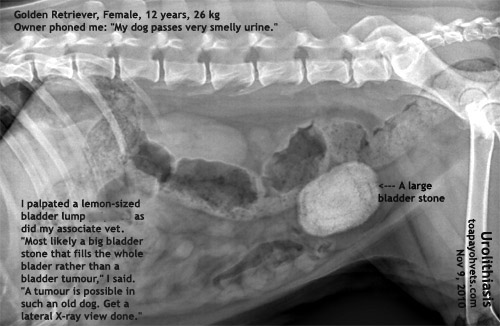
Old Golden Retriever passes smelly urine with blood. A gigantic bladder stone. toapayohvets singaporeStones submitted for analysis in one female golden retriever by Toa Payoh Vets showed magnesium ammonium phosphate (struvite) 95% in the stone and 100% in the shell with zero in the nidus and surface. Calcium phosphate carbonate was 5% inside the stone. More case studies, goto: urinary tract problems in dogs and cats

has the latest updates
Blogger can't display tables directly. The report is below:
FOR TOA PAYOH VETS VET REFERENCE BOOK FOR OWNER EDUCATION
Case study: Infection-induced struvite uroliths in the dog
Pug, Male, 2 and half years. Bladder stones removed by Vet 1 around one year ago. Dog was on Hill's SD on one month, CD for 3 months. The complaint was dysuria (straining to pee) for the past few days.
"Why?" the lady who had kept 3 pugs to an old age, had no urinary stone problems. The black pug lived up to 18 years of age. (3 pugs were fed home-cooked food by the mother but this 4th pug was given dry dog food as her mother had passed away.
However, she anticipated no problem after bladder stone removal by Vet 1. "Why did the vet not advise follow-up? I stopped giving the Hills' Prescription diet as my dog was showing allergy and feed home-cooked rice and meat." Her father asked me at another visit: "Is it because the vet (Vet 1) had not completely removed all urinary stones?" Residual stones could cause a recurrence but stones do recur even after complete stone removal.
urethral obstruction - used smaller catheter. pug drinks little. toapayohvets, singaporeA real case will interest the vet student as it can be sleep-inducing to read through the several hundreds of pages of urinary stones in dogs in various text books and the internet. The following case will help to explain to students the approach to one approach to the medical treatment of struvite uroliths in the dogs at Toa Payoh Vets.
There are 3 scenarios mentioned in the above website.
1. Medical dissolution of struvite uroliths in dogs
2. Prevention of infection-induced struvite uroliths
3. Prevention of sterile struvite uroliths in dogs
This pug has 1 and 2 and so the medical treatment (as contrasted to surgical treatment) is discussed below.
On 26.1.11, the pug strained to pass urine.
Urine Test results from lab:
Urine: amber & turbid
pH= 8.0 (5-8)
SG = 1.010 (1.005 - 1.030)
Bilirubin ++
Blood ++++
WBC 0
RBC 8
Casts Nil
Bacteria ++ Crystals
triple phosphate +,
calcium oxalate occasional, amorphous phosphate ++
Calcium oxalate crystalluria. Collect fresh urine and analyse within 30 minutes. If persistent and in breeds (Bichon Frise, Miniature Schnauzer, Yorkshire Terrier, Shih Tzu, Lhasa Apso), discontinue diets that promote formation of acidic urine and consult recommendations for Calcium oxalate prevention. Struvite crystalluria is insignificant if the dog has negative urine cultures. However this pug had bacteria in the urine. Struvite is also known as triple-phosphate, ammonium phosphate and urease stones and are invariably associated with urinary tract infections in people and dogs with alkaline urine (pH > 7.2).
Blood Test results from the lab:
% Absolute
WBC normal range. Biochemistry normal Neutrophils 71%
Lymphocytes 18%
Monocytes 9%
Eosinophils 0.2%
Basophils 1.8% 11.50
2.9
1.42
0.03
0.29
X-ray
No obvious urinary stones seen in the kidney, bladder or os penis. The alkaline pH, bacteria in the urine and struvite crystals indicated a recurrence of the urinary stone formation with urinary tract infection. The Owner wants medical (conservative) treatment. Acidifying tablets* (1 tablet 1 x/day for 10 days), canned CD diet and trimethoprim antibiotics were prescribed.
*1 tablet/5 kg twice a day is recommended by manufacturer. The pug is 9.5 kg and would be getting 2 tablets 2x/day in theory.
Feb 7, 2011. Owner is in her 30s and has good medical knowledge as she works in the medical profession. She probably does internet research on urinary stones in the dogs. She e-mailed to me the follow dipstick result I had asked her to do at home.
Feb 7, 2011
Greetings Dr Sing
Happy New Year to you, your family and your folks at Toa Payoh Vets! I had done a urine dipstix for XXX and results are as follows:
Leukocytes: Neg
Nitrate: Neg
Urobilinogen: 0.2 Protein: Neg
pH: 5.0-6.0
Blood: Neg Ketone: Neg
Bilirubin: Neg
Glucose: Neg
He's so much better with his urination though at times, his post void can be slightly delayed (meaning he puts his leg down quite some time even when there seems to be no more urine).
As I will be leaving for overseas for a week on Wed morning, do you need me to bring XXX over tomorrow?
Thanks and regards
The urine was not alkaline as on the first day of consultation. pH was 8.0 then. Dipstick results are not reliable but is easy for the owner to do. I advised a review of dog, urine bacterial culture and test 3-4 weeks after the first visit and get a urine test done (via catherisation since it is difficult for the owner to collect a mid-stream urine into the urine collection container! The pug would stop peeing when she tried to collect urine.)
On Feb 8, 2011, the lady owner came for acidurin tablets for another 20 days and said that since the dog does not have much difficulty in urination, the trimethoprim tablets must be effective and therefore there is no need for a urine antibiotic-sensistivity test.
PREVENTION OF INFECTION-INDUCED STRUVITE UROLITHS
1. Treatment: Control urinary tract infections. Select antibiotics based on urine bacterial culture and susceptibility results. Culture urine during therapy to verify effectiveness of antibiotics.
With additional recurrent infections, antibiotics for 4 weeks, then 1/2 daily doses for 9-12 months, 4-weekly urine cultures.
2. Acidify urine: medication
3. Diet which promotes acidic urine. These have reduced protein, phosphorus and magnesium.
4. Monitoring: Urine culture and urinalysis in 1 month and 3-monthly.
5. X-ray: Every 6 months or sooner if the patient has recurrent urinary tract infection symptoms*.
*excessive vulval licking, urinating in the house, pollakiuria, haematuria etc.
*identify and eradicate anatomic abnormalities (vaginourethrocystoscopy, contrast vaaginourethrocystography and ultrasonography) and functional (urine cortisol to creatinine ratio, serum biochemical and thyroid profiles and neurological exam) risk factors for recurrent infections.
Note 1: struvite crystalluria is insignificant if the dog has negative urine cultures. However this case has bacteria in the urine.
Note 2: Calcium oxalate crystalluria. Collect fresh urine and analyse within 30 minutes. If persistent and in breeds (Bichon Frise, Miniature Schnauzer, Yorkshire Terrier, Shih Tzu, Lhasa Apso), discontinue diets that promote formation of acidic urine and consult recommendations for Calcium oxalate prevention.
An American veterinary school (webpage not available to the members of the public) that does urolith analysis for Hills' samples, recorded that medical dissolution of struvite uroliths with Hills' s/d canine was 100% effective after 3-6 weeks for sterile struvite uroliths and 8-12 weeks with effective antibiotics for infection-induced struvite uroliths. It seems that this institution favours medical treatment (i.e. no surgery to remove stones).
Immature dogs should not be given low protein s/d for a long term. However, a short-term use with antibiotics has rapidly dissolved infection-induced struvite uroliths in 9-12 days without adverse events.
Owner/patient compliance when feeding s/d is easily determined with a urine SG (mean = 1.008+/-0.003) and pH (mean =6.2+/-0.7). If no urine sample, serum urea nitrogen is a reliable marker (mean 3.5+/- 2.4 mg/dl). The s/d diet is high in fat and high fat is a risk factor for pancreatitis.
Female Miniature Schnauzers and others with hyperadrenocortisicism risk pancreatitiis and UTI that includes urease-producing uropathogens. Respond by discontinuing s/d diet, maintain hydration if vomiting/pancreatitis occur. Consider alternative that also acidify urine eg. canned w/d Canine) to correct both diseases. 26% of canine nephroliths are composed of struvite. They can be dissolved medically as in bladder stones but this takes a much longer time due to reduced kidney function, reduced urine production and reduced nephrolith dwell time in therapeutically undersaturated urine.
CONCLUSION.
Approaches to treatment. Medical or surgical treatment? For large stones and urethral obstruction, I advise surgery to remove all the stones after antibiotic treatment. Stones do recur even after complete stone removal in some cases. Many Singapore owners do not comply with medical treatment and the follow-up reviews (urine tests 3-monthly, X-rays 6 monthly). I presume it is due to economics and lack of time. Surgery should be done only after effective antibiotic treatment rather than immediately.
In this case, the pug drinks little but drinks more after going outdoors for exercise. "Try adding some ice-cubes to the water," I said to the lady who loves pugs only. Regular urine monitoring will be needed for the next 6 months and no dry dog food or dog treats and biscuits must be given. The lady owner was satisfied with the outcome that the pug was no longer taking a long time to pee.
Urine-marking in male dogs may or may not lead to urinary tract infections as the male dog with-holds urine to have sufficient amount to mark the territory. The alpha male dog pees until the last drop and even tries to pee when there is no more urine in the bladder. Neutering the dog may help prevent urinary tract infection. The lady owner was not keen on neutering.
Old Golden Retriever passes smelly urine with blood. A gigantic bladder stone. toapayohvets singaporeStones submitted for analysis in one female golden retriever by Toa Payoh Vets showed magnesium ammonium phosphate (struvite) 95% in the stone and 100% in the shell with zero in the nidus and surface. Calcium phosphate carbonate was 5% inside the stone. More case studies, goto: urinary tract problems in dogs and cats

Monday, February 7, 2011
325. Young pug has difficulty in peeing
Pug, Male, 2 and half years
Bladder stone removed by Vet 1 around one year ago
On 26.1.11, the pug strained to pass urine.
Urine Test results:
Urine: amber & turbid
pH= 8.0 (5-8)
SG = 1.010 (1.005 - 1.030)
Bilirubin ++
Blood ++++
WBC 0
RBC 8
Casts Nil
Crystals triple phosphate +, calcium oxalate occasional, amorphous phosphate ++
Bacteria ++
Blood Test results:
WBC normal range
Neutrophils 71% Abs. 11.50
Lymphocytes 18% 2.9
Monocytes 9% 1.42
Eosinophils 0.2% 0.03
Basophils 1.8% 0.29
X-ray
No obvious urinary stones
Owner wants dog home but dog still pees in small amounts. Will come for review.
Acidurin, CD diet and antibiotics
Due to economics
1. No bacterial culture of urine
2. Owner did not come for review
Bladder stone removed by Vet 1 around one year ago
On 26.1.11, the pug strained to pass urine.
Urine Test results:
Urine: amber & turbid
pH= 8.0 (5-8)
SG = 1.010 (1.005 - 1.030)
Bilirubin ++
Blood ++++
WBC 0
RBC 8
Casts Nil
Crystals triple phosphate +, calcium oxalate occasional, amorphous phosphate ++
Bacteria ++
Blood Test results:
WBC normal range
Neutrophils 71% Abs. 11.50
Lymphocytes 18% 2.9
Monocytes 9% 1.42
Eosinophils 0.2% 0.03
Basophils 1.8% 0.29
X-ray
No obvious urinary stones
Owner wants dog home but dog still pees in small amounts. Will come for review.
Acidurin, CD diet and antibiotics
Due to economics
1. No bacterial culture of urine
2. Owner did not come for review
Subscribe to:
Posts (Atom)