"My Beagle is in great pain. The pain is in the back disc," the wife phoned for a house-call at 9am. I asked Dr Daniel to do the house-call with the intern who was studying in England and wanted to be a vet.
"How about passing blood clots again as you had told Dr Daniel 2 weeks ago?" I had operated on this dog for bladder cancer and had removed a portion of the tumour.
"It lasted a week and no more blood," the wife said. "The usual incontinence when sleeping but he was able to control his bladder when awake."
Later, the working couple came to pay the bill and went home. The wife phoned and said that the Beagle had passed away. This was surprising and I asked Dr Daniel what happened. "His rectal temperature was 35 deg C," he said. "I had told the owner of the poor prognosis." The normal temp is 38.5-39.5C.
The wife would never euthanase her beloved Beagle of 13 years and this natural passing away was expected. The dog had fits and needed medication daily for the past few years. So, was it the fits that caused his death? I was surprised that he could survive the bladder cancer surgery which took more than one year.
Thursday, August 2, 2012

1020. Painful throat - large dog bone treat or bone swallowed?
Hard to say. The 8-year-old male, chihuahua X came in with a big black scab of 5 cm x 4 cm under the neck. Not eating but could drink. Pain on palpation. What was it? The lady owner confirmed that the dog ate bones but had no problem.
Blood tests - Total WCC 14.9 (6-17).
N 75%, L 8%, M 15%, E 1.4%, B 1.2%
X-rays - Some radio-dense area occluded the pharynx or was it severe inflammation and ulceration?
Hospitalised for 3 days with IV drips and medication. On day 2, dark thick liquid stools were passed out. More IV drip and anti-spasmodic. No more passing stools for next 2 days.
The dog recovered and would be sent home today. No further complaints as at 3 days after going home.
Blood tests - Total WCC 14.9 (6-17).
N 75%, L 8%, M 15%, E 1.4%, B 1.2%
X-rays - Some radio-dense area occluded the pharynx or was it severe inflammation and ulceration?
Hospitalised for 3 days with IV drips and medication. On day 2, dark thick liquid stools were passed out. More IV drip and anti-spasmodic. No more passing stools for next 2 days.
The dog recovered and would be sent home today. No further complaints as at 3 days after going home.
1019. Providing value for money: Dematting a ferocious Himalayan cat
Aug 1, 2012 case
"My cat is very fierce," the undergraduate daughter from Bukit Batok put the cat carrier down on the table. She had made an appointment for sedation to de-mat her cat for the 2nd time. "She even scratched the vet nurses."
The mum said: "The nurses had to take a towel to wrap her for her IV injection."
The daughter said: "No, no, they put her inside a cage."
Yet this grey 6-year-old female Himalayan cat was docile inside the cage. I could see her eyes and her body language presented a picture of serenity and peace. The daughter continued to frighten me: "My mother was clawed. I would be clawed if I attempted to brush her belly area which is now matted and that is why I needed the sedation to get her lower body hair clipped bald. She does not mind me brushing her upper body and enjoyed it. But once I attempt to brush the lower body, she would claw me and run away."
I was wondering why didn't they go back to the first vet who had done the first de-matting. This must be really aggressive cat as the daughter said that the first vet had put the cat inside a cage to effect the sedation. There was a bit of confusion here as the owners did not actually see the sedation or did they?
In any case, I got my assistant Min to take the cat out by the scruff of the neck. There was no hissing nor raised hairs nor a meow. I could inject it IM and that was so much like the other cats. Mr Min clipped off the lower body coat in less than 5 minutes and went out as this was his day off.
PROVIDING VALUE FOR MONEY
Most vets would just consider dematting as a job done by the groomer and that's it.
For me, I checked the teeth. They were white and clean, surprisingly for a 6-year old cat.
I had the nails clipped. Most important I thought the owner how to express the anal sacs.
"Have you heard of the Bishop's nose, that is the backside gland of a chicken that some people love to eat?" I asked. "Your mum would know it." Mum nodded her head. "This gland produces oil for the chicken and is very smelly. The cat also has an equivalent called anal sacs at 4 and 8 o'oclock near the anus. It produces oil daily to mark the cat's stools and if there is a blockage, the oil stays inside and changes colour from light yellow to brown and accumulates. That is why you see so much of the oil."
FOLLOW UP THE 2ND DAY
I gave xylazine 0.2 ml + ketamine 0.8 ml IM for sedation to de-mat the cat yesterday. A lower dose of xylazine 0.15 + ketamine 0.6 ml IM could be given but this was a 6-kg cat and this formula was correct. The cat was said to be very ferocious.
I phoned the daughter at 9 am today. "My cat is eating at 8.30 am the next day but did not meow as usual. She appears drowsy. Yesterday, she vomited twice."
"It takes at least one day for the cat to recover from the sedation," I explained. "She will be back to normal tomorrow."
The cat never had it done for 6 years as nobody thinks of the cat's anal sacs. As the daughter did not know how to do it, I showed her. The oil that shot out was around 2 ml of thick brown oil. "Normally, there should be little oil or light yellow oil," I said.
REASON FOR NOT GOING BACK TO THE FIRST VET
The owners were phoned to take the cat home yesterday afternoon. "Would my cat have allergic reaction from the injection in the front leg?" the lady asked yesterday. "The first vet gave me a cream to apply."
"How is the leg now?" I asked.
"It is OK."
"Your cat was given an injection via the muscles at the left backside. Is the 'allergic' reaction the reason you did not go back to the first vet?" I asked. She nodded her head. It is difficult to give a frightened cat IV sedation but some vets/nurses prefer this route and are very good at it. For me, I don't see the need to struggle with the fine veins and gripping the frightened cat. I just do IM injection and that has never been any "allergic" reaction" in my cases.
"My cat is very fierce," the undergraduate daughter from Bukit Batok put the cat carrier down on the table. She had made an appointment for sedation to de-mat her cat for the 2nd time. "She even scratched the vet nurses."
The mum said: "The nurses had to take a towel to wrap her for her IV injection."
The daughter said: "No, no, they put her inside a cage."
Yet this grey 6-year-old female Himalayan cat was docile inside the cage. I could see her eyes and her body language presented a picture of serenity and peace. The daughter continued to frighten me: "My mother was clawed. I would be clawed if I attempted to brush her belly area which is now matted and that is why I needed the sedation to get her lower body hair clipped bald. She does not mind me brushing her upper body and enjoyed it. But once I attempt to brush the lower body, she would claw me and run away."
I was wondering why didn't they go back to the first vet who had done the first de-matting. This must be really aggressive cat as the daughter said that the first vet had put the cat inside a cage to effect the sedation. There was a bit of confusion here as the owners did not actually see the sedation or did they?
In any case, I got my assistant Min to take the cat out by the scruff of the neck. There was no hissing nor raised hairs nor a meow. I could inject it IM and that was so much like the other cats. Mr Min clipped off the lower body coat in less than 5 minutes and went out as this was his day off.
PROVIDING VALUE FOR MONEY
Most vets would just consider dematting as a job done by the groomer and that's it.
For me, I checked the teeth. They were white and clean, surprisingly for a 6-year old cat.
I had the nails clipped. Most important I thought the owner how to express the anal sacs.
"Have you heard of the Bishop's nose, that is the backside gland of a chicken that some people love to eat?" I asked. "Your mum would know it." Mum nodded her head. "This gland produces oil for the chicken and is very smelly. The cat also has an equivalent called anal sacs at 4 and 8 o'oclock near the anus. It produces oil daily to mark the cat's stools and if there is a blockage, the oil stays inside and changes colour from light yellow to brown and accumulates. That is why you see so much of the oil."
FOLLOW UP THE 2ND DAY
I gave xylazine 0.2 ml + ketamine 0.8 ml IM for sedation to de-mat the cat yesterday. A lower dose of xylazine 0.15 + ketamine 0.6 ml IM could be given but this was a 6-kg cat and this formula was correct. The cat was said to be very ferocious.
I phoned the daughter at 9 am today. "My cat is eating at 8.30 am the next day but did not meow as usual. She appears drowsy. Yesterday, she vomited twice."
"It takes at least one day for the cat to recover from the sedation," I explained. "She will be back to normal tomorrow."
The cat never had it done for 6 years as nobody thinks of the cat's anal sacs. As the daughter did not know how to do it, I showed her. The oil that shot out was around 2 ml of thick brown oil. "Normally, there should be little oil or light yellow oil," I said.
REASON FOR NOT GOING BACK TO THE FIRST VET
The owners were phoned to take the cat home yesterday afternoon. "Would my cat have allergic reaction from the injection in the front leg?" the lady asked yesterday. "The first vet gave me a cream to apply."
"How is the leg now?" I asked.
"It is OK."
"Your cat was given an injection via the muscles at the left backside. Is the 'allergic' reaction the reason you did not go back to the first vet?" I asked. She nodded her head. It is difficult to give a frightened cat IV sedation but some vets/nurses prefer this route and are very good at it. For me, I don't see the need to struggle with the fine veins and gripping the frightened cat. I just do IM injection and that has never been any "allergic" reaction" in my cases.
Wednesday, August 1, 2012
1818. Struvite bladder stones in Singapore dogs
Struvite Bladder Stones in Singapore dogs
Dr Sing KongYuen, BVMS (Glasgow), MRCVS
Toa Payoh Vets
July 31, 2012
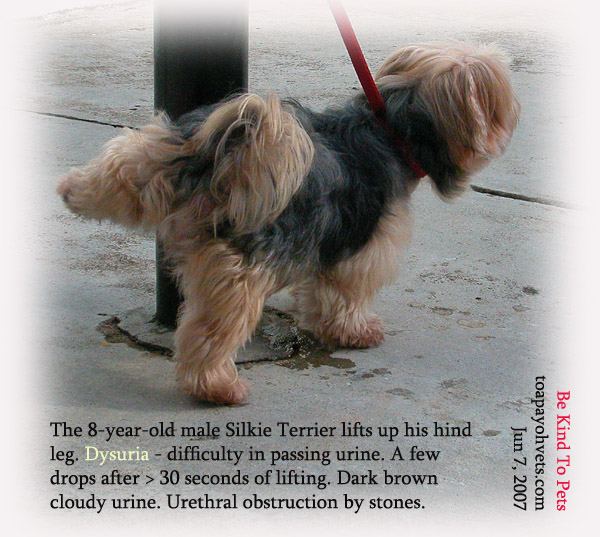
Difficulty in peeing, not able to pee and peeing urine with blood are the most common reasons for dog owners to seek veterinary advices at Toa Payoh Vets. Sometimes, the owner sees stones passed out in the urine.
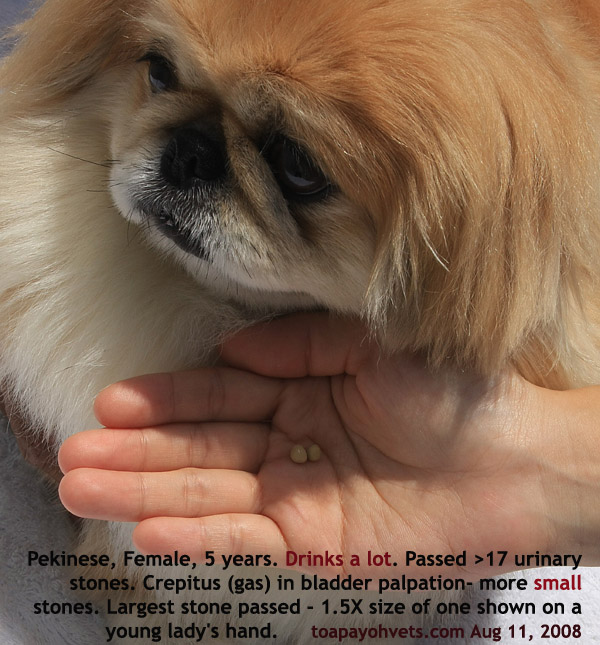
Urolithiasis in dogs is such a large topic of a few hundred pages as there are several types of bladder stones affecting the dog and their diagnosis and treatment vary. Therefore, only struvite urinary stones, being most commonly seen at Toa Payoh Vets will be discussed in this article.
Breeds usually affected include the Miniature Schnauzer, Shih Tzu, Bichon Frise, Miniature Poodle, Cocker Spaniel and Lhasa Apso, but any breed can be affected. Female dogs are said to form approximately 85% of bladder stone cases.
Some dogs may not show clinical signs of blood in the urine, difficulty in urination or inability to urinate until much later in the disease with severity of signs depending on the location, size,and number of uroliths formed. These stones can be formed anywhere along the urinary tract in the kidneys, the urethra and the bladder.
Struvite stones are composed primarily of Magnesium, Ammonium and Phosphate (MAP). They are formed within the urinary tract and occur when the urine is supersaturated with MAP (i.e. large quantities of the crystals are present). MAP supersaturation of urine may be associated with several factors, including urinary tract infections, alkalineurine, genetic predisposition and diet.
Your vet will take a comprehensive history to determine the commencement and the severity of the disease. Physical examination include bladder palpation to feel the crepitus (sounds of gas and stones rubbing against each other) inside the bladder or the solid stones if they are large.
However, a complete blockage of the urinary tract is life-threatening as the dog can't pee and the full bladder may rupture with delays in treatment. In such cases, a urinary catheter will be used to unblock the obstruction or the urine is extracted via the bladder as soon as possible. This is done to protect the bladder and kidney from further damage.
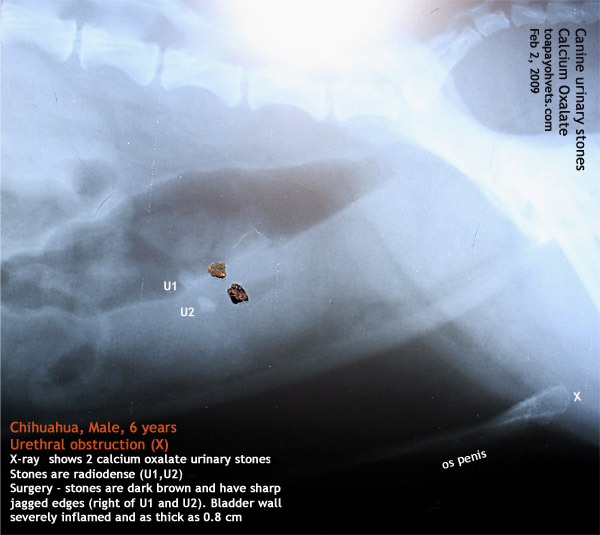
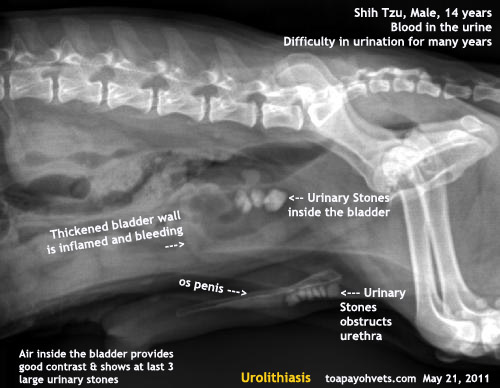 X-ray of a dog that cannot pee (left). If the dog cannot pee, the likely cause is urethral obstruction caused by urinary stones being stuck inside the urethra.
Blood screening, urine analysis and radiographs are usually performed to confirm the presence of urinary stones. Abnormal blood work may show if the obstruction of the urinary tract is severe. Blood tests may show changes to the kidney function or an increase in white blood cell counts affecting the health of the dog.
Urine analysis is the most useful and should always be done. A sterile sample is taken either via catherisation (passing a tube into the bladder) or cystocentesis (straight from the bladder). With the urine sample analysed, MAP crystals can be present but this is not always the case. For example, stones that are too well formed or too large may not shed crystals. Therefore, the vet should not deem the absence of crystals in the urine as no struvite or urinary stones being present in the affected dog.
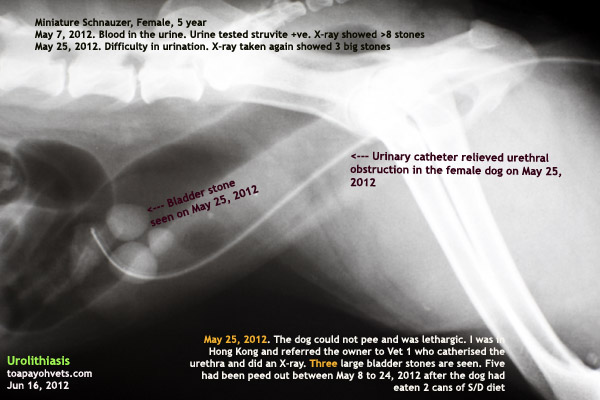 X-ray of a catheter to push back the stones into the bladder in a female dog that could not pee at all as the stone was stuck inside the urethra
In addition, urine pH gives the vet a good idea of the nature of the stone. Struvite crystals are formed very commonly in an alkaline environment in which bacteria is present. A urine sample can show the presence of bacteria. The bacteria be cultured to know the type of bacteria causing the infection and antibiotic sensitivity tests can be performed by the laboratory to advise on the appropriate antibiotics to be prescribed.
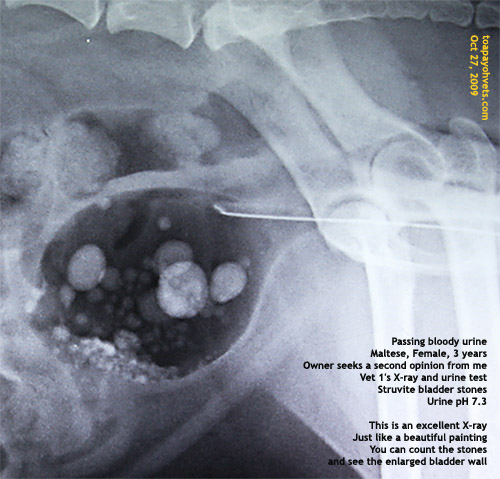 Struvite uroliths are radio-dense and can be detected on radiographs.
 However, they need to be of a certain size before they are evident. The number and size of urinary stones seen in the X-ray may not correlate with the severity of clinical signs.
However, a radiograph is highly recommended for the vet to know the number and size of stones and where they are located prior to surgical removal, if surgery is to be advised.
Clients need to understand that in spite of all the tests above, the composition of the actual stone cannot be determined unless a stone sample (from the surgery or that has been urinated out) is sent to the laboratory for analysis.
Treatment options for struvite bladder stones revolve around surgery or medical dissolution of the stones.
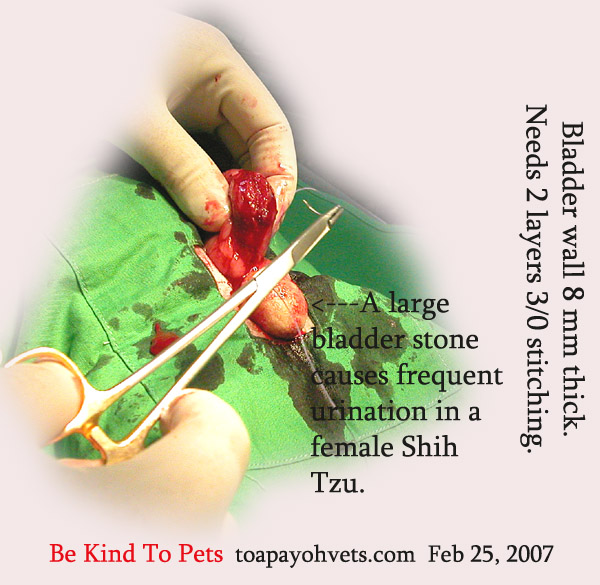
Benefits of surgery include faster recovery times, and the ability to identify the actual type of stone involved. Surgery is indicated if the stones are too large or too well formed as they may not dissolve medically. Disadvantages of surgery are that it is more invasive and there are risks associated with general anesthesia in a sick and/or older dog.
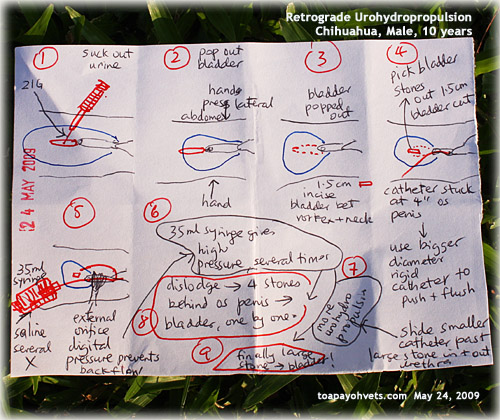
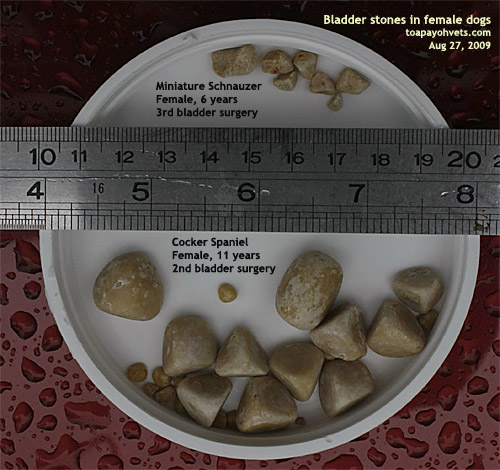
For clients that are not so comfortable with surgery or in cases where surgery is not advised due to health concerns (e.g. the dog is very old and in poor health), the alternative is medical dissolution. This medical solution is non-invasive but takes a much longer time to show the effect as the stones are dissolved slowly. However, large stones may not dissolve at all. One important note to take into consideration is that there is no way to accurately determine the nature of the stone without sending it for laboratory analysis. Obviously, the medical solution is not applicable to all types of urinary stones (e.g. calcium oxalate stones), but it is especially effective and useful in struvite stone dissolution.
Medical dissolution revolves around 3 main concepts. They are to acidify the urine, to reduce the intake of MAP such that it does not saturate in the urine and to dilute the urine so crystals do not have a chance to form. For struvite uroliths, there are specially formulated diets such as the Canine S/D, C/D or W/D that I have used to dissolve the stones.
Medical dissolution of stones takes a mean time of 3 months. The time taken for complete dissolution is varied depending onthe size of the uroliths and the quantity. Severe cases can take up to 6 months before the stones are fully dissolved. However, very large stones will not dissolve.
Along with this diet change, I prescribe an appropriate antibiotic course to treat any primary or secondary bacterial infection. During treatment, only the prescription diet should be used. I usually advise no dog treats or other food and to encourage the dog to drink water.
The S/D diet is used initially for 1-6 months before switching over to the C/D or W/D diet. It is not recommended for:
1. Use concurrently with urinary acidifiers
2. Feeding longer than 6 months
3. Dogs with non-struvite uroliths (urinary stones).
Transition to feeding S/D should be done over a period of seven days, gradually introducing the amounts during the transition period and monitoring the patient. Most dogs will not eat the S/D diet immediately and so the owner must be educated to switch to the S/D diet gradually over at least 7 days.
After successful dissolution of struvite stones confirmed by urine analysis and X-rays, Canine C/D or W/D can be used for maintenance. Canine S/D should not be used for the prevention of bladder stones as the diet is low in MAP and protein. Long term use of this diet is not recommended as the nutrients are not be sufficient.
Key benefits of Canine S/D include:
· Low levels of MAP to aid in dissolution of struvite uroliths and crystals.
· Promotion of acid urine by reducing the urinary pH to 5.9-6.1 (targeted) to increase the solubility of struvite crystals.
· Lower protein levels result in increased urine volume and more dilute urine.
· Antioxidants are added to defend cells from free radicals and to promote a healthy immune system.
In this article, I have written about the S/D, C/D and W/D prescription diets for the medical treatment of struvite urinary stones as I have used them in my practice. However, there are other equivalent prescription diets from other manufacturers and it is up to your vet to advise you as to the type of prescription diet to use or to get bladder surgery done to resolve the problem fast.
Many Singapore dog owners do not adopt my advices to review the cases 1-3 monthly and do urine tests and X-rays to ensure that no new stones are formed after surgical removal of the stones or after using the S/D diet. They are happy to see that the dog has not passed blood in the urine and does not have difficulty in urination and continue with feeding the usual dry dog food again.
In some cases, the problem recurs and it can be heart-breaking and costly if another surgery is required. So some owners elect to euthanase the dog. Regular urine tests would have been most useful in detecting the presence of struvite stones although the absence of struvite crystals in the urine does not mean that there are no stones present. Only X-rays will be able to tell. Sometimes, a dog that has had struvite stones may become later affected with another type of stone such as calcium oxalate stones and that is why regular urine tests are so important.
In conclusion, be alert as to the urination pattern of your older dog and seek veterinary advice promptly if there are signs of discoloured urine, urinary difficulty or inability to pee.
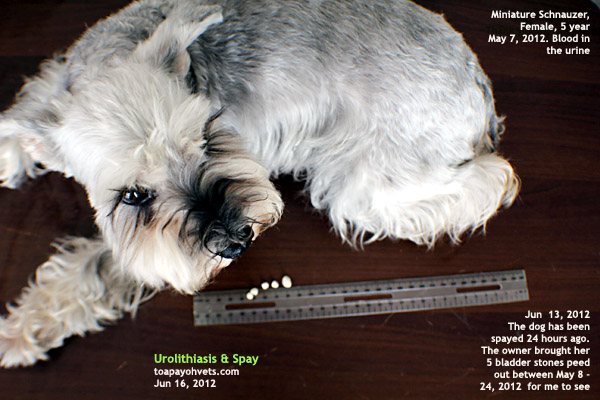
Image of a female dog that has peed out urinary stones
For more detailed case studies of urinary stone cases seen at Toa Payoh Vets, goto:
http://www.bekindtopets.com/animals/20081201PG7_Dog_Surgery_Anaesthesia_Urinary_Tract_Problems_ToaPayohVets.htm
Acknowledgement: I thank Dr Daniel Sing for his contribution to this article and various dog owners for permitting me to record their cases in this article
Sunday, July 29, 2012
Sunday 29 Jul 2012 afternoon cases
1. Dog with dead grey skin below throat of 20 cent area. Some pain. Could it be due to penetration by hard dog bone treats? Few days only. The owner was flying and would be back tomorrow. Large area of cellulitis. conservative treatment. IV drip first and blood test.
2. Owner phoned wanting to de-mat the cat under sedation. A man here told him that there are 2 types of sedation. One without recovery and one with recovery. The former type is safer. I was surprised. "Much depends on the cat's health like heart, liver and kidney problems," I said. If the cat is not healthy, both types may kill the cat.
3. Beagle, 13 years old follow up on high liver enzymes by Dr Vanessa. Had vomiting and diarrhoea last visit. I insisted on IV drip with medication and to bring the dog home with the drip as the young lady did not want hospitalisation. IV drip gives direct effect. The dog recovered the next 2 days. "Just giving an injection and some medication to give at home will not work," i said to the father. "The intestines are not well and so there wil be more bloody diarhoea overnight and unhappy owner having to clean up the mess." As to the request for liver supplementation, I educated the young lady to take another blood test to check the status of the liver health rather than getting supplements. "For all you know, the liver was damaged due to an infectious organism at that time and has now recovered. The monocytes were 36% last time while the normal should be around <5%. So there was a chronic infection somewhere. The blood test showed "degenerative changes in the blood cells" too indicating something toxic at that time. A blood test was agreed upon by her father.
4. "Thank you for your help," the woman with red eyes said to me after her 18-year-old shih tzu was euthanased as I had interrupted Dr Vanessa to treat her case first as an emergency of a suffering crying old dog. "I wonder whether I should have her anal tumour removed when it was very small." Earlier she had wanted a house-call to euthanase the dog but we could not spare a vet to do it on a busy Sunday.
"When was that?" I asked.
"2 years ago."
"Did you neuter the dog as the male hormones encourage the growth of this circum-anal tumour?" I asked.
"No," she said. "The tumour just exploded and grew large only in the last few weeks."
"The other vets would not advise operation as the dog was very old and high anaesthetic risk," I explained. "This dog has a long life."
"My female dog has been spayed and is 18 years old and alive. I didn't neuter the male."
I checked the recent blood test results:
Only significant changes were in the differential blood count with N=83% (60-70) and L = 8% (12-30) and M=1% (3-10). But total WBC was normal at 8.8 (6-17).
In conclusion, it is still best to neuter your dog and to get small anal tumours in male dogs removed by your vet when it is very small, even if the dog is "old".
2. Owner phoned wanting to de-mat the cat under sedation. A man here told him that there are 2 types of sedation. One without recovery and one with recovery. The former type is safer. I was surprised. "Much depends on the cat's health like heart, liver and kidney problems," I said. If the cat is not healthy, both types may kill the cat.
3. Beagle, 13 years old follow up on high liver enzymes by Dr Vanessa. Had vomiting and diarrhoea last visit. I insisted on IV drip with medication and to bring the dog home with the drip as the young lady did not want hospitalisation. IV drip gives direct effect. The dog recovered the next 2 days. "Just giving an injection and some medication to give at home will not work," i said to the father. "The intestines are not well and so there wil be more bloody diarhoea overnight and unhappy owner having to clean up the mess." As to the request for liver supplementation, I educated the young lady to take another blood test to check the status of the liver health rather than getting supplements. "For all you know, the liver was damaged due to an infectious organism at that time and has now recovered. The monocytes were 36% last time while the normal should be around <5%. So there was a chronic infection somewhere. The blood test showed "degenerative changes in the blood cells" too indicating something toxic at that time. A blood test was agreed upon by her father.
4. "Thank you for your help," the woman with red eyes said to me after her 18-year-old shih tzu was euthanased as I had interrupted Dr Vanessa to treat her case first as an emergency of a suffering crying old dog. "I wonder whether I should have her anal tumour removed when it was very small." Earlier she had wanted a house-call to euthanase the dog but we could not spare a vet to do it on a busy Sunday.
"When was that?" I asked.
"2 years ago."
"Did you neuter the dog as the male hormones encourage the growth of this circum-anal tumour?" I asked.
"No," she said. "The tumour just exploded and grew large only in the last few weeks."
"The other vets would not advise operation as the dog was very old and high anaesthetic risk," I explained. "This dog has a long life."
"My female dog has been spayed and is 18 years old and alive. I didn't neuter the male."
I checked the recent blood test results:
Only significant changes were in the differential blood count with N=83% (60-70) and L = 8% (12-30) and M=1% (3-10). But total WBC was normal at 8.8 (6-17).
In conclusion, it is still best to neuter your dog and to get small anal tumours in male dogs removed by your vet when it is very small, even if the dog is "old".
Jul 29, 2012 Sunday's interesting cases
July 29, 2012
Arrived at 8.30 am. Bright sunshine Sunday.
1. Poodle spay came in at 10 am. I told the owners that they could pick up the dog at 12 noon.
I prepared D+K, for this 3.5 kg dog.
D+K at 50% IV sufficient to intubate when done at the 4th minute after injection. Dr Daniel to spay.
2. Lady intern from stat board wanted to do internship as she wanted to become a vet. Had an Arts degree, AVA does not give vet scholarship to older graduates and the cost was prohibitive. "Be proactive and positive," I said. "Nobody can predict the future.
3. A Tampenis client of Dr Vanessa came to get some medicine and cream for his dog treated successfully for skin disease in Nov 2011. He wanted the tablets and the cream. When I advised that we don't sell tablets, he was furious as he could "buy from other vet clinics." So, he left in his taxi.
4. Dr Vanessa's 3 clients came in a bunch. So it is barking dogs. As it is a personalised service, her clients must wait. We have other vets but they want her.
5. You treated my Schnauzer with bloodied ears and pus flung onto Mr Saw last time," the lady selling rabbit health products said to me. "So I come back as the ears are giving me problems again." That was 3 days ago. I warded the 12-year old dog for ear irrigation and dental work. This morning I checked the oily ears. Much better. Took some pic. Will write up this case later.
Arrived at 8.30 am. Bright sunshine Sunday.
1. Poodle spay came in at 10 am. I told the owners that they could pick up the dog at 12 noon.
I prepared D+K, for this 3.5 kg dog.
D+K at 50% IV sufficient to intubate when done at the 4th minute after injection. Dr Daniel to spay.
2. Lady intern from stat board wanted to do internship as she wanted to become a vet. Had an Arts degree, AVA does not give vet scholarship to older graduates and the cost was prohibitive. "Be proactive and positive," I said. "Nobody can predict the future.
3. A Tampenis client of Dr Vanessa came to get some medicine and cream for his dog treated successfully for skin disease in Nov 2011. He wanted the tablets and the cream. When I advised that we don't sell tablets, he was furious as he could "buy from other vet clinics." So, he left in his taxi.
4. Dr Vanessa's 3 clients came in a bunch. So it is barking dogs. As it is a personalised service, her clients must wait. We have other vets but they want her.
5. You treated my Schnauzer with bloodied ears and pus flung onto Mr Saw last time," the lady selling rabbit health products said to me. "So I come back as the ears are giving me problems again." That was 3 days ago. I warded the 12-year old dog for ear irrigation and dental work. This morning I checked the oily ears. Much better. Took some pic. Will write up this case later.
Jul 29, 2012 Sunday's interesting cases
July 29, 2012
Arrived at 8.30 am. Bright sunshine Sunday.
1. Poodle spay came in at 10 am. I told the owners that they could pick up the dog at 12 noon.
I prepared D+K, for this 3.5 kg dog.
D+K at 50% IV sufficient to intubate when done at the 4th minute after injection. Dr Daniel to spay.
2. Lady intern from stat board wanted to do internship as she wanted to become a vet. Had an Arts degree, AVA does not give vet scholarship to older graduates and the cost was prohibitive. "Be proactive and positive," I said. "Nobody can predict the future.
3. A Tampenis client of Dr Vanessa came to get some medicine and cream for his dog treated successfully for skin disease in Nov 2011. He wanted the tablets and the cream. When I advised that we don't sell tablets, he was furious as he could "buy from other vet clinics." So, he left in his taxi.
4. Dr Vanessa's 3 clients came in a bunch. So it is barking dogs. As it is a personalised service, her clients must wait. We have other vets but they want her.
5. You treated my Schnauzer with bloodied ears and pus flung onto Mr Saw last time," the lady selling rabbit health products said to me. "So I come back as the ears are giving me problems again." That was 3 days ago. I warded the 12-year old dog for ear irrigation and dental work. This morning I checked the oily ears. Much better. Took some pic
Arrived at 8.30 am. Bright sunshine Sunday.
1. Poodle spay came in at 10 am. I told the owners that they could pick up the dog at 12 noon.
I prepared D+K, for this 3.5 kg dog.
D+K at 50% IV sufficient to intubate when done at the 4th minute after injection. Dr Daniel to spay.
2. Lady intern from stat board wanted to do internship as she wanted to become a vet. Had an Arts degree, AVA does not give vet scholarship to older graduates and the cost was prohibitive. "Be proactive and positive," I said. "Nobody can predict the future.
3. A Tampenis client of Dr Vanessa came to get some medicine and cream for his dog treated successfully for skin disease in Nov 2011. He wanted the tablets and the cream. When I advised that we don't sell tablets, he was furious as he could "buy from other vet clinics." So, he left in his taxi.
4. Dr Vanessa's 3 clients came in a bunch. So it is barking dogs. As it is a personalised service, her clients must wait. We have other vets but they want her.
5. You treated my Schnauzer with bloodied ears and pus flung onto Mr Saw last time," the lady selling rabbit health products said to me. "So I come back as the ears are giving me problems again." That was 3 days ago. I warded the 12-year old dog for ear irrigation and dental work. This morning I checked the oily ears. Much better. Took some pic
Friday, July 27, 2012
1813. Two vets not punctual.
The lab with epulis waited for Dr Daniel and another poodle owner waited for Dr Vanessa as they did not turn up early. That is not a good practice to come late.
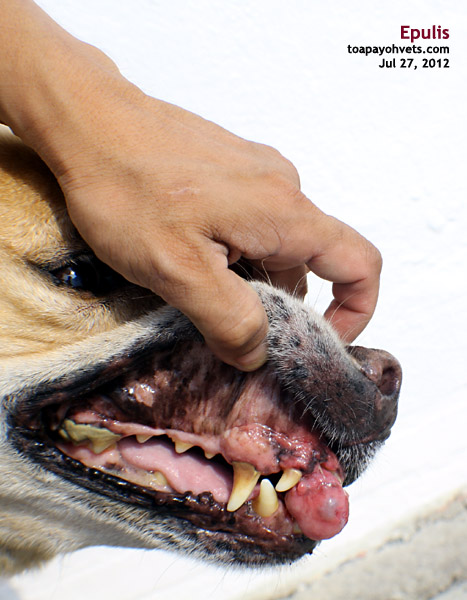
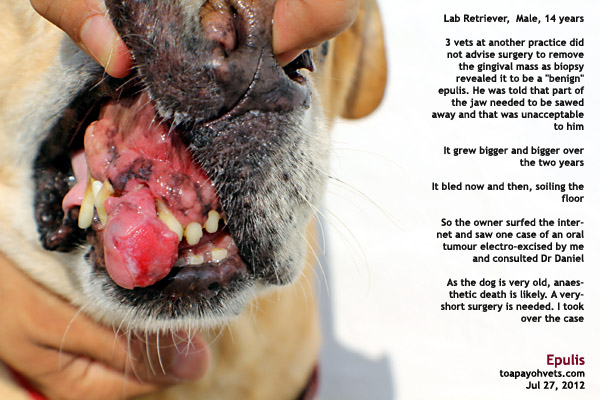
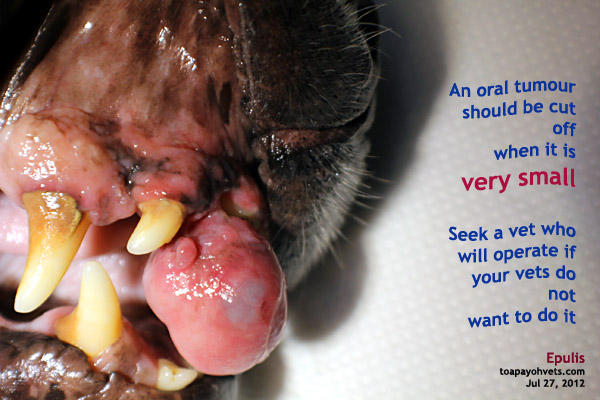
1812. Epulis - Vet 1 advised no need surgery, not malignant
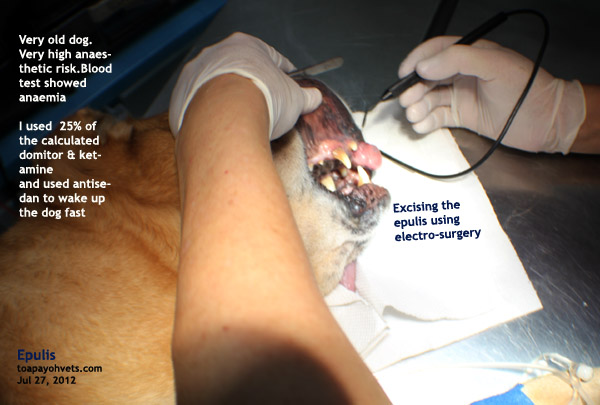
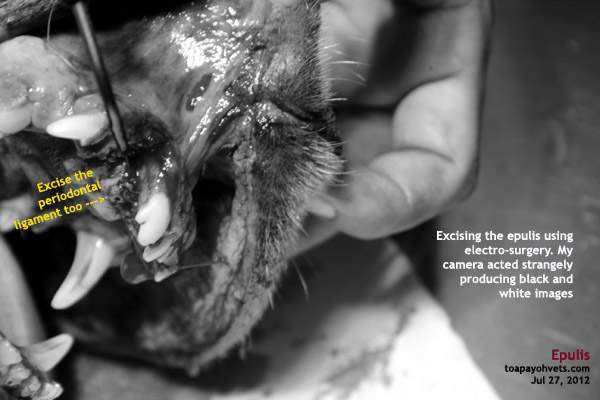
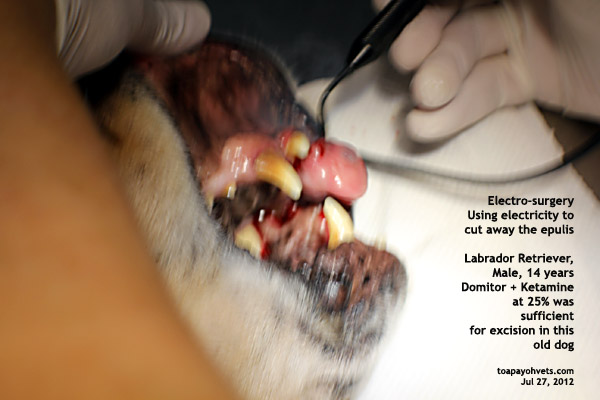
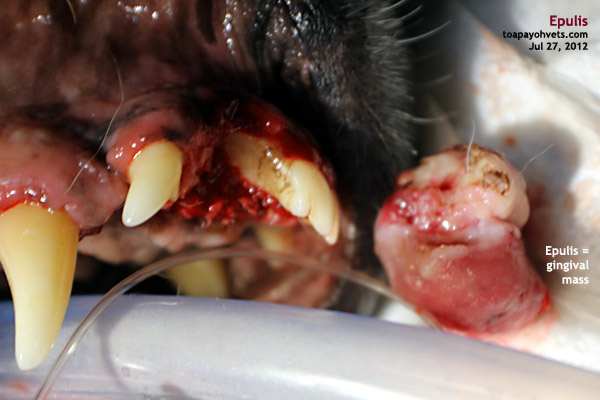
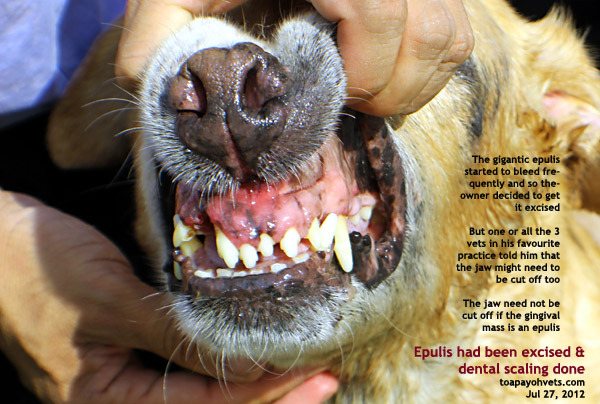
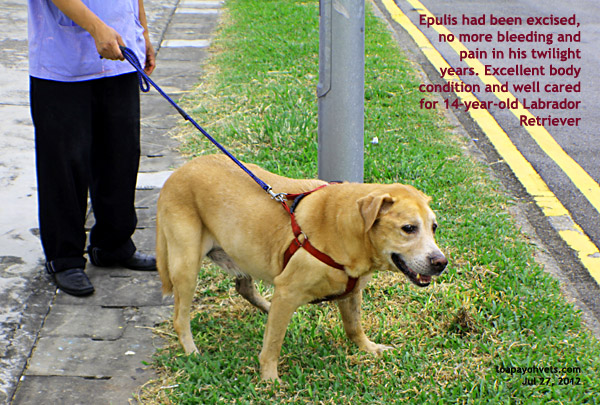
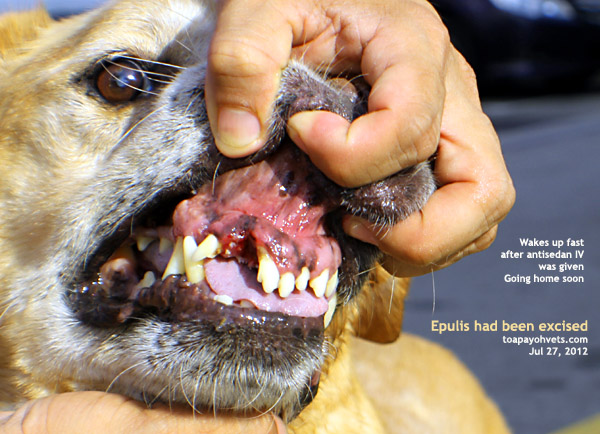
| Friday, July 27, 2012 Today, I left home at 7.19 am, missed the feeder bus and walked to the Yio Chu Kang subway as the next bus will be 9 min. A breezy bright morning with sunshine and blue skies. I reached Toa Payoh subway at 7.50 am and walked to Toa Payoh Vets reaching at 8.41 am. A slow walk for exercise. Quite breezy but still sweating at the end. A father and son came with a Labrador, Male, 12 years, bleeding from a large gum tumour. He had consulted "3 vets" but they did not advise surgical excision. According to Vet 1's medical report- biopsy of gingival mass which was a fibromatous epulis of periodontal origin. According to the owner, Vet 1 did not advise surgical excision as it was "generally benign". Neither did another 2 vets from the same practice. The lump grew and grew and started to bleed at times. He was bleeding spots of blood outside the surgery at 9.15 am when the owners came. I asked them to wait as Dr Daniel was not here yet. More bleeding. I decided to take over the surgical case as this is an old dog. Should be 14 years as he was stated 12 years in 2009 in Vet 1's record. Blood test by Dr Daniel showed normal results except slightly below the low range of RBC and PCV Domitor + Ketamine at 25% instead of 50% as the dog is really old. Electro-excision is OK at this dosage if not delayed. Needed some isoflurane gas. Also for dental scaling. Strong teeth. Implemented new anaesthetic recording system. Today I used my first Anaesthesia & surgery record No. 151. 27.7.12, Lab Retriever, Male, 12 years, 36.3 kg, 39.1C A *Inj Domitor (0.4 ml) +K (0.5ml) IV at 25% calculated dose 10.06 am B Isoflurane gas first given 10.18 am for dental scaling. Good teeth. C Isoflurane gas stopped 10.51 am. End of dental scaling D Electro-excision of epulis started 10.10 am E End of excision 10.18 am Antisedan IV to reverse domitor 11.02 am. Dog wakes up in 1 minute In 2009, Vet 1 said half the jaw had to be cut off, so the owner did not want surgery. Another of the 3 vets said that since the epulis was not cancerous as checked by biopsy, there was no need to remove it. But this epulis grew to twice the size and blood dripped from this tumour whenever it was injured, soiling the floor. He did some internet surfing and consulted Toa Payoh Vets' Dr Daniel as 2nd opinion. As the dog is old, I took over the case as I had more experience and could perform a shorter surgery, minimising risks of death on the op table. The likely reason that the other 3 vets didn't recommend surgery would be that the dog is old and they don't want to bear the high risk of anaesthetic death ruining their reputation. I took 8 minutes to excise the epulis 2x2x1.5 cm under Domitor and Ketamine at 25%. A vet must be quick and know what to do during surgery, as the analgesia would wear off 8 minutes after injection. The dog started to move around the 8th minute. The incisor tooth might be entombed but I did not think of slicing the epulis to check and gave it to the owner. The owner threw it away. Isoflurane and intubation were done for dental scaling. Solid teeth in general except for the tartar and plaque. The dog was given carrots and apples and had good food.
|
|||||||||||||||||

Subscribe to:
Comments (Atom)