Friday, July 6, 2012
1063. Medicine for stray dogs and cats in Cambodia
Hi, I'm Agnes. I was in Siem Reap, Cambodia recently, distributing stationery, clothes and food to the children.
I'll be visiting again from 27th July to 5th August. The purpose of this email is to enquire if you would be able to donate some much needed medicine to Katie, the only Western vet nurse in Siem Reap, she's rescuing and treating dogs and cats on a voluntary basis. I can link her up in the email if necessary, she's requesting the following:
Drontal worming preparation
It’s in tablets – for deworming cats
Over the counter
Nutrigel (vitamin paste/syrup)
It’s for dogs and cats
Over the counter
Calcium in the form of small bones
For dogs
Over the counter
Clavulanic acid/amoxicillin (clavulox) 50mg
It’s in tablets form. It’s an antibiotic for cats
On prescription? Over the counter?
Cephalexin 50-60mg
It’s also in tablets form, and also an antibiotic for cats
On prescription? Over the counter?
Hope to hear good news, thank you!
Regards
Agnes
E-MAIL REPLY FROM DR SING DATED JUL 6, 2012
I am Dr Sing from Toa Payoh Vets. We spoke today. There are generic drugs which can be used rather than branded ones as requested by Katie and are much less expensive when sourced from Thailand.
Pl ask the vet nurse to contact me by email and let me know more about her work with stray dogs and cats.

Wednesday, July 4, 2012
1062. Acute tick fever in a big white dog in Singapore
1062. Acute tick fever in a big white dog in Singapore
July 4, 2012
Wednesday
Deaths of pets are part of my veterinary work since I graduated in 1974. Yet, after almost 50 years in practice, I feel much sadness in the death of this beautiful snow-white big dog that died 4 hours after arrival in my Surgery yesterday, despite treatment and fluid therapy. She was middle-aged and quite plump, as cuddly as a miniature polar bear. Not a brown stain on her white coat. No skin disease unlike some others. I had taken a blood sample and did the tick-fever test for Babesia and Ehrlichia. The cause of death was babesiosis (identified as Babesia canis by blood smear), known as tick fever. The Ehrlichia test was negative. "Would she have lived if Vet 1 had diagnosed her with tick fever 8 days ago?" the lady in her 40s had been referred by her brother to consult me thinking that her dog had liver failure and no chance to live. I had told her that liver diseases are not a death sentence but it may be cured if the liver is infected. Vet 1 had given her many liver supplements and so she presumed her dog had liver disease. "It is hard to say whether your dog would have lived if she was diagnosed as having tick fever instead of liver disease 8 days ago," I replied. Babesiosis is a direct and an immune-mediated haemolytic anaemia. The immune response is said to be more lethal than the parasites (merozoites or piroplasm) inside the red blood cells. "Why didn't you consult Vet 1 if your dog is not well after 2 days of medication?" "Vet 1 did not tell me to do that," she replied. "He gave me 14 days of the green tablets (doxycycline 100 mg/tablet), to give two tablets two times a day and other medicine. But my dog stops eating and drinks little yesterday. She was unable to stand up. She vomited brown stuff and passed black stools and brown urine. So, my brother asked me to consult you." "The antibiotic you gave is ineffective against babesiosis," I said. "Your dog needed the anti-tick fever injection." "Why didn't Vet 1 diagnose tick fever?" she asked. "In his case sheet faxed to me, he did write 3 diseases. They are pyometra, tick fever and liver failure." "Why didn't he treat for tick fever?" she asked. "He has written that you did not want the tick fever test to be done. So, it is your decision." "Why didn't he tell me that I should do the tick fever test? Why did he ask me to take the antibiotics for 14 days first?" "He did advise you about the test and had written down in his case sheet that you did not want the test done," I said. "It is up to the owner to decide as the owner pays for the test." "Then why he did the blood test and the blood smear for? The ultrasound too." "He did the blood test to screen the health of your dog esp. the liver and kidney functions. Your dog had been sick for one week before you saw him. The total white cell count was high. The platelets, red blood cells and haemogloin were lower than normal. "But the values were not excessively high," the lady said to me. "So, there was not a big worry." I noted that Vet 1 had written "refractile inclusion bodies seen in the red blood cells." This seemed to give a clue that it was possible that the red blood cells had Babesia parasites. However, a blood smear with the stains would reveal the parasites. According to Dr Daniel, the blood smear under Gram stain showed lots of red blood cells with Babesia inside. But the owner had not wanted the "tick-vector test" and so the dog went home with liver medication, anti-abdominal fluid swelling (ultrasound had detected abundant fluid which was sucked out and examined by Vet 1) and vitamins. "My dog could hop into the car when I brought her to see Vet 1," the lady said. "Now she just lay on her chest and refused to stand up." "What is her normal sleeping position?" I asked. "Belly up, like people," she said. Eight days had passed. My blood test showed kidney failure, elevated liver enzymes, a very high total white cell count of 46 as compared to 20 when tested by Vet 1. The normal range is 5-17). The platelets were 26 as compared to 166 earlier (200 - 500). Red blood cells were much lower. "What are the purplish spots on her belly?" the owner asked me when she came to see the dog at 9 pm yesterday. The dog had passed away at around 7 pm. "Those are areas of skin bleeding as the platelets are very low," I said. "Your dog had difficulty breathing and vomited blood before she passed away peacefully." The dog first showed lethargy 15 days ago. The owner said that the dog had never gone downstairs and had never got any ticks for the past 6 years. Since this dog was so well groomed and never went downstairs, I could believe her that the dog had no exposure to ticks. "Did the dog go to the groomer?" I asked. "Yes, 2 months ago," she said. "I brought her to a new groomer. But she had no ticks on her body when she came back from the groomer." "Why didn't you go to the old groomer?" I asked. "He has stopped grooming since his groomer left." "It is a strange case as a dog must be bitten by an infected tick to get tick fever. Since you were so sure that your dog never had ticks, Vet 1 might have ruled out a high possibility of tick fever infection and went for liver failure diagnosis." CONCLUSION In many cases, owners do not want laboratory tests. However, the vet must be forceful in warning the owner of the fatal consequences of tick fever if the dog is not treated early. Refractile inclusion bodies in the red blood cells were the clue as blood parasites like Babesia can cause refractile inclusion bodies to be formed. It might be wise to treat as if the dog had tick fever rather than following the protocol of confirming tick fever, if economic reasons prevail. The interest of the dog is paramount and if the owner cannot afford the test, it may be advisable to strongly advise it being done. Did the vet phoned the owner 3 days after consultation? I believe he had done so and he had recorded in the case file. "He could have added this in after I asked for the medical report," the lady owner had a very difficult time getting the report to be released to me and therefore had her suspicions. 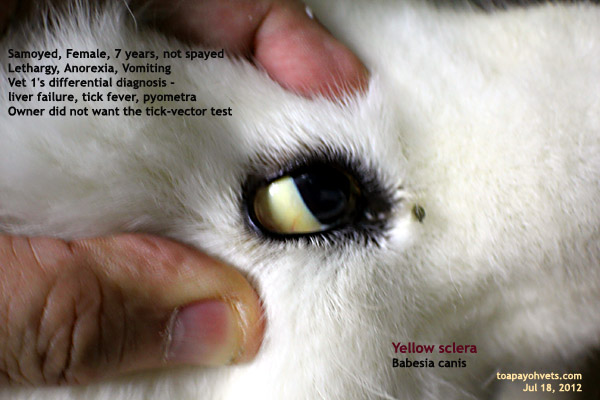 What
was the cause of death in this dog? Only an autopsy
would find the answer but the owner would not want
one. The dog was sent for cremation by her relative.
As to the possible cause of death, one experienced vet
said it was kidney failure rather than liver failure,
Dr Daniel told me. As for me, I would say that the
immune-mediated haemolytic anaemia reactions of
Babesia canis was the primary cause of the dog's quick
death rather than the destruction of the red blood
cells. Kidney and liver failures were the
consequences. What
was the cause of death in this dog? Only an autopsy
would find the answer but the owner would not want
one. The dog was sent for cremation by her relative.
As to the possible cause of death, one experienced vet
said it was kidney failure rather than liver failure,
Dr Daniel told me. As for me, I would say that the
immune-mediated haemolytic anaemia reactions of
Babesia canis was the primary cause of the dog's quick
death rather than the destruction of the red blood
cells. Kidney and liver failures were the
consequences. My hypothesis is that the reaction caused platelets to be extremely low and the dog would bleed internally to death. In the evening when the owner came, she pointed to several bruised like spots on the shaved abdomen where the first vet had done his "abdominal tap" to take out the peritoneal fluid. "These are bleeding spots caused by the tick fever parasite reactions," I said to the wife. The dog had coughed up some blood before dying. It was one of those unusual cases as the dog was said not to have been exposed to any ticks over the past years as she lived in the apartment and never went done for walks. If there was definitely no exposure to ticks, the first vet was distracted and went for liver failure diagnosis, disregarding the clue of the presence of refractile inclusion bodies in the red blood cells. Singapore pet owners are getting more sophisticated and demanding and therefore, evidence-based medicine and defensive medicine must be practised nowadays. All advices and client's objections to tests and advices must be recorded properly in the case file as a good habit. In this case, medical negligence would not stand in court, I believe, as the vet did advise an anti-tick vector test and the owner had been informed and had objected to it. The burden of proof is on the owner when negligence is alleged and the proof was not there in this case.
UPDATES & MORE IMAGES WILL BE AT:
http://www.sinpets.com/dogs/20120719Babesia_canis_samoyed_toapayohvets.htm |
Tuesday, July 3, 2012
1061. Solution to chronic ear problems in the dog: Toa Payoh Vets Video
July 2, 2012
I have commissioned an educational video on the surgery of the lateral ear canal done at Toa Payoh Vets. This video provides some information for dog owners whose dogs keep scratching and is very smelly for many years. The surgery resolves this problem and is shown in the video at:
http://www.youtube.com/watch?v=ycYKJbB4dYM&feature=youtu.be
The surgery is called Lateral ear canal resection.
For more info
judy@toapayohvets.com
+65 9668 6468
www.toapayohvets.com
I have commissioned an educational video on the surgery of the lateral ear canal done at Toa Payoh Vets. This video provides some information for dog owners whose dogs keep scratching and is very smelly for many years. The surgery resolves this problem and is shown in the video at:
http://www.youtube.com/watch?v=ycYKJbB4dYM&feature=youtu.be
The surgery is called Lateral ear canal resection.
For more info
judy@toapayohvets.com
+65 9668 6468
www.toapayohvets.com
Sunday, July 1, 2012
Sunday Jul 1, 2012 interesting cases
Jul 1, 2012
1. Pekinese with right eye ulcer. Owners had run out of eye drops. Around 10 days since tarsorrhapy done by Dr Daniel.
Eyelid stitches removed. Dr Daniel used fluorescein eye stain. NO more staining indicating ulcer had healed. I took some images of pre- and post-injury corneal ulceration. I wil use this as a case study for video production. Excellent surgical outcome in this case. This was because the owner's mother knew how to care for this dog. The eyelids did not have any discharge or dirt on Day 12 when I saw him as contrasted to other dogs with similar problems and being cared for at home.
2. Foul-smelling "decomposed dog" case Shih Tzu had been warded here for 15 days. No more bad smell. Main problem is an intense ventral contact dermatitis. Dog just had to scratch belly -- traumatic injury and smells. Will follow up.
History. Shih Tzu, Male, Born Sep 2004.
Seen other vets in Dec 5, 2009, Apr 16 10, May 10, 10, Aug 6 10, Oct 31 10, Apr 5, 11, Jul 10 11.
Wanted to send dog to SPCA if I can't cure this "smell like dead dog" lower half of body. "The decomposed dog smell comes back 2nd day after bathing," the serious gentleman told me. "Not all skin diseases in the Shih Tzu are curable," I said to him. "Hospitalise the dog for a few days and let me observe him." The dog had a full coat with no hair loss. Some scales drop off from the lower belly and chest areas which were inflamed. I expressed the anal sacs.
They were filled with dark brown oil and very smelly. The flies appeared from nowhere and landed on this oil when I took the tissue with the oil for photography outside the Surgery. "Can't be the anal sac oil causing this smell," the owner disagreed with my findings and the fact that the flies were so interested in this anal sac oil. Normally, flies don't come at all. My hypothesis was that the oil might have licked out and stained the dog with the smell of dead flesh. The owner was not convinced as he said the groomer and the other vets had expressed the glands. Well, I had the pictures of the flies but it was poinless to show him since he had discounted this as a cause.
I smelt the dog's body on Day 3 of hospitalisation with medication given and skin washes done. There was a faint oily smell but not the decomposed meat smell. "Not that smelly," I said to the owner. But I observed that the dog's lower body was very red. As if the dog had rubbed it or more likely scratched it vigorously. The inflamed neck and groin was seen on and off. So, this was the problem. My hypothesis is that the dog just could not help scratching the lower body, due to conditioned reflexes. He had been scratching it for months as it was a way to relieve the itchiness. Some anal oil would have contaminated this traumatised skin and made the skin much more itchy and infected. So, 2 days after bathing, the rancid dead flesh smell came back.
Altogether, I hospitalised the dog for 14 days. "How much it will cost me?" the owner asked. "Not much," I said. "Since there is no surgery done." After 14 days of medication and washing, I sent the dog home with instructions that he wear a shirt to protect his lower chest and groin. The owner did that and on July 9, 2012, I phoned him. He was very happy as the dog did not smell anymore. Before sending the dog home, I expressed the anal sac. Another lot of dark brown anal oil came out.
This dog was not sent to the SPCA now and should live a normal life much loved by this serious gentleman. Dogs with skin diseases are sent to the SPCA to be put to sleep usually. Skin diseases in Shih Tzus are more common than in other breeds, in my practice experience. It is possible that the busy and time-pressed Singapore owners don't have time to do the daily brushing and grooming. This leads to skin infections and continuous itchiness. Many of these skin disease cases need reviews and strict compliance with medication prescribed. But this owner said that his dog passed blood in the stools when the other vets prescribed oral medication and so he did not do it. He did see 7 vets in 7 times as the vet practice has different vets on duty at times he went.
UPDATE:
Yesterday, July 9, 2012, I phoned the owner to find out the fate of this Shih Tzu. He said: "No smell,"
"Did you buy the shirt for him to wear?" I asked. "Yes," he sounded quite happy. I hope this Shih Tzu's anal sacs don't produce more of the stinking oil again. I doubt the owner will come for review when there was no apparent skin problems!
1. Pekinese with right eye ulcer. Owners had run out of eye drops. Around 10 days since tarsorrhapy done by Dr Daniel.
Eyelid stitches removed. Dr Daniel used fluorescein eye stain. NO more staining indicating ulcer had healed. I took some images of pre- and post-injury corneal ulceration. I wil use this as a case study for video production. Excellent surgical outcome in this case. This was because the owner's mother knew how to care for this dog. The eyelids did not have any discharge or dirt on Day 12 when I saw him as contrasted to other dogs with similar problems and being cared for at home.
2. Foul-smelling "decomposed dog" case Shih Tzu had been warded here for 15 days. No more bad smell. Main problem is an intense ventral contact dermatitis. Dog just had to scratch belly -- traumatic injury and smells. Will follow up.
History. Shih Tzu, Male, Born Sep 2004.
Seen other vets in Dec 5, 2009, Apr 16 10, May 10, 10, Aug 6 10, Oct 31 10, Apr 5, 11, Jul 10 11.
Wanted to send dog to SPCA if I can't cure this "smell like dead dog" lower half of body. "The decomposed dog smell comes back 2nd day after bathing," the serious gentleman told me. "Not all skin diseases in the Shih Tzu are curable," I said to him. "Hospitalise the dog for a few days and let me observe him." The dog had a full coat with no hair loss. Some scales drop off from the lower belly and chest areas which were inflamed. I expressed the anal sacs.
They were filled with dark brown oil and very smelly. The flies appeared from nowhere and landed on this oil when I took the tissue with the oil for photography outside the Surgery. "Can't be the anal sac oil causing this smell," the owner disagreed with my findings and the fact that the flies were so interested in this anal sac oil. Normally, flies don't come at all. My hypothesis was that the oil might have licked out and stained the dog with the smell of dead flesh. The owner was not convinced as he said the groomer and the other vets had expressed the glands. Well, I had the pictures of the flies but it was poinless to show him since he had discounted this as a cause.
I smelt the dog's body on Day 3 of hospitalisation with medication given and skin washes done. There was a faint oily smell but not the decomposed meat smell. "Not that smelly," I said to the owner. But I observed that the dog's lower body was very red. As if the dog had rubbed it or more likely scratched it vigorously. The inflamed neck and groin was seen on and off. So, this was the problem. My hypothesis is that the dog just could not help scratching the lower body, due to conditioned reflexes. He had been scratching it for months as it was a way to relieve the itchiness. Some anal oil would have contaminated this traumatised skin and made the skin much more itchy and infected. So, 2 days after bathing, the rancid dead flesh smell came back.
Altogether, I hospitalised the dog for 14 days. "How much it will cost me?" the owner asked. "Not much," I said. "Since there is no surgery done." After 14 days of medication and washing, I sent the dog home with instructions that he wear a shirt to protect his lower chest and groin. The owner did that and on July 9, 2012, I phoned him. He was very happy as the dog did not smell anymore. Before sending the dog home, I expressed the anal sac. Another lot of dark brown anal oil came out.
This dog was not sent to the SPCA now and should live a normal life much loved by this serious gentleman. Dogs with skin diseases are sent to the SPCA to be put to sleep usually. Skin diseases in Shih Tzus are more common than in other breeds, in my practice experience. It is possible that the busy and time-pressed Singapore owners don't have time to do the daily brushing and grooming. This leads to skin infections and continuous itchiness. Many of these skin disease cases need reviews and strict compliance with medication prescribed. But this owner said that his dog passed blood in the stools when the other vets prescribed oral medication and so he did not do it. He did see 7 vets in 7 times as the vet practice has different vets on duty at times he went.
UPDATE:
Yesterday, July 9, 2012, I phoned the owner to find out the fate of this Shih Tzu. He said: "No smell,"
"Did you buy the shirt for him to wear?" I asked. "Yes," he sounded quite happy. I hope this Shih Tzu's anal sacs don't produce more of the stinking oil again. I doubt the owner will come for review when there was no apparent skin problems!
1059. Carnaissal tooth abscess, bone cyst or tumour?
I am reviewing the following case at Toa Payoh Vets on Sunday Jul 1, 2012 at 9.11 am as this time is peaceful, being located aways from lots of residents.

The 12-year-old Golden Retriever had a big hard lump on the right face, below the eye, in the position of a carnaissal tooth abscess fistula. At first sight, I diagnosed a carnaissal tooth abscess as this is the most common location and problem in older dogs that do not have any dental work done in 12 years! Dr Daniel said it could be a bone cyst or tumour.
As the owner did not want any X-ray to be done, Dr Daniel extracted the right maxillary 4th premolar.
I noted that the roots are shrivelled and blackened but I was not present during the dental work. According to Dr Daniel, this would not be a carnaissal tooth abscess. "I have seen two cases of bone cysts in Australia" he was doing internship then.
"Did you see the bone cyst in a similar location, below the eye?" I clarified with him later.
"Not in this location but bone cyst can occur in anywhere as a hard swelling from the bone. Bone cyst is a differential diagnosis."
"I have seen none in my past 30 years of practice," I said.
99% of my cases are small breeds as over 80% of Singaporeans live in apartments and so Golden Retrievers are uncommon patients and so I have not seen one with carnaissal tooth abscess in this breed.
So, is this a case of a carnaissal tooth abscess or not? The owner did not want histopathology or biopsy but agreed to X-rays after the tooth extraction. I have cropped the X-rays to focus on the relevant areas and to scrutinise them. What do you think?


X-ray after extraction of the maxillary PM4 showed a large dense globular lump (Y). It is hard to say whether it is a bone cyst, bone tumour or encapsulated abscess of the root of the carnaissal tooth.
MY HYPOTHESIS
Due to its unique location, I would say this hard lump is associated with the carnaissal tooth infection going on for many years. This dog did not have dental work for the last 12 years and the tooth root had rotted away sending bacteria into this area, infecting the bone. The reaction is a hard lump which the owner noticed recently. The dog was still "eating" and the owner consulted us for the lump.
FOLLOW UP
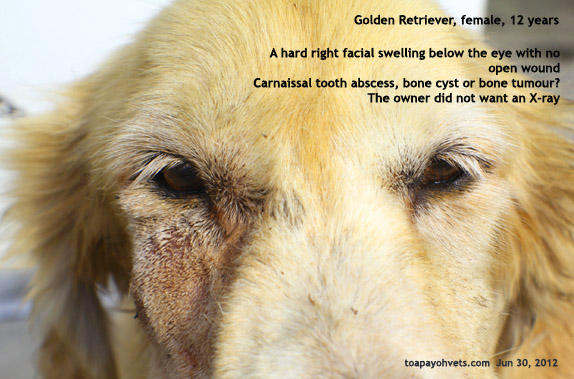
The 12-year-old Golden Retriever had a big hard lump on the right face, below the eye, in the position of a carnaissal tooth abscess fistula. At first sight, I diagnosed a carnaissal tooth abscess as this is the most common location and problem in older dogs that do not have any dental work done in 12 years! Dr Daniel said it could be a bone cyst or tumour.
As the owner did not want any X-ray to be done, Dr Daniel extracted the right maxillary 4th premolar.
I noted that the roots are shrivelled and blackened but I was not present during the dental work. According to Dr Daniel, this would not be a carnaissal tooth abscess. "I have seen two cases of bone cysts in Australia" he was doing internship then.
"Did you see the bone cyst in a similar location, below the eye?" I clarified with him later.
"Not in this location but bone cyst can occur in anywhere as a hard swelling from the bone. Bone cyst is a differential diagnosis."
"I have seen none in my past 30 years of practice," I said.
99% of my cases are small breeds as over 80% of Singaporeans live in apartments and so Golden Retrievers are uncommon patients and so I have not seen one with carnaissal tooth abscess in this breed.
So, is this a case of a carnaissal tooth abscess or not? The owner did not want histopathology or biopsy but agreed to X-rays after the tooth extraction. I have cropped the X-rays to focus on the relevant areas and to scrutinise them. What do you think?
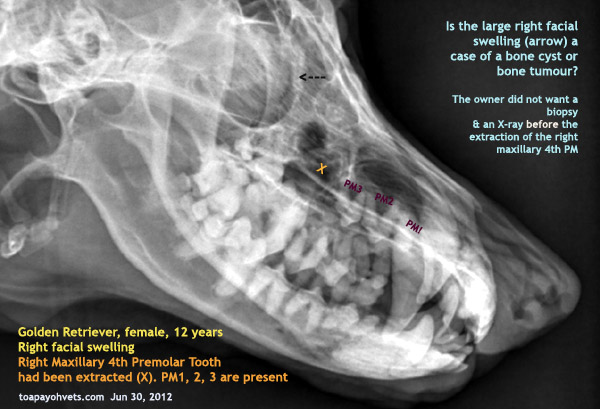
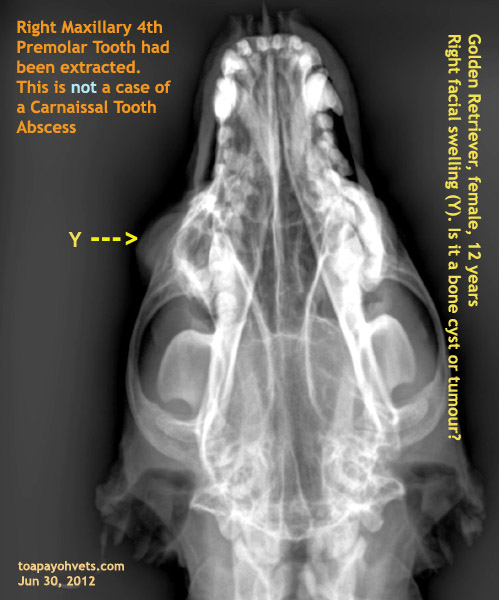
X-ray after extraction of the maxillary PM4 showed a large dense globular lump (Y). It is hard to say whether it is a bone cyst, bone tumour or encapsulated abscess of the root of the carnaissal tooth.
MY HYPOTHESIS
Due to its unique location, I would say this hard lump is associated with the carnaissal tooth infection going on for many years. This dog did not have dental work for the last 12 years and the tooth root had rotted away sending bacteria into this area, infecting the bone. The reaction is a hard lump which the owner noticed recently. The dog was still "eating" and the owner consulted us for the lump.
FOLLOW UP
1058. Medical negligence - failure to examine the baby's eyes
Sunday Jul 1, 2012
Blue skies, white clouds. I came to the Surgery at 8am and took some pictures of the yellow flowers and lime against the bright morning sun. My air-conditioning lady neighbour had planted them on the flower lots separating the car parking lots and cared for them well. I managed to take a picture of a butterfly and a solitary busy bee. There was a small bird with a yellow neck seen for a short while. Taking flower images with a working Sunday bee in bright morning sun make them look better.
MEDICAL NEGLIGENCE - FAILURE TO EXAMINE THE BABY'S EYES
Earlier, I read a Straits Time report about a 52-year-old paedectrician having to settle with a parent whose 12-year-old child's eyes (one blind and one in poor visual health) were not examined by him 12 years ago.
I always emphasized to Drs Vanessa and Daniel that certain procedures must be done and recorded. If the pet owner does not want the procedures, this must be written on the case file. Failing to perform certain procedures will lead to "medical negligence" litigation. They are to write "AMA" - procedures informed but not wanted to be done.
As each vet or doctor has his or her own sensibility and responsibility, it is up to the licensee to ensure that best practices are followed. For example, in a haematuria case, urine analysis is mandatory. No excuses. If the dog dies subsequently, a failure to get the urine analysed opens the vet to medical negligence litigation. As simple as that. It takes a lot of patience to ensure that the clinic is well managed so as to minimise litigation.
Blue skies, white clouds. I came to the Surgery at 8am and took some pictures of the yellow flowers and lime against the bright morning sun. My air-conditioning lady neighbour had planted them on the flower lots separating the car parking lots and cared for them well. I managed to take a picture of a butterfly and a solitary busy bee. There was a small bird with a yellow neck seen for a short while. Taking flower images with a working Sunday bee in bright morning sun make them look better.
MEDICAL NEGLIGENCE - FAILURE TO EXAMINE THE BABY'S EYES
Earlier, I read a Straits Time report about a 52-year-old paedectrician having to settle with a parent whose 12-year-old child's eyes (one blind and one in poor visual health) were not examined by him 12 years ago.
I always emphasized to Drs Vanessa and Daniel that certain procedures must be done and recorded. If the pet owner does not want the procedures, this must be written on the case file. Failing to perform certain procedures will lead to "medical negligence" litigation. They are to write "AMA" - procedures informed but not wanted to be done.
As each vet or doctor has his or her own sensibility and responsibility, it is up to the licensee to ensure that best practices are followed. For example, in a haematuria case, urine analysis is mandatory. No excuses. If the dog dies subsequently, a failure to get the urine analysed opens the vet to medical negligence litigation. As simple as that. It takes a lot of patience to ensure that the clinic is well managed so as to minimise litigation.
Thursday, June 28, 2012
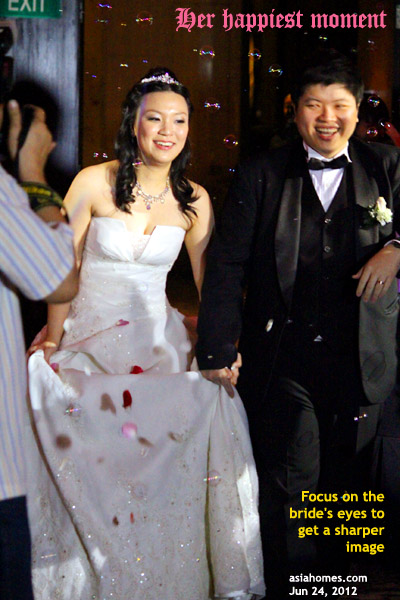
1057. How to succeed in the wedding photography business
Jun 28, 2012
National Library Board
Professional Photographer www.professionalphotographer.co.uk Feb 2012
THE BUSINESS - New Series - "What recession..." Kevin Mullins Pg 73
His plan was to double the bookings year on year to a comfortable level.
In his first professional year in 2009, he shot 15 weddings. In 2010, 33 and in 2011 doubled again to 58 weddings. In 2009, the standard wedding rate was 800 pounds. In 2011, over 2000 pounds. Success affected his personal and social life.
Success factors:
1. USE STATISTICS TO YOUR ADVANTAGE
Every enquiry made in a preadsheet and keep track of enquiries even for dates he is not available.
Can see whether the referral came from (website, oral etc), the venue, date of wedding and importantly the date of enquiry.
*From statistics, he checked his business practices e.g. venues, busiest periods for enquiries is in Jan and Feb. 2nd spike inend of summer. Plan for 2011.
*statistics gave him a profit per hour per wedding. assess whether worth sacrificing 6 days a week and lot of his social and personal life.
*do not really want to increase his fees a lot. Decided to spend less time to make the same amount of money per wedding.
Three moves that changed his business for the better:
1. Move to a time-based fee
2. No more pre-wedding shots (taking up lots of evenings and Sundays) for wedding packages.
3. Reduce the amount of editing per wedding
2. TRIM YOUR SERVICES*His brand is a photojournalistic wedding photographic style, so it does not lend to pre-wedding shots (which is stationary, like taking pictures in Taiwan).
*if do pre-wedding shots, should charge for time spent in the package prices and do it at times suitable to his business and his family.
*reduce number of imagaes from 400to 200 to clients. So he saved many hours a week time in editing output
*got new tools in his workflow e.g. Photo Mechanic - another article.
3. CHARGE FOR OVERTIME WORK
*He noted that he rarely leave a wedding on time. He usually worked on a "bridal prep" to "first dance" basis. (Singapore does not usually have "first dance"). He found that in 2010 he spent 60 hours after the "first dance" unpaid.
*now he charges overtime (like caterers, DJ, drivers etc)

4. KNOW YOUR CAPACITY LIMIT
*58 weddings are too much to shoot and edit as he has no personal life. In 2012, he capped bookings at 30 in his diary.
5. USE FORUMS AND SUPPORT GROUPS FOR TRAINING
*The SWPP is great for mentoring, support and access to great photographers
*frequently use a photography forum called IPPN (www.ippn.co.uk) - very helpful.
*learning all the time as idustry is tough. He knows that he must be on top of the business side of things to be successful.
Conclusion. Keep track of your business through metrics and accounting (including workflow and marketing), a lot of hard work and beautiful photography, have a faithful and honest work ethic, business will grow.
www.kevinmullinsphotography.co.uk
www.twitter.com/kevin_mullins
The above factors apply to the business of veterinary practices too esp. using metrics and proper accounting, hard work and do beautiful surgery (good surgical outcomes, no infections).
Today, I read that a "bogus vet" in Singapore was to be fined $42,000 for doing stray cat sterilisations in her Bishan apartment. She was a veterinary nurse working for a veterinary clinic. The Cat Welfare Society alerted the clinic that they had received invoices with two different types of clinic stamps. She gave $5.00 commission to the transport man for every cat brought to her and was using the clinic's invoices.
National Library Board
Professional Photographer www.professionalphotographer.co.uk Feb 2012
THE BUSINESS - New Series - "What recession..." Kevin Mullins Pg 73
His plan was to double the bookings year on year to a comfortable level.
In his first professional year in 2009, he shot 15 weddings. In 2010, 33 and in 2011 doubled again to 58 weddings. In 2009, the standard wedding rate was 800 pounds. In 2011, over 2000 pounds. Success affected his personal and social life.
Success factors:
1. USE STATISTICS TO YOUR ADVANTAGE
Every enquiry made in a preadsheet and keep track of enquiries even for dates he is not available.
Can see whether the referral came from (website, oral etc), the venue, date of wedding and importantly the date of enquiry.
*From statistics, he checked his business practices e.g. venues, busiest periods for enquiries is in Jan and Feb. 2nd spike inend of summer. Plan for 2011.
*statistics gave him a profit per hour per wedding. assess whether worth sacrificing 6 days a week and lot of his social and personal life.
*do not really want to increase his fees a lot. Decided to spend less time to make the same amount of money per wedding.
Three moves that changed his business for the better:
1. Move to a time-based fee
2. No more pre-wedding shots (taking up lots of evenings and Sundays) for wedding packages.
3. Reduce the amount of editing per wedding
2. TRIM YOUR SERVICES*His brand is a photojournalistic wedding photographic style, so it does not lend to pre-wedding shots (which is stationary, like taking pictures in Taiwan).
*if do pre-wedding shots, should charge for time spent in the package prices and do it at times suitable to his business and his family.
*reduce number of imagaes from 400to 200 to clients. So he saved many hours a week time in editing output
*got new tools in his workflow e.g. Photo Mechanic - another article.
3. CHARGE FOR OVERTIME WORK
*He noted that he rarely leave a wedding on time. He usually worked on a "bridal prep" to "first dance" basis. (Singapore does not usually have "first dance"). He found that in 2010 he spent 60 hours after the "first dance" unpaid.
*now he charges overtime (like caterers, DJ, drivers etc)
4. KNOW YOUR CAPACITY LIMIT
*58 weddings are too much to shoot and edit as he has no personal life. In 2012, he capped bookings at 30 in his diary.
5. USE FORUMS AND SUPPORT GROUPS FOR TRAINING
*The SWPP is great for mentoring, support and access to great photographers
*frequently use a photography forum called IPPN (www.ippn.co.uk) - very helpful.
*learning all the time as idustry is tough. He knows that he must be on top of the business side of things to be successful.
Conclusion. Keep track of your business through metrics and accounting (including workflow and marketing), a lot of hard work and beautiful photography, have a faithful and honest work ethic, business will grow.
www.kevinmullinsphotography.co.uk
www.twitter.com/kevin_mullins
The above factors apply to the business of veterinary practices too esp. using metrics and proper accounting, hard work and do beautiful surgery (good surgical outcomes, no infections).
Today, I read that a "bogus vet" in Singapore was to be fined $42,000 for doing stray cat sterilisations in her Bishan apartment. She was a veterinary nurse working for a veterinary clinic. The Cat Welfare Society alerted the clinic that they had received invoices with two different types of clinic stamps. She gave $5.00 commission to the transport man for every cat brought to her and was using the clinic's invoices.
1056. KPI and follow-up: Open Pyometra chihuahua
On Jun 15, 2012, the breeder's Chihuahua that had been adopted by a couple was spayed after 24 hours of IV drip and antibiotics.
12 days later, the owner complained about some bloody discharge from the dog's vagina.
"Is she eating normally?" I asked. "Yes," he replied. "Some cases of pyometra do have small amounts of bloody discharge some days after operation," I prescribed him antibiotics.
Today, I review the June 14 blood test result. Total WCC 14.4 (6-17) was normal. N59%, L21%, M15%, E2%, B3%. Platelets wee lower at 175 (200-500). Platelet clumping noted. However, the dog is normal and the high monocytes (M) and low platelets did not adversely affect this dog.
USING STATISTICS TO LOOK AT MY BUSINESS PRACTICE - TIME SPENT/DOG SPAYED BY THE VET. IN THIS CASE, THE VET IS MYSELF.
HOW LONG IT TAKES TO SPAY AN OPEN PYOMETRA CHIHUAHUA?
Date of surgery: Jun 15, 2012
Vet: Dr Sing Kong Yuen
Procedures: Spay and dental scaling
Chihuahua, F, 9 years old, 2.2 kg, 37.2C.
No. of packets used: 2. Type: Polysorb absorbable 2/0 and 3/0
Dom + Ket at 25% 0.02 + 0.03 ml IV
1. A: IV inj Dom + Ket 10.07 am
2. B: Isoflurane gas first given 10.09am
3. C: Isoflurane gas Stopped: 10.51am (spay and then dental work)
4. D: First skin incision: 10.18 am
5. E: Skin stitched: 10.44 am
E-D = 26 minutesE-A = 37 minutesA small breed dog or cat spay should be completed (E-D) in less than 20 minutes and (E-A) should be less than 30 minutes. For pyometra as in the above dog, the time taken is longer as the womb is filled with pus and extra care and longer skin incision are needed during surgery.


Proper accounting must be done to ensure that the business can survive in this harsh economic environment.
12 days later, the owner complained about some bloody discharge from the dog's vagina.
"Is she eating normally?" I asked. "Yes," he replied. "Some cases of pyometra do have small amounts of bloody discharge some days after operation," I prescribed him antibiotics.
Today, I review the June 14 blood test result. Total WCC 14.4 (6-17) was normal. N59%, L21%, M15%, E2%, B3%. Platelets wee lower at 175 (200-500). Platelet clumping noted. However, the dog is normal and the high monocytes (M) and low platelets did not adversely affect this dog.
USING STATISTICS TO LOOK AT MY BUSINESS PRACTICE - TIME SPENT/DOG SPAYED BY THE VET. IN THIS CASE, THE VET IS MYSELF.
HOW LONG IT TAKES TO SPAY AN OPEN PYOMETRA CHIHUAHUA?
Date of surgery: Jun 15, 2012
Vet: Dr Sing Kong Yuen
Procedures: Spay and dental scaling
Chihuahua, F, 9 years old, 2.2 kg, 37.2C.
No. of packets used: 2. Type: Polysorb absorbable 2/0 and 3/0
Dom + Ket at 25% 0.02 + 0.03 ml IV
1. A: IV inj Dom + Ket 10.07 am
2. B: Isoflurane gas first given 10.09am
3. C: Isoflurane gas Stopped: 10.51am (spay and then dental work)
4. D: First skin incision: 10.18 am
5. E: Skin stitched: 10.44 am
E-D = 26 minutesE-A = 37 minutesA small breed dog or cat spay should be completed (E-D) in less than 20 minutes and (E-A) should be less than 30 minutes. For pyometra as in the above dog, the time taken is longer as the womb is filled with pus and extra care and longer skin incision are needed during surgery.
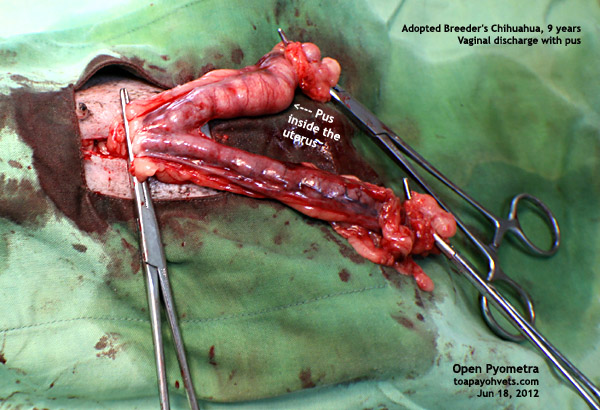
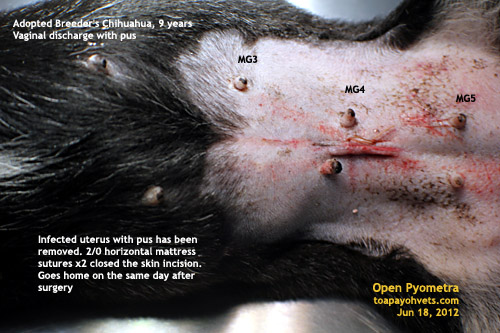
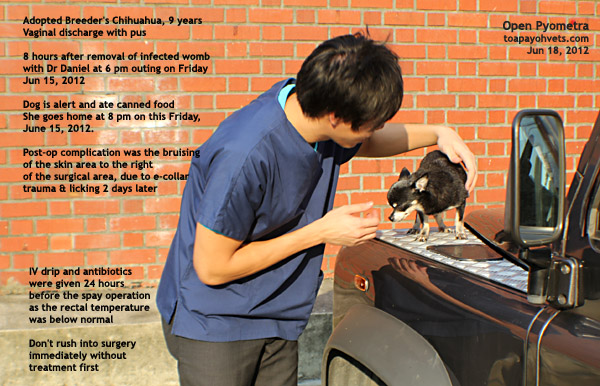
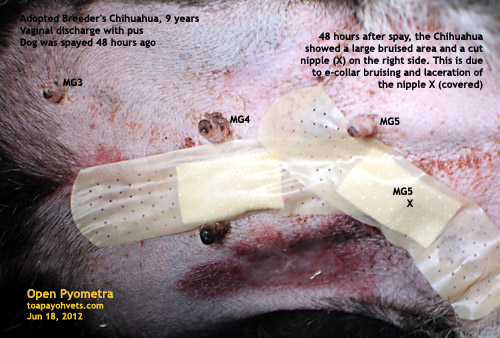
I am still doing a trust and audit check on my vets to make sure that the time spent/spay is not too long due to lack of planning and inefficiency or idle chatting. Employees love to chat and that is part of human nature. However, no chats should be done during surgery as there must be focus on the patient's life.
Proper accounting must be done to ensure that the business can survive in this harsh economic environment.
1055. Update on article: Be Kind & Brave - Adopt a Stray
PROMOTING THE ADOPTION OF STRAY CATS
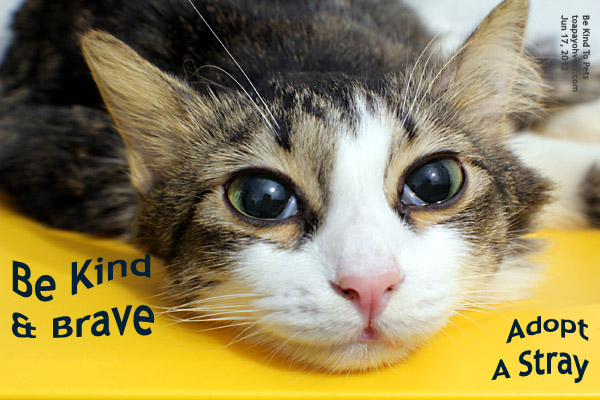
My latest image "Be Kind & Brave" was inspired by a Singaporean couple who adopted a cat from the Cat Welfare Society. "Adopt a female cat," I advised since the 7-year-old male cat had signs of FLUTD and had passed away during treatment at a veterinary practice, causing much distress and sadness to the wife.
Compared to my older image in 2003, I have improved my photographic skills and have got a better lens! Both cats were photographed outside the Toa Payoh Vets with the wall as the background. I prefer the 2003 image as it seems more dynamic.
It is quite difficult to think of captions. Both cats were sterilised by me. The male cat in 2003 was brought in by a cat activist to be neutered and left ear tip snipped. After that, he was put back to the streets. Over the years, pest control firms appeared to net the stray cats and so in 2012, you seldom see stray cats at eating places in the wet market.
However the other "Be Kind & Brave" cat in 2012 has a very good home and is well loved. There was no need to snip her left ear tip unlike community cats without homes. Her spay operation is shown below. She is OK and back to normal now.
I hope that in the next 3 years, Singapore will permit cats to be housed in the HDB apartments so that they need not be "illegal" in public housing.
A pretty stray cat from the Cat Welfare Society was adopted and came to Toa Payoh Vets for general examination and later on, vaccinations.
She grows up fast. She caterwauls and is the loud screams disturb the neighbours. I spayed her around the 10th day from the onset of caterwauling.

Her owner wanted a complete blood test and FIV screening to check her health status. Blood test shows low platelet count which was worrisome. FIV test was negative. As at Jun 28, 2012, the cat is in excellent health and is very active, being much loved by a Singaporean couple.
TIPS TO EXCEL IN VETERINARY MEDICINE AND SURGERY
Young vets are advised to learn the skills of digital photography such that they can produce excellent veterinary images. By illustrating reports of cases seen with attractive pictures, the vet improves his or her veterinary knowledge and diagnosis.
There are many distractions in Singapore such as the many online shows and TV programs to watch. If young vets want to be great vets, they need to sacrifice their spare time to do practical research and write up case studies. In doing this, the vet reflects on his or her handling of the case and gets better at treatment of similar cases. Good clinical and surgical outcomes are produced and the vet builds up a good reputation over the years as referrals from happy clients come from distant parts of Singapore. They come not because the vet is "cheap", but because he or she can resolve the owner's pet problems fast.
IMAGES ARE AT:
http://www.toapayohvets.com/sinpets/20120615digital_photography_stray_cat_adoption_singapore-ToaPayohVets.htm
My latest image "Be Kind & Brave" was inspired by a Singaporean couple who adopted a cat from the Cat Welfare Society. "Adopt a female cat," I advised since the 7-year-old male cat had signs of FLUTD and had passed away during treatment at a veterinary practice, causing much distress and sadness to the wife.
Compared to my older image in 2003, I have improved my photographic skills and have got a better lens! Both cats were photographed outside the Toa Payoh Vets with the wall as the background. I prefer the 2003 image as it seems more dynamic.
It is quite difficult to think of captions. Both cats were sterilised by me. The male cat in 2003 was brought in by a cat activist to be neutered and left ear tip snipped. After that, he was put back to the streets. Over the years, pest control firms appeared to net the stray cats and so in 2012, you seldom see stray cats at eating places in the wet market.
However the other "Be Kind & Brave" cat in 2012 has a very good home and is well loved. There was no need to snip her left ear tip unlike community cats without homes. Her spay operation is shown below. She is OK and back to normal now.
I hope that in the next 3 years, Singapore will permit cats to be housed in the HDB apartments so that they need not be "illegal" in public housing.
A pretty stray cat from the Cat Welfare Society was adopted and came to Toa Payoh Vets for general examination and later on, vaccinations.
She grows up fast. She caterwauls and is the loud screams disturb the neighbours. I spayed her around the 10th day from the onset of caterwauling.
Her owner wanted a complete blood test and FIV screening to check her health status. Blood test shows low platelet count which was worrisome. FIV test was negative. As at Jun 28, 2012, the cat is in excellent health and is very active, being much loved by a Singaporean couple.
TIPS TO EXCEL IN VETERINARY MEDICINE AND SURGERY
Young vets are advised to learn the skills of digital photography such that they can produce excellent veterinary images. By illustrating reports of cases seen with attractive pictures, the vet improves his or her veterinary knowledge and diagnosis.
There are many distractions in Singapore such as the many online shows and TV programs to watch. If young vets want to be great vets, they need to sacrifice their spare time to do practical research and write up case studies. In doing this, the vet reflects on his or her handling of the case and gets better at treatment of similar cases. Good clinical and surgical outcomes are produced and the vet builds up a good reputation over the years as referrals from happy clients come from distant parts of Singapore. They come not because the vet is "cheap", but because he or she can resolve the owner's pet problems fast.
IMAGES ARE AT:
http://www.toapayohvets.com/sinpets/20120615digital_photography_stray_cat_adoption_singapore-ToaPayohVets.htm
Wednesday, June 27, 2012
1054. Adopted stray cat with low platelet count
TOA PAYOH VETS ARTICLE AT:
http://www.toapayohvets.com/sinpets/20120615digital_photography_stray_cat_adoption_singapore-ToaPayohVets.htm
The owners wanted a complete blood test of the adopted cat that was to be spayed on the same day. She was caterwauling 11 days ago. There was a weight loss and I was told she was fed a Barf diet. I advised against spay surgery to be on the safe side. The wife wanted it. The ovarian vessels were much congested due to the heat period and needed extra care in ligation.
The cat took around 2 days to recover but this is the normal situation after spay. Now the cat is very active as I read from the email below.
BLOOD TEST
Jun 8, 12
TP 41855
Cat Welfare Society Adopted cat around 1 year old, female.
Significant findings blood test (jugular vein)
Total WCC 5.3 (5.5-19.5)
N 63%, L28%, M 4%, E6%, B0.1%
Plateltes 38 (300-800)
No platelet clumps seen. Large platelets present.
As to why the platelets are low, it is hard to know the cause. Clinically, the cat was active and the surgical outcome is excellent as the cat has no complications (bleeding and infection) after spay and is active. So, this low platelet count is one of the mysteries of veterinary medicine.
UPDATE JUN 27, 12. However, the cat is OK. One dangling stitch is still present 19 DAYS after spay on Jun 8, 12. But the is not bothered. I advised they will dissolve in 2-4 weeks' time, so no need to come to me for stitch removal. I use polysorb absorbable sutures 3/0 and did 2 horizontal mattress sutures. As the cat would not permit a focused image to be emailed to me, I don't know whether it is the stitch or not. In any case, all dissolvable stitches in the skin drop off from 14-28 days after surgery.
I am keeping the emails for reference and will reply if I have more info.
E-MAIL TO DR SING DATED JUN 27, 2012
Dear Dr Sing
Thank you for the care and advice concerning Sofi. As spoken yesterday, she has healed and recovered exceptionally well. The stiches are still visible though she shows no discomfort and does not lick the site at all. Please find the links below for 1) Barf and 2) Wellness
1) BARF - http://barfsingapore.com.sg/
This appears to be a well balanced and species approraite diet for cats though we are a little concerned about the possibility of contamination and exposure given the transportation process from Australia to Singapore. Going back to Sofi's blood test which indicated low platelets, we also wonder whether it could possibly be toxoplasmosis from eating the raw food, this is just speculation of course, the low platelet count could be due to a variety of reasons. Since the operation, we have stopped feeding her BARF completely.
2) WELLNESS - http://www.wellnesspetfood.com/recipes.aspx?pet=cat&ft=2
We are currently feeding her the canned chicken version. She consumes a can in about one and a half days with a little water added in every meal. In addition to the canned food, she also receives about a spoonful of Wellness Core kibbles daily. This is more to add variety and give her something to chew on.
We would be happy eto hear your thoughts on the pet food and anything else you have to say.
Best Regards
TOA PAYOH VETS ARTICLE AT:
http://www.toapayohvets.com/sinpets/20120615digital_photography_stray_cat_adoption_singapore-ToaPayohVets.htm
http://www.toapayohvets.com/sinpets/20120615digital_photography_stray_cat_adoption_singapore-ToaPayohVets.htm
The owners wanted a complete blood test of the adopted cat that was to be spayed on the same day. She was caterwauling 11 days ago. There was a weight loss and I was told she was fed a Barf diet. I advised against spay surgery to be on the safe side. The wife wanted it. The ovarian vessels were much congested due to the heat period and needed extra care in ligation.
The cat took around 2 days to recover but this is the normal situation after spay. Now the cat is very active as I read from the email below.
BLOOD TEST
Jun 8, 12
TP 41855
Cat Welfare Society Adopted cat around 1 year old, female.
Significant findings blood test (jugular vein)
Total WCC 5.3 (5.5-19.5)
N 63%, L28%, M 4%, E6%, B0.1%
Plateltes 38 (300-800)
No platelet clumps seen. Large platelets present.
As to why the platelets are low, it is hard to know the cause. Clinically, the cat was active and the surgical outcome is excellent as the cat has no complications (bleeding and infection) after spay and is active. So, this low platelet count is one of the mysteries of veterinary medicine.
UPDATE JUN 27, 12. However, the cat is OK. One dangling stitch is still present 19 DAYS after spay on Jun 8, 12. But the is not bothered. I advised they will dissolve in 2-4 weeks' time, so no need to come to me for stitch removal. I use polysorb absorbable sutures 3/0 and did 2 horizontal mattress sutures. As the cat would not permit a focused image to be emailed to me, I don't know whether it is the stitch or not. In any case, all dissolvable stitches in the skin drop off from 14-28 days after surgery.
I am keeping the emails for reference and will reply if I have more info.
E-MAIL TO DR SING DATED JUN 27, 2012
Dear Dr Sing
Thank you for the care and advice concerning Sofi. As spoken yesterday, she has healed and recovered exceptionally well. The stiches are still visible though she shows no discomfort and does not lick the site at all. Please find the links below for 1) Barf and 2) Wellness
1) BARF - http://barfsingapore.com.sg/
This appears to be a well balanced and species approraite diet for cats though we are a little concerned about the possibility of contamination and exposure given the transportation process from Australia to Singapore. Going back to Sofi's blood test which indicated low platelets, we also wonder whether it could possibly be toxoplasmosis from eating the raw food, this is just speculation of course, the low platelet count could be due to a variety of reasons. Since the operation, we have stopped feeding her BARF completely.
2) WELLNESS - http://www.wellnesspetfood.com/recipes.aspx?pet=cat&ft=2
We are currently feeding her the canned chicken version. She consumes a can in about one and a half days with a little water added in every meal. In addition to the canned food, she also receives about a spoonful of Wellness Core kibbles daily. This is more to add variety and give her something to chew on.
We would be happy eto hear your thoughts on the pet food and anything else you have to say.
Best Regards
TOA PAYOH VETS ARTICLE AT:
Subscribe to:
Comments (Atom)