961. An old dog pants heavily. This is a serious health problem for the old dog.
AN OLD DOG PANTS HEAVILY - AN ULTRASOUND TO CHECK FOR LIVER CANCER?
E-MAIL TO DR SING DATED APRIL 26, 2012
To: judy@toapayohvets.com
Dear Mdm
I would like to make an enquiry about my dog (Schnauzer-cross). She is 15 years old.
We brought her to the vet as she was panting heavily and her stomach swelled and keeps hiding in the room, away from the rest of the family.
X-ray results shows that she has an enlarged liver. Also, the blood test shows that she has high Calcium, high platelets and white blood cells.
Most likely, says the vet, my dog has cancer and recommended an ultrasound at its hospital. Meanwhile, the vet has given her some liver medication and my dog's condition has improved though the vet did share that this would be temporary.
I am worried about the costs of sending my dog to their hospital as I did some research and found that the hospital tend to order several tests and cost of the treatment usually escalates. If she is found to have cancer, it's likely that we will not opt for treatment as she is old and already her quality of life is poor, with poor eyesight etc.
Does your clinic offer ultrasound services and how much does it cost?
Is ultrasound the best option for my dog now?
My family wants to see her pass on without suffering too much. What should I do to alleviate her suffering?
I would really appreciate if you could advise me. Please feel free to call me if need be.
Rgds
Name & Phone
E-MAIL REPLY FROM DR SING DATED APRIL 26, 2012
I am Dr Sing from Toa Payoh Vets. We spoke by phone today Apr 26, 2012, 3.31 pm and the following is my brief reply to you:
In my opinion, the important health care issues in your old dog are:
1. what is the cause of "panting heavily" and "swollen stomach"
2. what is the cause of the "high platelet and white blood cell count"
Is there liver cancer or not? Is there a cure? If the cause of the illness is known and treatment can be effective, it should not be "panting heavily".
Thursday, April 26, 2012

Wednesday, April 25, 2012
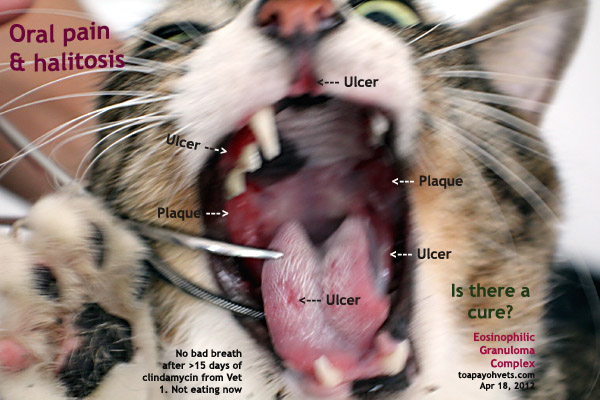
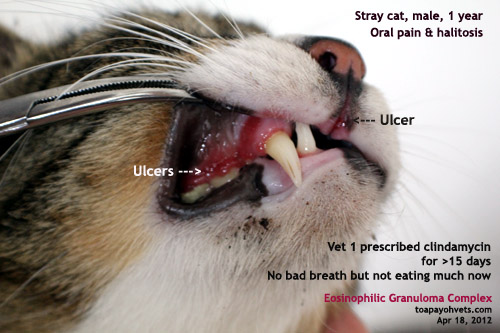
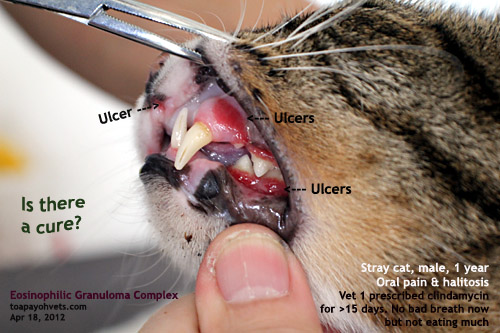
960. Update: Feline Eosinophilia Granuloma Complex (Images)
For veterinary students studying hard on oral conditions in the cat, the
updated website and more images are


 at:
http://www.toapayohvets.com/20120415feline-eosinophilic-mouth-ulcers-young-stray-cat-singapore-ToaPayohVets.htm
at:
http://www.toapayohvets.com/20120415feline-eosinophilic-mouth-ulcers-young-stray-cat-singapore-ToaPayohVets.htm
Tuesday, April 24, 2012
959. What to do? Carrier cover closed on the cat's tail
April 24, 2012
I saw the consultation table stained by KMnO4 today and was quite furious that there was no newspapers being used to protect this table. Vets who don't bother to take care of equipment will have to pay for the damages. The KMnO4 powder was applied to stop the bleeding from the cat's tail. Somebody had closed the lid on the longer tail of the cat and injured it.
There was hysteria and bleeding. So the vet used KMnO4 and did not bother to use the newspaper to protect the table. "KMnO4 does not work in stopping bleeding of bigger tail wound," I said.
"In such situations, treat it as an emergency and apply the following procedures:"
1. Be firm and ask the owner to wait outside the at the waiting room.
2. Bring the cat to the surgery room.
3. Sedate if necessary as the cat gets excited and worried with all the human commotion.
4. Pressure bandage will stop the bleeding.
Bandaging and cleaning the wound would be better.
PREVENTION Get the owner to put the cat in her carrier when she comes to take her cat back. I had given such instructions for owners to cage their own cats and not let the assistants do it. All of us learn from experiences.
There was hysteria and bleeding. So the vet used KMnO4 and did not bother to use the newspaper to protect the table. "KMnO4 does not work in stopping bleeding of bigger tail wound," I said.
"In such situations, treat it as an emergency and apply the following procedures:"
1. Be firm and ask the owner to wait outside the at the waiting room.
2. Bring the cat to the surgery room.
3. Sedate if necessary as the cat gets excited and worried with all the human commotion.
4. Pressure bandage will stop the bleeding.
Bandaging and cleaning the wound would be better.
PREVENTION Get the owner to put the cat in her carrier when she comes to take her cat back. I had given such instructions for owners to cage their own cats and not let the assistants do it. All of us learn from experiences.
958. Uterine prolapse in the cat - seen by Dr Sing
On Tue, Apr 24, 2012 at 3:33 AM, Sorrel J Langley-Hobbs wrote:
Dear Dr Sing Kong Yuen, I am writing a chapter on the feline genital tract and would like an image of a uterine prolapse to include in the chapter. I found yours - the website was forwarded to me by another veterinarian. If you have a higher resolution image of the uterine prolapse (attached) - needs to be 300dpi and about 10cm x 10cm then it could be publishable. I would of course acknowledge you for use of the picture. thanks very much Sorrel Langley-Hobbs -- Sorrel Langley-Hobbs MA BVetMed DSAS(O) DECVS MRCVS European Specialist in Small Animal Surgery University Surgeon Head of Small Animal Surgery, Department of Veterinary Medicine, University of Cambridge, Madingley Road, Cambridge CB3 OES Tel 01223 337621 / 337653 Fax +44 1223 330848 Email - SJL41@cam.ac.uk
E-MAIL REPLY FROM DR SING DATED APRIL 24, 2012
Hi I am Dr Sing. The picture was taken many years ago and at that time, the images were on poor quality as I was just starting out my digital photography. Pl feel free to use the image and I have not seen any more such cases of uterine prolapse in the cat. Best wishes
Dear Dr Sing Kong Yuen, I am writing a chapter on the feline genital tract and would like an image of a uterine prolapse to include in the chapter. I found yours - the website was forwarded to me by another veterinarian. If you have a higher resolution image of the uterine prolapse (attached) - needs to be 300dpi and about 10cm x 10cm then it could be publishable. I would of course acknowledge you for use of the picture. thanks very much Sorrel Langley-Hobbs -- Sorrel Langley-Hobbs MA BVetMed DSAS(O) DECVS MRCVS European Specialist in Small Animal Surgery University Surgeon Head of Small Animal Surgery, Department of Veterinary Medicine, University of Cambridge, Madingley Road, Cambridge CB3 OES Tel 01223 337621 / 337653 Fax +44 1223 330848 Email - SJL41@cam.ac.uk
E-MAIL REPLY FROM DR SING DATED APRIL 24, 2012
Hi I am Dr Sing. The picture was taken many years ago and at that time, the images were on poor quality as I was just starting out my digital photography. Pl feel free to use the image and I have not seen any more such cases of uterine prolapse in the cat. Best wishes
957. Eosinophils and monocytes compared in two old dogs
April 24, 2012
Blood test done by the same lab on two aged dogs.
An interesting case of the circling dog to be compared to an ordinary case of maggot wounds.
Case 1. The circling Schnauzer 12 years old, Male - Dr Sing's case
Date of test April 23, 2012
Total WCC 6.2 (6-17)
Neutrophils 71.5% 4.43 (absolute)
Lymphocytes 11.3% 0.70
Monocytes 6.5% 0.40
Eosinophils 9.6% 0.59 Basophils 1. 0% 0.06
PCV 0.47 (0.37 - 0.55)
Platelet 337 (200-500) Few giant platelets seen. No platelet clumping noted.
Glucose - specimen grossly haemolysed. Query glycolysis. Suggest repeat.
April 24, 2012. Day 2 after treatment. 10am. Dog does not cry. Sedated. Can walk with head straight but ataxic. No circling. Went home on April 25, 2012 with no head tilt. To review.
Case 2. The eye-maggot-wound Golden Retriever 14 years old, Male - Dr Vanessa's case Numerous maggots below R eyelid
Date of test April 20, 2012
Total WCC 22.5 (6-17)
Neutrophils 90.8% 20.43 (absolute)
Lymphocytes 7.6% 1.71
Monocytes 0.3% 0.07
Eosinophils 1.2% 0.27 Basophils 0% 0.0
PCV 0.39 (0.37 - 0.55)
Platelet 276 (200-500) Large platelets present. Platelet clumping noted.
Glucose 3.9 (3.9 - 6)
Conclusion: The monocytes and eosinophils were very high in Case 1. Case 2 would be considered to have normal ones but the total white cell count and neutrophils were high (bacterial infection) .
Could Case 1 be suffering from a chronic illness? For example, bad rotten teeth infection - toxins and bacteria travelled via the Eustachian tube to the middle ear and the brain? This resulted in increase in monocytes and eosinophils and a possible auto-immune reaction?). Hard to confirm unless a spinal tap is also done. There is the economics additional tests to be considered.
Case 1. The circling Schnauzer 12 years old, Male - Dr Sing's case
Date of test April 23, 2012
Total WCC 6.2 (6-17)
Neutrophils 71.5% 4.43 (absolute)
Lymphocytes 11.3% 0.70
Monocytes 6.5% 0.40
Eosinophils 9.6% 0.59 Basophils 1. 0% 0.06
PCV 0.47 (0.37 - 0.55)
Platelet 337 (200-500) Few giant platelets seen. No platelet clumping noted.
Glucose - specimen grossly haemolysed. Query glycolysis. Suggest repeat.
April 24, 2012. Day 2 after treatment. 10am. Dog does not cry. Sedated. Can walk with head straight but ataxic. No circling. Went home on April 25, 2012 with no head tilt. To review.
Case 2. The eye-maggot-wound Golden Retriever 14 years old, Male - Dr Vanessa's case Numerous maggots below R eyelid
Date of test April 20, 2012
Total WCC 22.5 (6-17)
Neutrophils 90.8% 20.43 (absolute)
Lymphocytes 7.6% 1.71
Monocytes 0.3% 0.07
Eosinophils 1.2% 0.27 Basophils 0% 0.0
PCV 0.39 (0.37 - 0.55)
Platelet 276 (200-500) Large platelets present. Platelet clumping noted.
Glucose 3.9 (3.9 - 6)
Conclusion: The monocytes and eosinophils were very high in Case 1. Case 2 would be considered to have normal ones but the total white cell count and neutrophils were high (bacterial infection) .
Could Case 1 be suffering from a chronic illness? For example, bad rotten teeth infection - toxins and bacteria travelled via the Eustachian tube to the middle ear and the brain? This resulted in increase in monocytes and eosinophils and a possible auto-immune reaction?). Hard to confirm unless a spinal tap is also done. There is the economics additional tests to be considered.
956. Miniature Schnauzer with head turned left
Yesterday, April 23, 2012, I was surprised to see a 12-year-old Miniature Schnauzer I had not seen since 11 years ago. A young couple in their mid 20s came with the dog whose head tilted or turned left at around 90 degrees to the neck.
I recognised the name of this dog which was one of a kind and recalled the father who brought this dog specially for the young daughter who was 12 years old then.
As he lived quite far from Toa Payoh, it was understandable that I had not seen this dog. There could be other reasons but this is expected. "Was the dog walking in circles?" I asked. "Yes," the young lady said. "At first wide circles near the wall. Now, in small circles. Always circling to the right."
Sudden onset 2 weeks ago said to have fallen from the couch. Vet 1 examined and said nothing was abnormal. Soon the dog started walking in smaller circles and crying. The daughter decided to consult me. The father wanted euthanasia as the dog was whining the whole day and restless.
Yet he ate and had not lost much weight. He vomited the food recently. What's the cause of this circling? Is there a solution?
There was mild pain in the spinal area on palpation esp. T/L and inside the ears when I applied a cotton bud. Other than that, no cervical pain.
Blood tests were not taken by Vet 1 and no medication or injection was given as the dog was "normal." This was a puzzling case. Middle ear infection or trauma? Ears were quite clean. Infection from bad teeth's bacteria into the brain via the Eustachian tubes to the brain?
The dog had two dentals, the recent one being in January 2012.
TREATMENT Diazepam 1.5 ml sedated the dog for around 2 hours. The dog started to paddle. I gave Domitor+Ketamine at 20% to let him sleep. His neck was now straight due to diazepam. Will wait till blood test results come in today and see what's the problem.
No spinal fluid test is done yet. There's a big below gum upper molar tooth embedded.
Could this tooth be rotten inside the gum, causing bacteria to go up the maxillary sinuses into the frontal sinus and to the brain? Now, there is no bad breath. Ear canal had little yellow wax and grooming was done 2 weeks before the appearance of clinical signs. It is a difficult situation as the cause is still hard to find without X-rays and scans which would cost money.
UPDATE
Blood test - significant results were the high eosinophils and monocytes.
The dog was warded two nights and went home. The head had not tilted 90 degree to the left. When I called him, he could turn his head to the right. So far, he could walk straight and his head pointed normally forward. What is the cause of his circling? He circled from larger circle to small tight circles to the right. He could circle no more in the sense that the circle had become too small. A very rare case reminding me of "scrapie" in the sheep shown by the professors when I studied at Glasgow Vet College some 40 years ago. The sheep was walking in circles and it was quite unforgettable even now.
As he lived quite far from Toa Payoh, it was understandable that I had not seen this dog. There could be other reasons but this is expected. "Was the dog walking in circles?" I asked. "Yes," the young lady said. "At first wide circles near the wall. Now, in small circles. Always circling to the right."
Sudden onset 2 weeks ago said to have fallen from the couch. Vet 1 examined and said nothing was abnormal. Soon the dog started walking in smaller circles and crying. The daughter decided to consult me. The father wanted euthanasia as the dog was whining the whole day and restless.
Yet he ate and had not lost much weight. He vomited the food recently. What's the cause of this circling? Is there a solution?
There was mild pain in the spinal area on palpation esp. T/L and inside the ears when I applied a cotton bud. Other than that, no cervical pain.
Blood tests were not taken by Vet 1 and no medication or injection was given as the dog was "normal." This was a puzzling case. Middle ear infection or trauma? Ears were quite clean. Infection from bad teeth's bacteria into the brain via the Eustachian tubes to the brain?
The dog had two dentals, the recent one being in January 2012.
TREATMENT Diazepam 1.5 ml sedated the dog for around 2 hours. The dog started to paddle. I gave Domitor+Ketamine at 20% to let him sleep. His neck was now straight due to diazepam. Will wait till blood test results come in today and see what's the problem.
No spinal fluid test is done yet. There's a big below gum upper molar tooth embedded.
Could this tooth be rotten inside the gum, causing bacteria to go up the maxillary sinuses into the frontal sinus and to the brain? Now, there is no bad breath. Ear canal had little yellow wax and grooming was done 2 weeks before the appearance of clinical signs. It is a difficult situation as the cause is still hard to find without X-rays and scans which would cost money.
UPDATE
Blood test - significant results were the high eosinophils and monocytes.
The dog was warded two nights and went home. The head had not tilted 90 degree to the left. When I called him, he could turn his head to the right. So far, he could walk straight and his head pointed normally forward. What is the cause of his circling? He circled from larger circle to small tight circles to the right. He could circle no more in the sense that the circle had become too small. A very rare case reminding me of "scrapie" in the sheep shown by the professors when I studied at Glasgow Vet College some 40 years ago. The sheep was walking in circles and it was quite unforgettable even now.
955. Sinusitis
Sinuses are empty air spaces in the skull bones. They have openings to drain mucus from the sinus into the nose. People have 4 pairs of sinuses in the spaces.
The frontal sinuses near the eyebrows, the maxillary sinuses inside the cheekbones, the ethmoid sinuses between the eyes and the sphenoid sinuses behind the ethmoid sinuses.
Sinusitis is an infection of the sinuses in the face. Swelling and inflammation of the sinus mucosa blocking up the sinus passages to the nose. Obstruction can also be due to nasal polyps, a deviated septum or enlarged sinus turbinates.
The frontal sinuses near the eyebrows, the maxillary sinuses inside the cheekbones, the ethmoid sinuses between the eyes and the sphenoid sinuses behind the ethmoid sinuses.
Sinusitis is an infection of the sinuses in the face. Swelling and inflammation of the sinus mucosa blocking up the sinus passages to the nose. Obstruction can also be due to nasal polyps, a deviated septum or enlarged sinus turbinates.
Follow up: Lateral ear resection poodle, cat eosinophilia
Monday April 23, 2012 report
LATERAL EAR CANAL RESECTION POST-OP COMPLICATONS
All vet surgeons will encounter post-surgical complications no matter how experienced they are. So, I got one case now. Yesterday Sunday, I re-stitched the two ears (day 5 of surgery). Took over 1 hour under isoflurane gas only. Stitch breakdown uncommon but does occur in any surgery. Phoned owner not to take the dog back as scheduled as I need to nurse it again. Why stitch breakdown? Many reasons probably.
1. I noted that the ears had oozed thick fluid on Day 2 and Day 3, unlike other dogs and took some images.
2. High tension stitching?
3. Handling of ears by my assistant Min to give oral medication painkillers and antibiotics, ear powder, cleaning surgical area, disturbing the stability of the ear sutures? Most likely. I told Min not to touch the dog. Today I used a scoop and drop water at a height to wash away the oozing fluid in one ear (left?, check images). The other ear was dry.
4. I need another 5 days.
UPDATE ON APRIL 26, 2012. Ear wounds still oozing with fluid. Unusual. Used antibiotic powder to dry wound. Owner visited yesterday.
CAT EOSINOPHILIC GRANULOMA COMPLEX Cat went home on last Saturday. Gum and palate ulcers have shrunk 30% by observation of less redness and size after the steroid injection.
Advised 4 weeks to review and cat is on medication.
Blood test results on April 17, 2012
Glucose 11 (normal 3.9 - 6)
SGPT/ALT 294 (121) SGOT/AST 121 (67)
Total WBCC 13.5 (5.5 - 19.5)
N 64.4 8.69 (absolute)
L 23.6 3.19
M 5.7% 0.77
E 6% 0.81 B 0.3% 0.04
GOLDEN RETRIEVER, 9 YEARS, MALE, TICK FEVER
PASSED AWAY YESTERDAY
Positive for Ehr +ve Babesiosis +ve
4 weeks ago
Apr 21, 2012 haemoglobin 5.2 (10.8 -15.6)
Total RCC 2 (3.8 - 5.8)
Total WBCC 102 (5.5 - 19.5)
Dog died one day later
Extremely high total WBCC and loss of blood.
For some reasons, the owner did not follow up and delayed treatment of the tick fever.
LATERAL EAR CANAL RESECTION POST-OP COMPLICATONS
All vet surgeons will encounter post-surgical complications no matter how experienced they are. So, I got one case now. Yesterday Sunday, I re-stitched the two ears (day 5 of surgery). Took over 1 hour under isoflurane gas only. Stitch breakdown uncommon but does occur in any surgery. Phoned owner not to take the dog back as scheduled as I need to nurse it again. Why stitch breakdown? Many reasons probably.
1. I noted that the ears had oozed thick fluid on Day 2 and Day 3, unlike other dogs and took some images.
2. High tension stitching?
3. Handling of ears by my assistant Min to give oral medication painkillers and antibiotics, ear powder, cleaning surgical area, disturbing the stability of the ear sutures? Most likely. I told Min not to touch the dog. Today I used a scoop and drop water at a height to wash away the oozing fluid in one ear (left?, check images). The other ear was dry.
4. I need another 5 days.
UPDATE ON APRIL 26, 2012. Ear wounds still oozing with fluid. Unusual. Used antibiotic powder to dry wound. Owner visited yesterday.
CAT EOSINOPHILIC GRANULOMA COMPLEX Cat went home on last Saturday. Gum and palate ulcers have shrunk 30% by observation of less redness and size after the steroid injection.
Advised 4 weeks to review and cat is on medication.
Blood test results on April 17, 2012
Glucose 11 (normal 3.9 - 6)
SGPT/ALT 294 (121) SGOT/AST 121 (67)
Total WBCC 13.5 (5.5 - 19.5)
N 64.4 8.69 (absolute)
L 23.6 3.19
M 5.7% 0.77
E 6% 0.81 B 0.3% 0.04
GOLDEN RETRIEVER, 9 YEARS, MALE, TICK FEVER
PASSED AWAY YESTERDAY
Positive for Ehr +ve Babesiosis +ve
4 weeks ago
Apr 21, 2012 haemoglobin 5.2 (10.8 -15.6)
Total RCC 2 (3.8 - 5.8)
Total WBCC 102 (5.5 - 19.5)
Dog died one day later
Extremely high total WBCC and loss of blood.
For some reasons, the owner did not follow up and delayed treatment of the tick fever.
Monday, April 23, 2012
Sunday's interesting cases
Sunday April 22, 2012
Case 1: The hot dog farted on abdominal palpation again! The two young ladies came with the hot dog for a review and blood test. "The Miniature Schnauzer bites," one young lady held the dog's head with both hands as I palpated the abdomen with my left hand. "No more vomiting. Normal now." Suddenly the dog farted as I palpated the back half of the abdomen.
This was a loud cracking sound. It was a reproduction of the same incident when I saw him on April 8, 2012. Scientific experiments are valid if others can reproduce the outcome and in this case, I was able to do it again. It is not a common occurrence and so I was much surprised with this loud puffing crack from his backside. "Something wrong with the intestines producing too much gas," I said. The dog was on LD prescription diet and some dog treats, but he still farted. I asked the owners to wait 4 weeks from the first blood test to take blood to check whether the liver has recovered.
I gave the young lady a bottle to collect the dog's urine in the morning as he pees a lot and then dribbles with difficulty (I suspect urine marking as some male non-neutered dogs will try their best even to pee nothing!). In any case, the first urine test show struvite + and spermatozoa 2+ and so we need to review again. The male dog had no more urine and so I did not bother to catherise to collect the urine.
Case 2: Two shrivelled front teeth in a 5-year-old Maltese. The marketing books say "Give what the owner wants." Well, the wife did not want the teeth to be extracted and had been to Vet 1 who did recommend that. "It is not good for the dog," I showed that the gum had receded considerably. "The dog does feel the pain and bacteria will continue to grow after antibiotics.
The teeth may then crack." After much discussion, the wife agreed one bent front tooth to be extracted. Giving what the customer wants is good marketing. I asked the couple to think about it as the dog would need another anaesthesia if the other tooth fracture due to shrivelled root and instability. "It is not stable anymore," I said. "Like tree with rotten roots. During thunderstorms, the tree topples. This root will break and part remains in."
Much time was spent in discussion. It was up to the wife. Much time would have been saved and more fees earned if the vet just do what the customer wants as there will be two anaesthesias involved. The first to do dental scaling of the two front teeth. The later one to extract. However, this cost the owner money and the dog more pain in the delay. Finally, the wife agreed to extraction of the two front teeth and dental scaling.
During anaesthesia, another right upper molar tooth was loose after tartar removal. I did not extract it, knowing the wife's preference to have teeth present in this 5-year-old Maltese. It was loose but not that unstable. Yet all the other teeth were quite strong and relatively clean. The two loose front teeth were a surprising revelation as the other teeth were solid. Veterinary dentistry can be full of surprises. Domitor + Ketamine 50% and isoflurane was safe and fast. Owner wanted a blood test which was done.
Case 3. Phone review of the Maltese with acute bacterial meningitis 10 days ago. I phoned the owner. She said the Maltese was OK and she would come for a blood test later.
Case is written in: http://www.sinpets.com/F5/20120414acute-meningitis-dog-singapore-ToaPayohVets.htm
Signficant blood test results at time of stiff neck is as follows:
April 12, 2012 Maltese, 5 years, Male
Glucose **. Specimen grossly haemolsed. Query glycolysis, suggest to repeat.
Plasma glucose = 20mg/dL Liver Profile. ALT/SGPT normal. AST/SGOT 95 (normal = 81)
Total WCC 19.3 (6-17)
Neutrophils 94% 18.16 Lymphocytes 5.4% 1.04
Monocystes 0.4% 0.08
Eosinophils 0% 0 Basophils 0% 0
Based on sudden onset clinical signs and the total tal WCC and very high Neutrophils, this would be a case of acute bacterial meningitis.
Case 4. The spayed cat caterwauling loudly for the past 4 weeks, starting from first month after being spayed by Vet 1. The young couple showed me their phone video of the cat rolling over, tail up, backside up as if ready for mating. However, no audio. "Most likely, there is a bit of ovarian tissue left behind by Vet 1," I said. "It will be very difficult to find this tissue even if there is a repeat spay." What to do?
Case 5. A 2.5-year-old dwarf hamster had a much swollen right eye. The lower eyelid was as round as a ball, around 4 mm X 4 mm. Squeezing out the pus with fingers had been done by Vet 1 but the swelling remains as solid as ever. A small hole released the pus if you press the lower eyelid. "The best way is to cut a big cut and release the pus," I said to the mother who said this was her favourite "Small White" hamster and was concerned that the hamster would die under anaesthesia. "The hamster is at the end of his lifespan," she said.
"If he dies on the operating table, there is no more." "He will die if he does not eat or drink. Within 2 weeks," I predicted."No antibiotics and eyedrops will help. This is a large conjuntival abscess that needs to be cut around 3 mm to let the thick pus out. Anaesthesia is needed. The hamster may just die during surgery."
So, the 40-year-old mother with a small boy did not know what to do. The older man who could be her father was more aware of the no chance with eye drop and antibiotic treatment. Finally, she decided. I got it done.
A big cut. The hamster survived with a much normal sized lower eyelid and went home.
UPDATE: APRIL 26, 2012. No complaint from the owner
Case 6. The previous blog is below: 939. The hot dog growls at the vet Tuesday, April 10, 2012 "More active, no more vomiting," the lady said. "The dog has not recovered fully from hepatitis yet," I said. I prescribed some liver supplements and anitbiotics. Every family member is happy. The dog was warded 4 days for lethargy and recurring fever.
10 days ago, I had operated on him and removed a big epidermal cyst. The dog was rubbing his back area where the cyst had been removed. So, the grandpa applied bright yellow powder onto the wound. It looked like yellow sulphur, which is toxic. Saturday, April 8, 2012 The owner had brought the dog to see me last Wednesday with complaint of lethargy and fever.
I boarded him for observation and on Saturday, the whole family of 2 ladies, their husbands and grandparents came to visit this miniature schnauzer of 5 years, male. Saturday was my day off, but I went back to Toa Payoh Vets to see this dog. That was how I met the group outside. The dog growled when I approached him to palpate his abdomen to see whether it was still tense and hard. "That is a good sign of recovery to health," I said.
"Yesterday, Dr Daniel said he stood like a statute for a few minutes when let out." "Maybe he is frightened," the young lady said. "Possibly," I asked the owner to hold his muzzle while I palpated his abdomen. Not tense as before.
So,I decided to let him go home. He would recover faster at home. Well, he did recover. As to the cause of his tense stomach area, I can only sketch this scenario as follows: 1. The wound was contaminated by the yellow powder. Toxins and bacteria entered the wound.
Blood test showed high liver enzymes. Low red cell count. The stomach was full. Impaction. I had given anti-spasmodic inj to cool him down. The tense anterior abdomen was due to his liver inflammation.
APRIL 26, 2011Urine test did not reveal any struvite crystals.
This morning, the owner phoned to say the dog had 4 partly swollen paws and red eyes. Yesterday, he had fever and was treated by me with one anti-fever injection. Eating and drinking normally this morning. Had vomited once on going home and after eating the AD canned food.
I asked her to wait and see. Could the liver be inflamed again?
Case 1: The hot dog farted on abdominal palpation again! The two young ladies came with the hot dog for a review and blood test. "The Miniature Schnauzer bites," one young lady held the dog's head with both hands as I palpated the abdomen with my left hand. "No more vomiting. Normal now." Suddenly the dog farted as I palpated the back half of the abdomen.
This was a loud cracking sound. It was a reproduction of the same incident when I saw him on April 8, 2012. Scientific experiments are valid if others can reproduce the outcome and in this case, I was able to do it again. It is not a common occurrence and so I was much surprised with this loud puffing crack from his backside. "Something wrong with the intestines producing too much gas," I said. The dog was on LD prescription diet and some dog treats, but he still farted. I asked the owners to wait 4 weeks from the first blood test to take blood to check whether the liver has recovered.
I gave the young lady a bottle to collect the dog's urine in the morning as he pees a lot and then dribbles with difficulty (I suspect urine marking as some male non-neutered dogs will try their best even to pee nothing!). In any case, the first urine test show struvite + and spermatozoa 2+ and so we need to review again. The male dog had no more urine and so I did not bother to catherise to collect the urine.
Case 2: Two shrivelled front teeth in a 5-year-old Maltese. The marketing books say "Give what the owner wants." Well, the wife did not want the teeth to be extracted and had been to Vet 1 who did recommend that. "It is not good for the dog," I showed that the gum had receded considerably. "The dog does feel the pain and bacteria will continue to grow after antibiotics.
The teeth may then crack." After much discussion, the wife agreed one bent front tooth to be extracted. Giving what the customer wants is good marketing. I asked the couple to think about it as the dog would need another anaesthesia if the other tooth fracture due to shrivelled root and instability. "It is not stable anymore," I said. "Like tree with rotten roots. During thunderstorms, the tree topples. This root will break and part remains in."
Much time was spent in discussion. It was up to the wife. Much time would have been saved and more fees earned if the vet just do what the customer wants as there will be two anaesthesias involved. The first to do dental scaling of the two front teeth. The later one to extract. However, this cost the owner money and the dog more pain in the delay. Finally, the wife agreed to extraction of the two front teeth and dental scaling.
During anaesthesia, another right upper molar tooth was loose after tartar removal. I did not extract it, knowing the wife's preference to have teeth present in this 5-year-old Maltese. It was loose but not that unstable. Yet all the other teeth were quite strong and relatively clean. The two loose front teeth were a surprising revelation as the other teeth were solid. Veterinary dentistry can be full of surprises. Domitor + Ketamine 50% and isoflurane was safe and fast. Owner wanted a blood test which was done.
Case 3. Phone review of the Maltese with acute bacterial meningitis 10 days ago. I phoned the owner. She said the Maltese was OK and she would come for a blood test later.
Case is written in: http://www.sinpets.com/F5/20120414acute-meningitis-dog-singapore-ToaPayohVets.htm
Signficant blood test results at time of stiff neck is as follows:
April 12, 2012 Maltese, 5 years, Male
Glucose **. Specimen grossly haemolsed. Query glycolysis, suggest to repeat.
Plasma glucose = 20mg/dL Liver Profile. ALT/SGPT normal. AST/SGOT 95 (normal = 81)
Total WCC 19.3 (6-17)
Neutrophils 94% 18.16 Lymphocytes 5.4% 1.04
Monocystes 0.4% 0.08
Eosinophils 0% 0 Basophils 0% 0
Based on sudden onset clinical signs and the total tal WCC and very high Neutrophils, this would be a case of acute bacterial meningitis.
Case 4. The spayed cat caterwauling loudly for the past 4 weeks, starting from first month after being spayed by Vet 1. The young couple showed me their phone video of the cat rolling over, tail up, backside up as if ready for mating. However, no audio. "Most likely, there is a bit of ovarian tissue left behind by Vet 1," I said. "It will be very difficult to find this tissue even if there is a repeat spay." What to do?
Case 5. A 2.5-year-old dwarf hamster had a much swollen right eye. The lower eyelid was as round as a ball, around 4 mm X 4 mm. Squeezing out the pus with fingers had been done by Vet 1 but the swelling remains as solid as ever. A small hole released the pus if you press the lower eyelid. "The best way is to cut a big cut and release the pus," I said to the mother who said this was her favourite "Small White" hamster and was concerned that the hamster would die under anaesthesia. "The hamster is at the end of his lifespan," she said.
"If he dies on the operating table, there is no more." "He will die if he does not eat or drink. Within 2 weeks," I predicted."No antibiotics and eyedrops will help. This is a large conjuntival abscess that needs to be cut around 3 mm to let the thick pus out. Anaesthesia is needed. The hamster may just die during surgery."
So, the 40-year-old mother with a small boy did not know what to do. The older man who could be her father was more aware of the no chance with eye drop and antibiotic treatment. Finally, she decided. I got it done.
A big cut. The hamster survived with a much normal sized lower eyelid and went home.
UPDATE: APRIL 26, 2012. No complaint from the owner
Case 6. The previous blog is below: 939. The hot dog growls at the vet Tuesday, April 10, 2012 "More active, no more vomiting," the lady said. "The dog has not recovered fully from hepatitis yet," I said. I prescribed some liver supplements and anitbiotics. Every family member is happy. The dog was warded 4 days for lethargy and recurring fever.
10 days ago, I had operated on him and removed a big epidermal cyst. The dog was rubbing his back area where the cyst had been removed. So, the grandpa applied bright yellow powder onto the wound. It looked like yellow sulphur, which is toxic. Saturday, April 8, 2012 The owner had brought the dog to see me last Wednesday with complaint of lethargy and fever.
I boarded him for observation and on Saturday, the whole family of 2 ladies, their husbands and grandparents came to visit this miniature schnauzer of 5 years, male. Saturday was my day off, but I went back to Toa Payoh Vets to see this dog. That was how I met the group outside. The dog growled when I approached him to palpate his abdomen to see whether it was still tense and hard. "That is a good sign of recovery to health," I said.
"Yesterday, Dr Daniel said he stood like a statute for a few minutes when let out." "Maybe he is frightened," the young lady said. "Possibly," I asked the owner to hold his muzzle while I palpated his abdomen. Not tense as before.
So,I decided to let him go home. He would recover faster at home. Well, he did recover. As to the cause of his tense stomach area, I can only sketch this scenario as follows: 1. The wound was contaminated by the yellow powder. Toxins and bacteria entered the wound.
Blood test showed high liver enzymes. Low red cell count. The stomach was full. Impaction. I had given anti-spasmodic inj to cool him down. The tense anterior abdomen was due to his liver inflammation.
APRIL 26, 2011Urine test did not reveal any struvite crystals.
This morning, the owner phoned to say the dog had 4 partly swollen paws and red eyes. Yesterday, he had fever and was treated by me with one anti-fever injection. Eating and drinking normally this morning. Had vomited once on going home and after eating the AD canned food.
I asked her to wait and see. Could the liver be inflamed again?
Sunday, April 22, 2012
952. Epulis in an old chihuahua
952. Epulis in an old Chihuahua
APRIL 22, 2012. ||
"Wait-and-see, take antibiotics" is not the appropriate advice to give to an owner of an old Chihuahua with a gingival growth, known as Epulis. Gingival growths in old dogs may not be Epulis and a biopsy is most important to confirm the diagnosis of Epulis or malignant tumour.
Surgical excision using electro-surgery involving the periodontal ligament should be advised. Some vet text books advise the complete removal of the tooth and periodontal ligament to prevent recurrence. A "wait-and-see" advice may be considered negligent advice.

 5227. In old dogs, gingival tumours or growths should be excised, not being advised to "wait-and-see" after a course of antibiotics. Electro-excision of epulis including the periodontal ligament prevents recurrence.
However, this means the whole tooth or teeth must be removed and this may not be what the owner desires. An informed decision must be made by the owner
The vet should advise the surgical excision of all growths in dogs especially old dogs.
5227. In old dogs, gingival tumours or growths should be excised, not being advised to "wait-and-see" after a course of antibiotics. Electro-excision of epulis including the periodontal ligament prevents recurrence.
However, this means the whole tooth or teeth must be removed and this may not be what the owner desires. An informed decision must be made by the owner
The vet should advise the surgical excision of all growths in dogs especially old dogs.
Whether the owner accepts the advice or not, depends on the wishes of the owner and this response must be recorded in writing in the case record in the presence of the owner.
This "Against Medical Advice" record is very important in cases of veterinary complaint investigation or litigation when family members find that the gingival growths had grown considerably, leading to pain, bleeding and dysphagia due to "wait-and-see" advice of the vet. Youtube website has one similar case of Epulis video: http://www.youtube.com/watch?v=1KDwaAWCY1s&feature=related
951. System, processes and protocols to prevent veterinary errors
Yesterday, April 20, 2012, I met the owner of the 14-year-old Chihuahua with a reddish gum growth extending downwards and covering the front upper teeth and asked what Dr Vanessa had advised. "Give antibiotics for 2 days, wait and see," she had spotted the growth since 7 days and it had "not grown much bigger." This dog had been looked after by me for many years. She had two operations to remove breast tumours last year. Now she had this gum growth which may or may not be malignant. Growths in old dogs should be advised to be removed early, not wait and see. "Do you expect the growth to disappear or become smaller after 2 days of antibiotics and an injection?" I asked her.
She was not sure. "I trust the vet's opinion." I asked Vet 1 whether she did advise a wait-and-see. She said she had advised surgery and blood test. "Were the advices recorded?" I looked at her case sheet. "It is best to record your advices in case of litigation. Oral evidence during litigation is one person's word against the other. The world nowadays is much more complex and owners are prone to sue. So, record down as you speak. For example, yesterday I spayed a 6-month-old Shih Tzu. I advised blood test to screen the health and to prevent misunderstanding from family members should the dog die on the operating table or after surgery.
I wrote on the case sheet, in font of the owner that he did not want a blood test. That is all that is needed. An informed consent." "Will advising surgery be like being pushy?" she asked. "Professional advices to take blood tests are optional as the pet owner has to pay for them. If the owner does not want the blood test, it is up to the vet whether he or she should undertake the anaesthetic risk to operate the dog.
Unlike the Singapore General Hospital, all surgery patients have to undergo blood tests, X-rays of the chest and ECG to check the heart before the surgeon will operate. This is to prevent litigation if the patient dies on the operating table. "However failure to record the advices may lead to a possibility of negligence or a lack of duty of care. This written recording is part of the vet's professionalism and protection in a court of law."
It should not take a law suit to make a vet wiser. I have instituted a system and process to record AMA (Against Medical Advices) and vets must adopt them for their own good. It is not that my vets must do hard-sell. If the owner does not want blood tests and surgery to remove an oral growth, this is AMA (Against Medical Advice). Record this down promptly in the presence of the owner. Not later. There is no need for a vet to do hard-selling in Toa Payoh Vets. For younger vets, they must be aware of the litigious world they are operating in and the sophistication of the Singaporean clientele.
The licensee (me) must beef up the system and processes to prevent veterinary errors in consultation and treatment. Also protocols for the diagnosis of diseases. There is no other way to protect the practice and the veterinary when litigation comes. P.S. In the human medicine area, a few Singapore surgeons and doctors had been sued for "negligence" and for failure to give informed consent.
Vets in private practice must learn from the reports of such cases and beef up their system, processes and protocols.
Any update will be at: Toa Payoh Vets webpage is at: http://www.sinpets.com/F5/20120418epulis-chihuahua-14years-female-spayed-singapore-ToaPayohVets.htm
"Wait-and-see, take antibiotics" is not the appropriate advice to give to an owner of an old Chihuahua with a gingival growth, known as Epulis. Gingival growths in old dogs may not be Epulis and a biopsy is most important to confirm the diagnosis of Epulis or malignant tumour.
Surgical excision using electro-surgery involving the periodontal ligament should be advised. Some vet text books advise the complete removal of the tooth and periodontal ligament to prevent recurrence. A "wait-and-see" advice may be considered negligent advice.


Whether the owner accepts the advice or not, depends on the wishes of the owner and this response must be recorded in writing in the case record in the presence of the owner.
This "Against Medical Advice" record is very important in cases of veterinary complaint investigation or litigation when family members find that the gingival growths had grown considerably, leading to pain, bleeding and dysphagia due to "wait-and-see" advice of the vet. Youtube website has one similar case of Epulis video: http://www.youtube.com/watch?v=1KDwaAWCY1s&feature=related
951. System, processes and protocols to prevent veterinary errors
Yesterday, April 20, 2012, I met the owner of the 14-year-old Chihuahua with a reddish gum growth extending downwards and covering the front upper teeth and asked what Dr Vanessa had advised. "Give antibiotics for 2 days, wait and see," she had spotted the growth since 7 days and it had "not grown much bigger." This dog had been looked after by me for many years. She had two operations to remove breast tumours last year. Now she had this gum growth which may or may not be malignant. Growths in old dogs should be advised to be removed early, not wait and see. "Do you expect the growth to disappear or become smaller after 2 days of antibiotics and an injection?" I asked her.
She was not sure. "I trust the vet's opinion." I asked Vet 1 whether she did advise a wait-and-see. She said she had advised surgery and blood test. "Were the advices recorded?" I looked at her case sheet. "It is best to record your advices in case of litigation. Oral evidence during litigation is one person's word against the other. The world nowadays is much more complex and owners are prone to sue. So, record down as you speak. For example, yesterday I spayed a 6-month-old Shih Tzu. I advised blood test to screen the health and to prevent misunderstanding from family members should the dog die on the operating table or after surgery.
I wrote on the case sheet, in font of the owner that he did not want a blood test. That is all that is needed. An informed consent." "Will advising surgery be like being pushy?" she asked. "Professional advices to take blood tests are optional as the pet owner has to pay for them. If the owner does not want the blood test, it is up to the vet whether he or she should undertake the anaesthetic risk to operate the dog.
Unlike the Singapore General Hospital, all surgery patients have to undergo blood tests, X-rays of the chest and ECG to check the heart before the surgeon will operate. This is to prevent litigation if the patient dies on the operating table. "However failure to record the advices may lead to a possibility of negligence or a lack of duty of care. This written recording is part of the vet's professionalism and protection in a court of law."
It should not take a law suit to make a vet wiser. I have instituted a system and process to record AMA (Against Medical Advices) and vets must adopt them for their own good. It is not that my vets must do hard-sell. If the owner does not want blood tests and surgery to remove an oral growth, this is AMA (Against Medical Advice). Record this down promptly in the presence of the owner. Not later. There is no need for a vet to do hard-selling in Toa Payoh Vets. For younger vets, they must be aware of the litigious world they are operating in and the sophistication of the Singaporean clientele.
The licensee (me) must beef up the system and processes to prevent veterinary errors in consultation and treatment. Also protocols for the diagnosis of diseases. There is no other way to protect the practice and the veterinary when litigation comes. P.S. In the human medicine area, a few Singapore surgeons and doctors had been sued for "negligence" and for failure to give informed consent.
Vets in private practice must learn from the reports of such cases and beef up their system, processes and protocols.
Any update will be at: Toa Payoh Vets webpage is at: http://www.sinpets.com/F5/20120418epulis-chihuahua-14years-female-spayed-singapore-ToaPayohVets.htm
Subscribe to:
Comments (Atom)