|
|||||||||||||
Thursday, February 28, 2013
1401. Update on KPI spay Maltese

1400. Follow up on bladder stone cat 7 days after surgery
Feb 27, 2013 - I phoned the busy gentleman owner of the cat with the bladder stones as I was reviewing the past few days' cases. All cases done by associate vets and be me are reviewed by me as much can be learned from cases done. But this takes a lot of time and time is not much when there are many other things to do.
"My cat is back to as good as normal," he said that the cat was jumping and his stools and urine were normal. He had told me the day before that the cat drank less. I explained that the cat was fed canned K/D diet and canned food has a lot of water.
"Does he eat on his own?" I asked this important question.
"He eats a bit and does not mind spoon-feeding by my maid." This was a moment of great joy to know that a surgical patient who was having kidney disease based on blood test by Vet 2 had recovered almost fully. The stitched bladder with a 8-mm cut by me to extract the 8-mm diameter stone must have healed well, otherwise this cat would be dead.
Follow ups are much appreciated and great learning lessons for any vet but we seldom have much time to do it. It creates an excellent customer service experience.
This owner loves his grandmother as he did bring her to take the cat home the day after surgery. Grandmothers are most loved as they usually spend most time with the grand children while the parents are out working and surviving in the corporate jungle. His grandmother was over 80 years old and her mind was sharp and alert.
"Remember the S/D can of food given by Vet 2?" I asked the owner. "It may not be useful as the cat's urinary pH is acidic at pH=5.0. That means that the bladder stones are unlikely to be struvites as S/D is for prevention and dissolution of struvite stones. Most likely, they are calciuum oxalate stones but we have to wait for the results of the stone analysis."
This info was obtained when I collected urine before opening up the bladder for stone removal. It is important that the vet performs this procedure as it may not be possible to collect urine from an angry non-sedated cat earlier. That could be one reason Vet 2 did not do a urine analysis and just prescribed S/D of one can. It is best to practise evidence-based medicine by doing urine analysis. In this case, there were no crystals in the urine.
A 4th year vet student from the top Portugal Vet University was with me and I asked Catarina Mateu : "No crystals in the urine test means no bladder stones. Many vets will come to this conclusion. What about you?"
"Yes," she replied. "I also think this way." She will be making a video for me.
"My cat is back to as good as normal," he said that the cat was jumping and his stools and urine were normal. He had told me the day before that the cat drank less. I explained that the cat was fed canned K/D diet and canned food has a lot of water.
"Does he eat on his own?" I asked this important question.
"He eats a bit and does not mind spoon-feeding by my maid." This was a moment of great joy to know that a surgical patient who was having kidney disease based on blood test by Vet 2 had recovered almost fully. The stitched bladder with a 8-mm cut by me to extract the 8-mm diameter stone must have healed well, otherwise this cat would be dead.
Follow ups are much appreciated and great learning lessons for any vet but we seldom have much time to do it. It creates an excellent customer service experience.
This owner loves his grandmother as he did bring her to take the cat home the day after surgery. Grandmothers are most loved as they usually spend most time with the grand children while the parents are out working and surviving in the corporate jungle. His grandmother was over 80 years old and her mind was sharp and alert.
"Remember the S/D can of food given by Vet 2?" I asked the owner. "It may not be useful as the cat's urinary pH is acidic at pH=5.0. That means that the bladder stones are unlikely to be struvites as S/D is for prevention and dissolution of struvite stones. Most likely, they are calciuum oxalate stones but we have to wait for the results of the stone analysis."
This info was obtained when I collected urine before opening up the bladder for stone removal. It is important that the vet performs this procedure as it may not be possible to collect urine from an angry non-sedated cat earlier. That could be one reason Vet 2 did not do a urine analysis and just prescribed S/D of one can. It is best to practise evidence-based medicine by doing urine analysis. In this case, there were no crystals in the urine.
A 4th year vet student from the top Portugal Vet University was with me and I asked Catarina Mateu : "No crystals in the urine test means no bladder stones. Many vets will come to this conclusion. What about you?"
"Yes," she replied. "I also think this way." She will be making a video for me.
1399. Identification of patient and operation area
|
|||||||||||||
Wednesday, February 27, 2013
1398. Domitor + Ketamine Anaesthesia for spay duration + KPI
Feb 27, 2013 I spayed a Maltese X., 4.3 kg
ANAESTHESIA
Based on formula of 10 kg, young healthy dog Dom=0.4 and Ket=0.5, I gave this 4.3 kg dog IV Dom=0.2 + Ket = 0.17 totalling 0.37 ml IV one syringe with 0.13 ml Hartmann.
A: Injection of D+K IV 10.22 am
B: Isoflurane first given 10.43 am
C: Isoflurane stopped 10.53 am
D: First skin incision: 10.34 am
E: Completion of skin stitching: 11.01 am.
E-A = 39 minutes. This is because the dog started moving at 10.43 am (21 minutes after injecton)and the surgery was paused to give gas by mask to stabilise. This shows that duration of D + K is 21 minutes for this dog. Spay should be completed in 21 minutes but there was some delay as there was training of the new veterinary staff on gas anaesthesia. Without traiining, spay should be completed in 30 minutes for this small breed.
E-D= 27 minutes. Dog was on heat. More time was spent ensuring no bleeding and on speed on hooking out the ovaries.
Hooking left ovary took 3 trials and it was hooked out at 10.38 am. 4 minutes after incision. Right ovary was hooked out at 10.42 am, 8 minutes after skin incision.
Conclusion: Usually the above formula gives at least 20 minutes of surgical anaesthesia. If spay takes longer, isoflurane top up is needed. Efficiency and timing are important in productivity of a vet surgeon. Taking too long to spay a dog is not good.
ANAESTHESIA
Based on formula of 10 kg, young healthy dog Dom=0.4 and Ket=0.5, I gave this 4.3 kg dog IV Dom=0.2 + Ket = 0.17 totalling 0.37 ml IV one syringe with 0.13 ml Hartmann.
A: Injection of D+K IV 10.22 am
B: Isoflurane first given 10.43 am
C: Isoflurane stopped 10.53 am
D: First skin incision: 10.34 am
E: Completion of skin stitching: 11.01 am.
E-A = 39 minutes. This is because the dog started moving at 10.43 am (21 minutes after injecton)and the surgery was paused to give gas by mask to stabilise. This shows that duration of D + K is 21 minutes for this dog. Spay should be completed in 21 minutes but there was some delay as there was training of the new veterinary staff on gas anaesthesia. Without traiining, spay should be completed in 30 minutes for this small breed.
E-D= 27 minutes. Dog was on heat. More time was spent ensuring no bleeding and on speed on hooking out the ovaries.
Hooking left ovary took 3 trials and it was hooked out at 10.38 am. 4 minutes after incision. Right ovary was hooked out at 10.42 am, 8 minutes after skin incision.
Conclusion: Usually the above formula gives at least 20 minutes of surgical anaesthesia. If spay takes longer, isoflurane top up is needed. Efficiency and timing are important in productivity of a vet surgeon. Taking too long to spay a dog is not good.
1397. Follow up on the dog with a cancerous leg
TOA PAYOH VETS
toapayohvets.com
Date: 27 February, 2013
Focus: Small animals - dogs, cats, hamsters, guinea pigs & rabbits The old dog had a cancerous leg
Dr Sing Kong Yuen, BVMS (Glasgow), MRCVS
Date: 27 February, 2013toapayohvets.com
Be Kind To Pets
Veterinary Education
Project 2010-01291397. Follow up on the dog with a cancerous leg
EMAIL FROM DR SING DATED FEB 27, 2013
It is very difficult to diagnose based on emails as what you write may not be what I think as regards "dead space." The "success of surgery" is not a guarantee in any surgery as there are many risks and complications involved especially in an older patient with poor health. Old age and poor health delay in wound healing in people as well as in animals.
Pl understand that some old aged patient undergoing surgeries have post-operation complications like bleeding and infections especially when the dog was not in good health (e.g old age, cancer, delay in seeking treatment, spreading of cancerous cells).
I will advise you bringing the dog to me or your vet for examination and treatment of the post-operation complications in your older dog which nearly did not survive the general anaesthesia during the amputation of the cancerous leg.
Best wishes.
EMAIL TO DR SING DATED FEB 26, 2013
On Tue, Feb 26, 2013 at 2:31 PM, S@hotmail.com> wrote:
EMAIL TO DR SING DATED FEB 25, 2013Hi,By the way, I read that with that dead space the dog's wound will heal much slower. Does this mean that the surgery was not successful? What can be done to increase the healing process?Thanks.
From: s@hotmail.comSent: Monday, February 25, 2013 10:23 PMTo: Kong Yuen SingSubject: Re: X-rays and blood test report for xxx (Appt 15 Feb 2013, 9.30am)Hi,There seems to be a dead space as liquid keeps flowing out of the wound. I have cleaned the dog's wound and squeezed out the liquid in his leg. Other then that his wounds seems fine.Thanks.
From: Kong Yuen SingSent: Monday, February 25, 2013 6:10 AMTo: SSubject: Re: X-rays and blood test report for bobby (Appt 15 Feb 2013, 9.30am)
How is the dog now? Is his wound healing well?
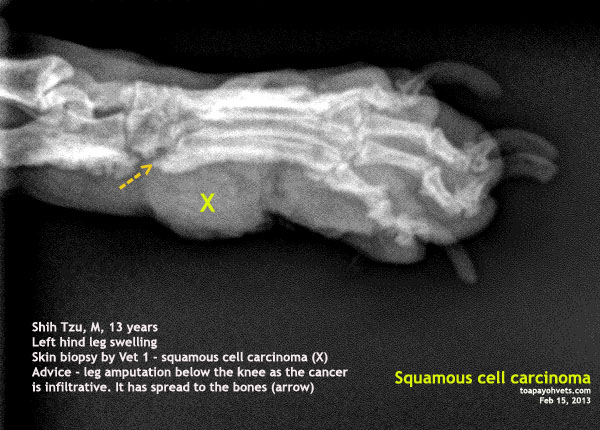
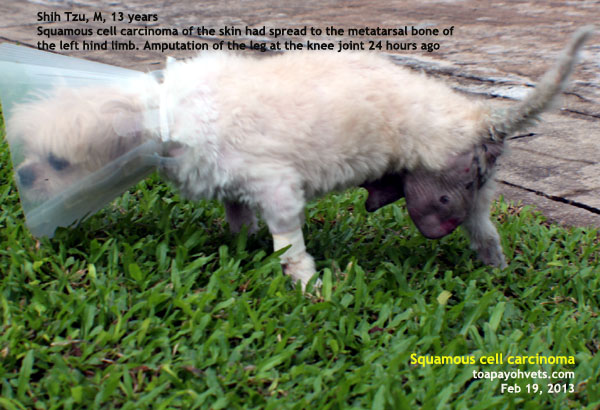
An old dog with a non-healing ulcerated skin wound on the left hind leg. Vet 1 diagnosed skin cancer. Vet 2 did an X-ray and skin biopsy and advised leg amputation but did not do it. The biopsy showed squamous cell carcinoma. The X-ray showed bone involvement around the hock area. The owner consulted me.
The dog was operated at Toa Payoh Vets and I followed up on Feb 25, 2013, around 10 days after the amputation of the left hind leg above the knee joint by Dr Daniel of Toa Payoh Vets. It was a very high anaesthetic risk case as the dog was not in good health.On Thu, Feb 14, 2013 at 6:42 PM, S@hotmail.com> wrote:Hi,I am S... I made an appointment for 15 Feb 2013 at 9.30am for my dog to undergo surgery to amputate his leg due to cancer. I have attached the relevant information to this email for your reference.Thanks.
Updates will be on this webpage:
www.bekindtopets.com/animals/20130227leg_bone_squamous
_cell_sarcoma_toapayohvets.htm
More info at: Dogs or Cats
To make an appointment: e-mail judy@toapayohvets.com
tel: +65 9668-6469, 6254-3326
Toa Payoh Vets
Clinical Research
Tuesday, February 26, 2013
1396. Feb 26, 2013
Cat owner with bladder stones didn't phone me yesterday. Today Tue Feb 26, he phoned to report progress.
"My cat is drinking less, otherwise he is ok. No puking. I run out of K/D diet. Shall I feed him the S/D can (given by Vet 2?).
"As his bladder stone is still being analysed, no point feeding the S/D unless he has struvite stones," I advised. He will buy more K/D for the time being. K/D is given because of renal impairment accordin to the Vet 2's blood test..
"My cat is drinking less, otherwise he is ok. No puking. I run out of K/D diet. Shall I feed him the S/D can (given by Vet 2?).
"As his bladder stone is still being analysed, no point feeding the S/D unless he has struvite stones," I advised. He will buy more K/D for the time being. K/D is given because of renal impairment accordin to the Vet 2's blood test..


Subscribe to:
Comments (Atom)