Sunday, October 9, 2011

649.Everted cheek pouch in a dwarf hamster.

CASE STUDY by Dr Sing Kong Yuen, BVMS (Glasgow).

The young lady's vet gave a baytril 1% oral antibiotic 2 days ago. He said he would not operate as he was not able to do so.

So the young lady must have had surfed the net and brought her hamster to me. I did not ask her. Nowadays, young people are "google" people and they sometimes know more than the vet regarding specific niche conditions of their pets! A vet has to know everything in the hamster from nose to toe and that is only one species. How about dogs, cats, terrapins, guinea pigs, birds and fishes, iguanas and others? This comes from time in practice. 


She knew that her hamster's left pouch had turned inside out and needed to get a vet to operate. A pink mass dangled from the left cheek. One end had become black, a sign of gangrene. Blood supply had been cut off. The surrounding part had turned yellow due to bacterial infection. A speck of yellow pus dried on the upper eyelid.

"Antibiotics will not shrink the dwarf hamster's cheek pouch inwards," I said. "Your hamster needs surgery and the end of the infected pouch needs to be cut away. There is anaesthetic risk. Will you accept the risk?"

The young lady had no choice. If she did not consent to the operation, the hamster will die from infections. If she consented, the hamster may return to a normal life.

I would operate by amputation of the cheek pouch in this case. Everted cheek pouch surgery is best seen early as it may be pushed back and there is no need for surgery. The risk is not surgery but anaesthesia.

Isoflurane gas was used. The assistant must focus on this. "It is a simple surgery compared to Caesarean section or spay. Clamp the pouch first," I said to my assistant. "Cut and stitch".

It is easy to lecture. The hamster woke up from the gas anaesthesia and needed to be given the gas again. The necrotic end was excised with scalpel. Anaesthesia again. Stitch 6/0 absorbable x 3 interrupted.

"Don't stress the hamster," I gave this advice to my assistant. "Unclamp as the hamster had woken up and may die of fright struggling with a clamp. The correct way is to give the gas anaesthesia again."

On unclamping, the cut end of the pouch shrank inwards. "No problem with that," I said. "Used the forceps to pull out the cut ends to give 3 simple interrupted stitches".

As long as the hamster is anaesthesized adequately without killing him, the stitching is not a problem. The pouch was thus stitched with 6/0 absorbable sutures. The hamster went home to a happy young lady. There was slight bleeding and she would take care of it. "Use the other vet's antibiotics to save you some money," I said. "Do you want to take the excised pouch home with you?"

She shook her head. I showed her the illustration of how the pouch was excised. She seemed to be in a hurry and so I did not detain her. Overall, this was a satisfactory outcome. As long as the hamster survives the anaesthesia, the surgery is not complicated and the hamster owner is usually very delighted with the surgical outcome.

Questions asked by owner:
1. Feed liquid food? No need.
2. Can she store food? Not much as 80% had been cut off in the left cheek pouch. The right cheek pouch is still there.
3. What if she did not get surgery done?
Pus already in pouch. Gangrene tip. Hamster will die from infections.
4. "The hamster had pulled out a stitch," she phoned me later. "The stitch could have been cut longer and therefore looked loose," I said. But she did not turn up for a check up. I presumed all are well as I did not see her 7 days after surgery nor hear from her by phone.

UPDATES AT:
https://2010vets.blogspot.com/2011/10/update-on-blog-no-648-everted-cheek.html


Isoflurane + oxygen gas anaesthesia was used in this case. 


671. Update on xylazine + ketamine IV anaesthesia in dogs and cats

There are many methods of anaesthesizing the dogs. One of them is the use of xylazine and ketamine IV. I believe this is seldom used as each vet has his own preferences. For example, I use xylazine tranquilisation IM and halothane and nowadays isoflurane gas anaesthesia over the past 20 years of practice and I find it to be very effective and safe, with rapid recovery.

However, old dogs can learn new tricks and I always ask other vets what anaesthesia they use. There is a great variety.

My associate vet loves to use Domitor pre-anaesthetic dosage, isoflurane and then Anti-sedan reversal. Another vet loves the xylazine/ketamine combination for anaesthesia. Another one loves zoletil injectable anaesthesia. Other vets may premedicate with ACP and use domitor + diazepam.

The following is my observation of xylazine:ketamine IV anaesthesia I used in one 26-kg, 5-year-old Labrador Retriever yesterday to treat a lick granuloma of the LH D5 toe.

THE GENERAL GUIDELINE FROM ONE VET
FOR XYLAZINE:KETAMINE IV ANAESTHESIA IN DOGS

FOR ANAESTHESIA
26kg, 5-year old dog
Xylazine 2% at 2.3 ml
Ketamine 100mg/ml at 0.3 ml
In one syringe, the total is 2.6 ml, IV

FOR SEDATION, the dosage is reduced as follows:
26kg, 5-year old dog
Xylazine 2% at 1.3 ml
Ketamine 100mg/ml at 0.3 ml
In one syringe, the total is 1.6 ml. IV
This was what I gave to the dog
After 1 minute, the dog was sedated.
After 5 minutes, I injected prednisolone into his large LH 5th digit granuloma. Slick flicker of pain reaction. He was sedated well.

Recovery
He took more than half an hour to wake up and more than 1 hour to stand up. I did not given any anti-xylazine reversal as ketamine is involved and may cause excitation effects.

CONCLUSION
I prefer dogs to be standing up within 2 minutes of the end of a procedure or surgery. So, I will not be using this method. It will be good for cases where there are no gas machines. This is why I am recording this case for the benefit of vets who may not have anaesthetic gas facilities.

P.S.
XYLAZINE + KETAMINE IM IN DOGS
From this practitioner who is experienced in this method of anaesthesia, there is a general formula for xylazine:ketamine IV anaesthesia in adult dogs.

For example, 26 kg, 5-year-old dog
Xyalzine 2.3 ml + ketamine 0.3 ml = 2.6 ml in one syringe.
This is a general formula and must be reduced according to health, age and weight.

XYLAZINE + KETAMINE IM IN CATS
I find this method most effective and safe for cat spays and neuters and short surgeries of <30 minutes. My dosage is
For cats below 2 kg, xylazine 0.1 ml + ketamine 0.4 ml IM = 0.5 ml in one syringe.
For cats 6-8 kg, xylazine 0.2 + ketamine 0.8 ml = 1.0 ml in one syringe.
For cats 2-6 kg, xylazine 0.15 ml + ketamine 0.6 ml IM = 0.75 ml in one syringe.

GENERAL GUIDELINE FOR IV ANAESTHESIA
More ketamine in cats, less in dogs.


Toa Payoh Vets Web page veterinary anaesthesia knowledge sharing at:
http://www.sinpets.com/F5/20110611veterinary-anaesthesia-knowledge-sharing_ToaPayohVets.htm

Saturday, October 8, 2011

670. Critical importance of annual blood testing for your dogs and cats

Comprehensive blood testing to Toa Payoh Vets clients that are affordable and convenient.

A large number of diseases in your dogs and cats can be detected early through blood testing. Annual blood testing prevents many end-stage kidney/liver failure, diabetes, blood disorders, other degenerative and heart diseases.

Once a year, in 1-7 of March, June, Sep, 90% of the costs of a comprehensive blood test will be given. The normal cost is $150.

No consultation fee. Just go to Toa Payoh Vets at your convenience. The results of the blood tests are mailed directly to you. Phone our vets for any questions on the results.

ANNUAL BLOOD TESTING is the single most effective method of detecting abnormalities that can be corrected before your pets get serious illness or death. Phone 6254-3326 or 9668 6469 to order this test.

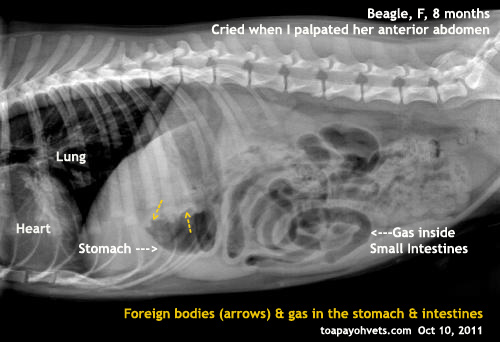
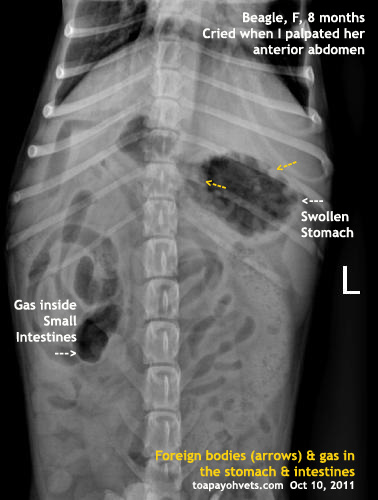
669. Ultrasound or x-ray of the stomach for foreign bodies?

Stomach ache suspected - ultrasound or X-ray? Record AMA.
Dr Sing Kong Yuen, BVMS (Glasgow), MRCVS
10 October, 2011
toapayohvets.com
Be Kind To Pets
Veterinary Education
Project 2010-0129
A young beagle puppy became lethargic. What's wrong?

I put her on the consultation table and put my left hand to palpate the abdomen. pain. She yelped when I palpated the anterior abdomen in front of the two women, one of whom was the owner. "Your puppy had stomach ache," I said. "You can see the and hear her discomfort crying. I advise an X-ray as puppies do swallow pebbles and other foreign bodies when they go outdoors."

This was a case I collaborated with Dr Vanessa on the management of the case. Sometimes I do intervene as part of quality control and mentorship of my associate vets. Dr Vanessa later spoke to me as she wanted an ultra-sound.

"I don't think ultrasound will be good in this case," I said.
She had shown me an ultrasound of a pyometra case. The ultrasound scan showed an increase in thickness of the endometrium. So it was pyometra and the surgery proved it.

"Speak to Vet 1," I said. "He has experience in ultrasound and X-ray." As vets have their own preferences and judgment, it would be a matter of decision and so I did not object when Dr Vanessa to favour ultra-sound. There are more than one way to handle a case of anterior acute abdomen. I decided to phone Vet 1. However, it was difficult to contact Vet 1 as he was busy in his practice. I left a message with Vet 1's staff to call me back.

Vet 1 phoned me when the Beagle arrived at his Surgery. I asked him whether ultrasound would be useful or an X-ray in the Beagle suspected of having foreign bodies (bones, stones and others) in his stomach.

"If you are looking for foreign bodies in the stomach, an X-ray is better," he advised me. "Why scan for the other organs like kidneys and liver when you suspect foreign bodies in the stomach?"


"Go ahead with the X-ray, 2 views," I thanked him. I told Dr Vanessa the switch to X-rays while she was consulting.


Acute anterior Abdominal Pain in a Beagle. I put the dog on the consultation table. Then I palpated a swollen stomach with my good left hand. The dog arched her back high and gave a whimpering cry. The lady owner heard the cry.

RECORD ANY AMD (AGAINST MEDICAL ADVICE)
If the owner does not want to have X-rays taken, this ought to be recorded in the case sheet. "If the dog dies a few days later," the family members who are not present during consultation will bad-mouth the vet as not even competent as he has not taken any X-ray!
No two vets will have the same method of using ancillary aids to diagnosis, but it is best to consult another vet who has more experience in practice and in doing ultrasound and X-rays on certain conditions, as in this case.

To excel in veterinary science, a small animal vet in private practice needs to open his or her mouth to seek advices as veterinary medicine is extremely diverse as vets are anesthetists surgeons and general practitioners unlike human medicine where there is specialisation. Usually they are given as this case illustrates. Experience comes with time and cases handled.

One needs to be humble to ask for veterinary advices from others. There is no way a vet can know everything as interpretation and when to use veterinary radiology and ultrasound is again another big specialised field that will take years to master.


Case at:

http://www.sinpets.com/dogs/20111018ultrasound-x-ray-suspect-foreign-bodies-stomach-singapore_ToaPayohVets.htm

668. Sunday Oct 3, 2011. Veterinarian rage

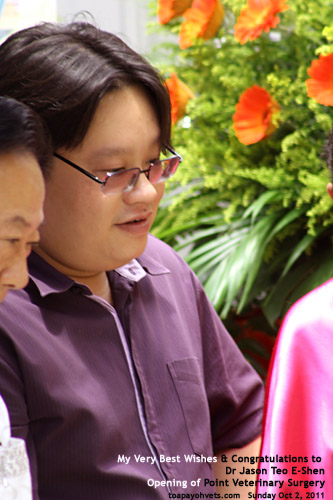
Sunday Oct 3, 2011 is a very important day for Dr Jason Teo as he celebrated the opening of his own vet clinic and had asked me to join him at 12.30 pm.

So I worked in the morning trying to clear the cases as fast as possible.

Many clients had made black faces when Dr Vanessa took some time in certain case handling on Sundays. My target for waiting times to be less than 15 minutes/person on busy weekends. Singaporeans don't like to wait a long time to see the doctor or vet.

So, on this Sunday morning, I asked one client to enter the consultation room while she was doing some minor op in the Surgery Room.

The man and his tall son got his dog into the consultation room. I had not asked him whether he wanted Dr Vanessa before he entered the room. In the room, I asked him and he said he was waiting for Dr Vanessa. So, I asked him to wait a while. I asked the second client and she said the same. So I asked the 3rd client with the Shih Tzu eye ulcer to come into the room since she was seen by me earlier.

Soon, Dr Vanessa was free, after taking blood samples in a dog and I got her client into the room. But I noted that he was bad-mouthing Toa Payoh Vets as not having a process to the 2nd client. I asked him what did he mean after identifying myself as the Principal of the practice. He started shouting: "I don't care whether you are the Principal. Dr Vanessa is a very good vet. I came to see her. You want to know what's wrong? Pay me and I will tell you! I know Dr Thiru...Dr Vanessa is a very good vet!!!"

This was the first time I encountered a dog owner's rage. I did not pursue the matter and kept my temper. Something was wrong with his behaviour and I left him alone while I took the 3rd client and her dog to the Surgery room to check on the eye.

"What's wrong with him?" the 3rd client asked me. "Is it because I jump queue?"
"I don't know," I said. "He wanted Dr Vanessa to treat his dog and so he had to wait because she was treating another dog."
I thought all was over as the angry man was with Dr Vanessa.
Suddenly, he barged into the Surgery room and shouted at me: "Go to the back of the Surgery and I will tell you what's wrong with you!"
I remained cool. What was wrong with him? He was actually being abusive. I looked at him with sad eyes. At 61 years of age, I have learnt to stay cool in such a provocative situation. His son pulled him out from the room.

Later I spoke to Dr Vanessa. "What is your relationship to this client? He even started to barge into the Surgery room after the end of your consultation. He praised you a lot and at the same time he showed disrespect to me. There is something not right here!"

Dr Vanessa said she did not know. I reviewed his case. There were contributing elements of unhappiness in the management of his case by Dr Vanessa and I advised her accordingly.

Such outburst and uncontrolled anger from a mature man in his 50s is very rare. We have road rage and educational notices on public hospitals and the National Library against abusing the staff. I don't see the need for one in Toa Payoh Vets as this is a very rare thing in my 40 years of practice.

I guess if the vet works long enough, he will encounter at least one case of veterinarian rage.

I will monitor his case and if he continues to be abusive to any staff in Toa Payoh Vets, it is best he go to another vet for his dog treatment. In the handling of veterinarian rage, just do not provoke by shouting back at the abuser. Keep cool. There are always some other causes that initiate the rage.

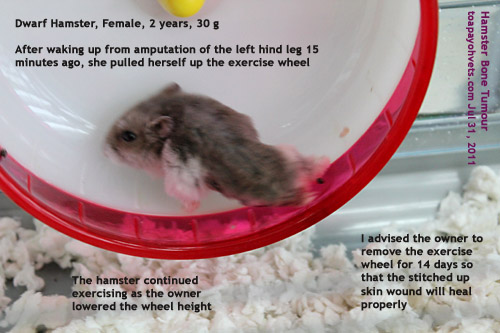
667. Follow up: The sibling hamster with the amutated leg had left ear itch

"Remember? She was 19kg when you amputated her leg?" the slim writer asked me. "Now she is 31 g. I had fed her well."
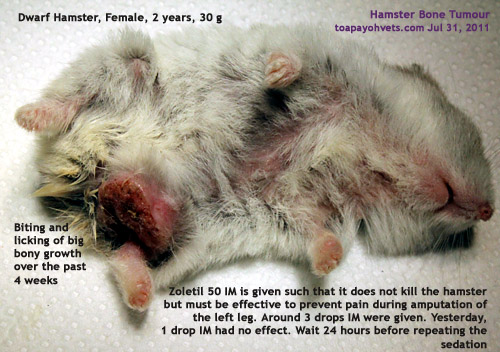
"How can I ever forget her?" I was impressed with the care given as I thought this hamster would never live after such a drastic surgery. Being amputated at the knee and being such a tiny creature. And the delay in seeking surgery due to Vet 1's advice. The suspected bone cancer had not spread since the leg was cut away. That is why she is alive now. 31 g from 19 g. What an achievement.


"There are some dwarf hamsters that stand out." The other vet had delayed her operation and the tumour exploded in size to a 10-cent disc coin mass stuck to the knee and nearby areas.

Furthermore her sibling had this smelly ear and had died, at the weight of 19g, after 4 operations.

"This sibling had no ear problem at all," the lady said. "She has been scratching her left ear."

"Was she housed together with the sibling?"
"No, she lives alone all the while," she said.
"How come she got her ear infected?" I asked. She shook her head. The hamster squeaked loudly when touched.
"There is only one common connection between the two siblings," I said. "And that is you, the owner".
The writer smiled. Themes are relevant to a writer and there is a theme in "ear infections and hamster owner".
"She is hard to handle," the lady said when I suggested some ear drops.


I put the hamster under isoflurane gas and showed 1 polytechnic student who turned up by himself how the hamster's ear is irrigated.

The next day, the hamster was not scratching her left ear. But she started scratching her right ear. I phoned the owner to take her home and observe. "If it is ear tumour," I assumed due to the age, the non-use of hamster sand bath, the fact that the sibling had died from ear infection and cyst and probably tumour, "I may need to remove the ear canal early. Wait for 2 weeks and see what happens."

665. Follow up on the stray cat with FIV

"Do you know how to open the cat's mouth to check the gum ulcers?" I asked the Temasek Poly lady who was volunteering and had chosen "pneumonia" as her first case study. This was the stray cat with the FIV and she had to write a report and produce a video. No point just see like a tourist. Writing will bring vet medicine alive to a student and so I do insist on such recording. Her writing was excellent as I admire good handwriting. She had not come for the past 2 days and in that time, the stray cat made excellent progress.

I got the 3 students together. Got the cat out and demonstrated how to open a cat's mouth. The student tried while her male classmate was positioned to video the mouth. The cat swung out her right hand and claws came out. She withdrew to prevent scratching. "This is a gentle cat," I said. "Try again." She did not succeed 100%. The cat swung out her left hand and claws came out.

"Lift the upper lip at the side," I said. "You will see that the gum ulcers have healed a lot."

The cat should go home on Oct 10, 2011 i.e. at the 7th day after hospitalisation. Blood tests were normal. No immuno-suppression. The 2 months of yellow nasal discharge was gone. The two teenaged daughters visited this cat daily, brought the canned food.

This was an excellent case study for the lady student from the Poly. Learning is best when real cases are studied in detail and written up. Being an observer leads to superficial knowledge. I will see how she produces the video.

664. Follow up: Good practice to phone the owner after surgery

"What is happening mum? What's happening?..." I heard a distant voice as I spoke to the mother one hour after the surgical excision of the hamster.

This was the hamster that Vet 1 had said would die under anaesthesia and had given unacceptable advices to cause distress to the daughter. The Vet 1's advice was to wait till the tumour bleeds. Then bring the hamster to Vet 1 to be put to sleep.

The right thing to do would be to refer the mother and daughter to another vet or just ask them to seek their own vets. Unacceptable advices greatly distress the owners as the young girl wept for the past 3 days thinking about the impending horrible painful bleeding of the tumour. And she had examinations to be done during this period of time. The poor mum was really stressed out by such advices too as she contacted me by phone.

In pragmatic terms, get the daughter's hamster put to sleep immediately so that she would focus on her examinations. Is it as easy as that? No. There must be another solution as it was Friday and the coming Monday would be examination day.

Well, Dr Vanessa had excised the tumour. There was no death and the hamster started to jump onto the exercise wheel around one hour post-op. She was unsteady for around 15 minutes after the end of surgery.

I phoned the mother to let her know the good outcome and to confirm that she did not want histopathology of the tumour done. "How much?" she asked. "$150," I said. I guessed the daughter must be in her study room and had overhead bits of the mother's hamster conversation and was worried that something had gone wrong. Perhaps her hamster had died post-op and therefore called out to her mum.

Well, the hamster was OK. The bleeding was cleaned off. "The hamster can go home today," I said to the mother. "Just clean up her wound."
The mother would take back on Tuesday. That would give time and space for the young girl to study for her Monday exams. As for histopathology, it is good practice to ask the owner and record this. Histopathology adds to the cost and previously, I assume the owner would not want it done and therefore had not asked them. However, in defensive medicine to be practised nowadays in a litigious society, it is best to cover all bases and record down advices like histopathology and laboratory tests suggested.

663. Follow up on hamster with itchy elbows and knees - Oct 7, 2011

"Is your hamster still licking her elbows and knees?" I phoned the young lady on Oct 7, 2011, around 3 days after I had given an anti-inflam injection and prescribed medication, advised change of diet.

"Much better. Slightly itchy though. Some hairs are growing."
"It will take some time to be free of itchiness," I said. "Did you feed sunflower seeds?"
"No," she believed that sunflower seeds cause obesity. The dwarf hamster weighed 91 g 4 weeks ago when she came in for the first consultation. 3 days ago, she weighed 86 g.
"What food do you feed?" I asked.
"Pumpkin seeds," she said. "I could not find melon seeds for sale." I did advise buying the dried melon seeds from some provision shops, shelling them and feeding to the hamster since she did not want to feed sunflower seeds which are the usual component of a hamster's ration in Singapore.

It would need another 4 weeks for the hamster to recover.

663. Switching to become a small animal vet

E-MAIL TO DR SING DATED OCT 7, 2011

Dear Dr Sing,

I chanced upon your blog when I was looking up some vet related blogs. I read that you completed your bond with the PPD, then started up toapayoh vet clinic. Was it difficult to transition from a government vet to a small animal vet? How do you keep the knowledge learnt for small animals fresh in your mind as being a PPD government vet requires a completely different set of skills? Would be great if you could provide me with some advice on this issue. I've been pondering on career pathways recently and I need guidance.

Regards,
XXX


E-MAIL REPLY FROM DR SING DATED OCT 8, 2011

Thank you for your email. In reply to your questions:

1. It is not difficult to change to small animal practice from regulatory practice for me as I had a mentor (an experienced senior vet) whom I spent time in the evenings (closing my practice) learning from him, assisting him, working as locum and doing house-calls.

2. Lots of reading on small animal vet journals. In 1982, when I started Toa Payoh Vets, there was no such thing as the world wide web. So, lots of reading vet articles and journals and subscription to the British and American vet journals. The PPD had a small vet library at 40 Kampong Java Road, now the K.K. Hospital.

3. For your situation, be an employee in one of the 46 vet practices in Singapore for at least two years. Choose a busy one, otherwise you would have not sufficient variety of cases. Work the night shifts and really attend to each emergency as if it was your own pet instead of being a "lazy" vet, letting the vet technicians do the hands-on blood collection, urine collection and X-rays.

Give practically free services to the dog breeders and animal activists. So much small animal veterinary work to do nowadays. Read up and discuss with mentors. Review cases done and see if there are better and more efficient and cost-effective ways to handling the case.

Add value to your employer. For example, I note that some young employee vets use more than necessary (increasing expenses to the practice and reducing the bottom-line) the sutures and materials used in surgery and treatment. This may not endear yourself to the Principal of the practice as it shows you don't care about the bottom-line. In private practice, the costs are high and you need to be aware of the economics of practice, other than the salary and benefits you are getting.

In conclusion, venturing to a new field requires a new mindset to work the long hours to achieve competence and success. Small animal private practice hours are longer and will not be similar to the regular hours of civil service as most clients are free during weekends and public holidays when the civil service vet is having time off.

Passion is required if you wish to excel. Competition is great nowadays as I expect more than 50 small animal practices to be set up in the next 5 years if you intend to open your own practice. Know the economics of practice. Add value to your employer or principal. Continuing education. Network. Be proactive in vet matters.

Phone me if you need more advice as writing advices are not as good as one-to-one talk.
- Show quoted text -